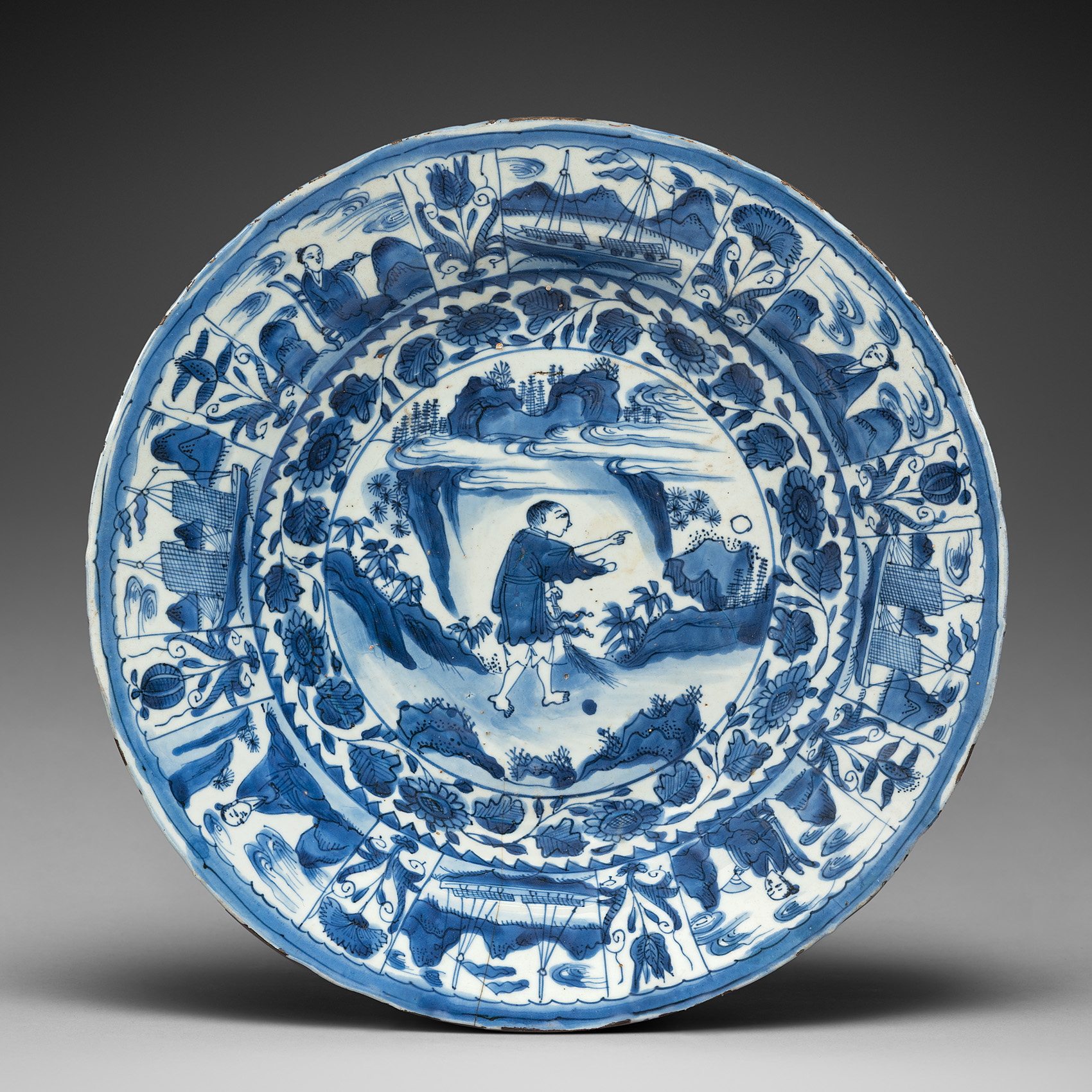
A Chinese blue and white charger. Transitional period

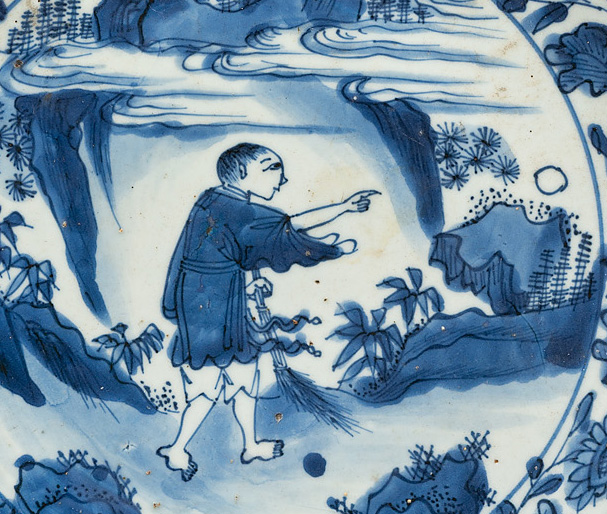
At the center of the medallion stands a barefoot Buddhist monk, holding a straw whisk (fuchen, 拂塵) in his left hand. With his right hand, he gestures toward a white disc in the sky — the moon — while a second, darker disc lies at his feet. This second disc represents the moon’s reflection on the ground. The monk’s gaze is directed toward the moon itself. Behind him, rugged rocks in a mountainous landscape form a natural arch above his head, pierced by stylized clouds. At the base of the medallion, a few twisted pines and aquatic flowers — including lotuses — grow along the shore. The entire scene is painted in a cobalt-blue monochrome on a white ground, with spontaneous brushwork and tonal shading typical of the Transitional style.

Encircling the central scene is a frieze of stylized lotuses — fully opened eight-petalled blooms with their leaves — framed by a scrolling border. The rim of the dish is divided into alternating panels featuring junks, paired figures in mutual regard, and vegetal motifs, including flowers reminiscent of Iznik designs.
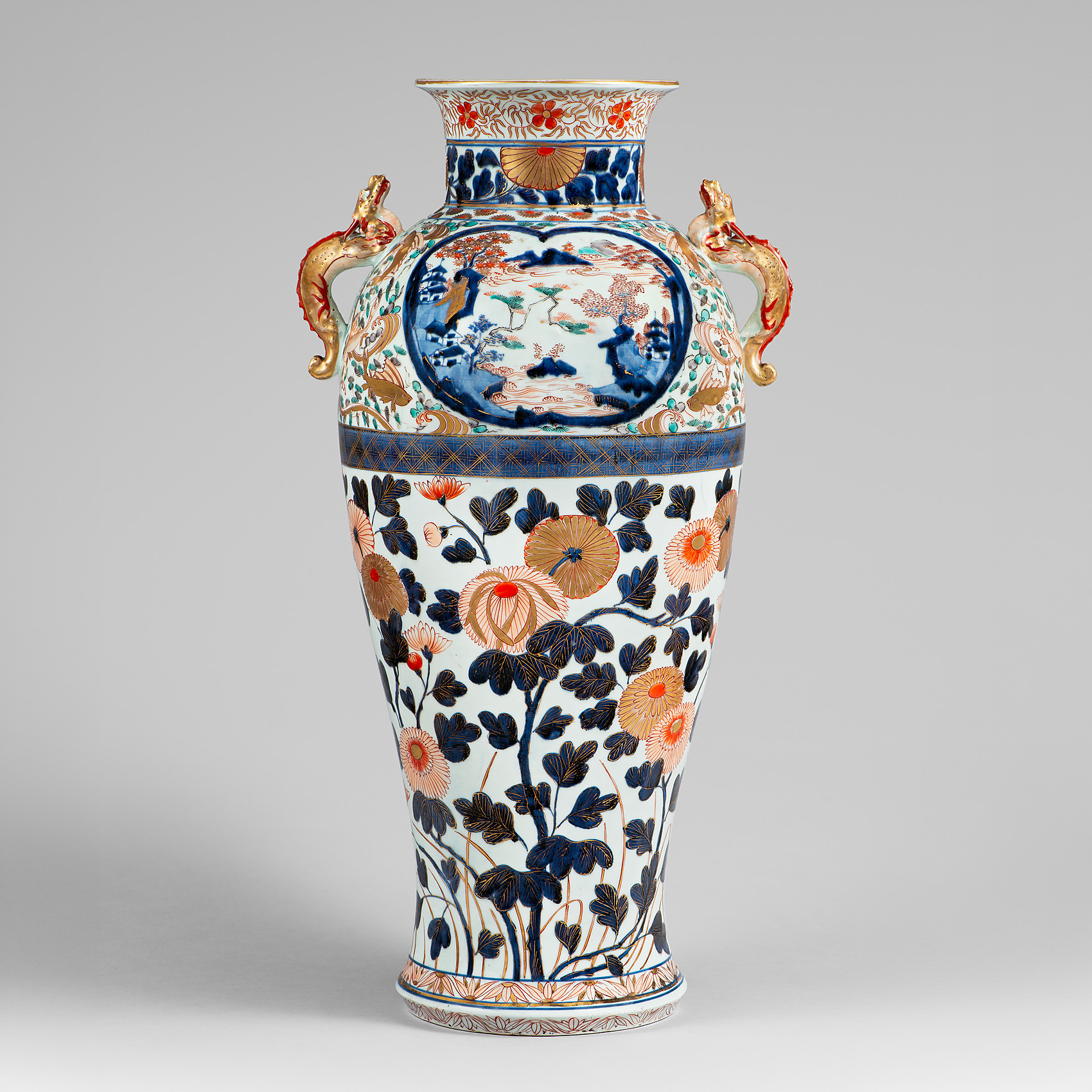
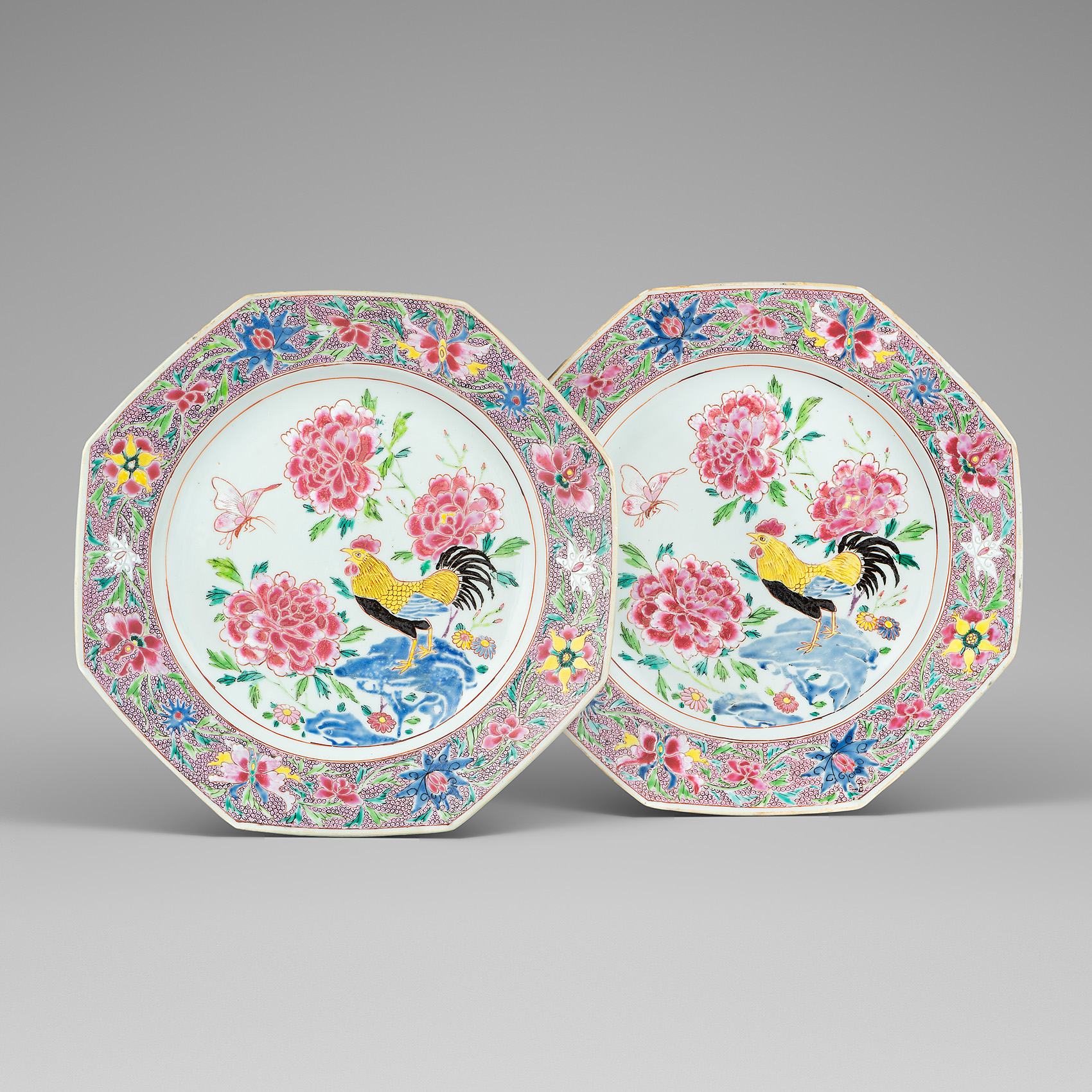
COUNTRY : China
PERIOD : Epoque Transition, vers 1635-1650
MATERIAL : Porcelain
SIZE : 35,5 cm
REFERENCE : E646
STATUT : sold
Related works :

This dish belongs to a group of Kraak porcelain dishes and bowls with a characteristic design composition that combines the typical kraak panelled border with narrative scenes depicting figures (scholars and attendant) and stylized flowers in the Transitional style. For a discussion on this type of dishes, please see M. Rinaldi, Kraak Porcelain- A moment in the history of trade, London, 1989, pp. 112-116.

For similar chargers, see Regina Krahl, Chinese Ceramics in the Topkapi Saray Museum Istanbul, A Complete Catalogue I : Yuan and Ming Dynasty Celadon Wares,1986, T. I, pp. 801-804.

Additonal informations :

The scene at the center of the dish evokes an anecdote from Chan (Zen) Buddhism — the kōan of the double moon. A monk, identifiable by his shaved head, short robe, humble posture, and bare feet, is depicted holding a broom while pointing toward a body of water in which a lunar disc is reflected.

The monk’s gesture, directed toward the moon’s reflection, serves as a visual metaphor drawn from a well-known kōan (didactic parable) in the Zen tradition. This motif, often referred to in Chinese as 扫月 (sao yue, “sweeping the moon”), originates in Chan teachings and expresses the illusion of appearances. The monk, in attempting to sweep away not the real moon but its reflection, enacts a symbolic gesture — one that points to the impermanence and emptiness (śūnyatā) of the material world. The act thus becomes a contemplative one, a means of transcending illusion (maya) to attain ultimate reality.

The episode alludes more specifically to a passage in the Chanmen Guanzong (《禅门关宗》, Collected Teachings of the Chan Gate), and more precisely to the Book of Serenity (Congrong Lu, 《從容錄》), compiled in the 12th century. In it, the Zen master Yunyan is seen sweeping the courtyard of a monastery. This scene, often titled sweeping the moon (掃月), illustrates the confusion between reality and its reflection: the monk does not seek to erase the moon itself, but to reveal the illusory nature of the visible world — the reflection as symbol of illusion, and the broom as the instrument by which such illusion is cleared away through practice.

Demande de condition report

Question about condition report