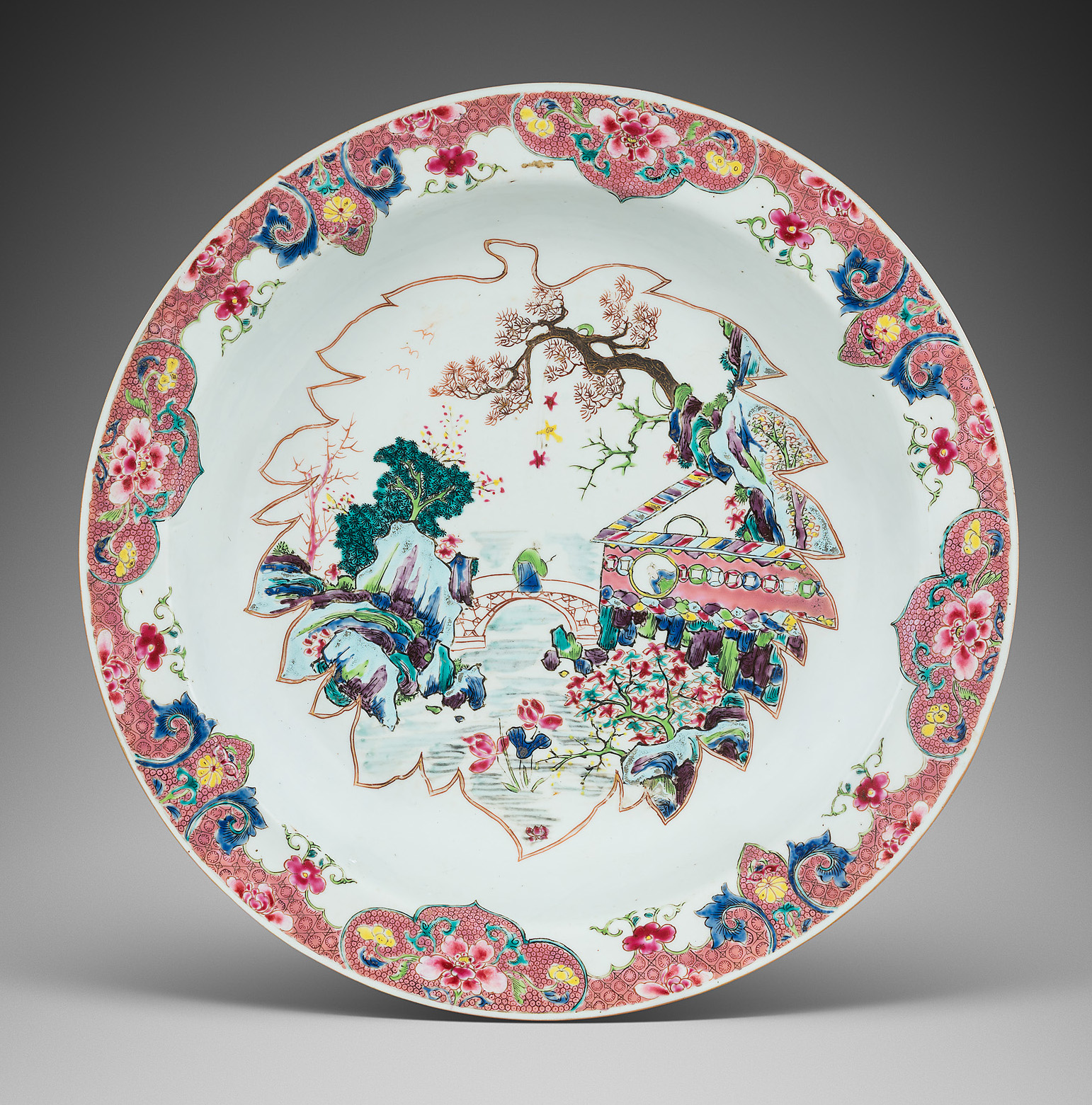
A Chinese famille rose “shanshui” charger. China, Yongzheng / Qianlong

The large circular charger is decorated in the famille rose palette. The central composition, set within a broad reserve shaped as a lotus leaf, depicts an animated landscape: in the foreground, a garden punctuated with turquoise- and blue-glazed rockwork, peonies, and flowering shrubs; at the centre, a small arched bridge spans a stream, upon which stands a Buddhist monk wearing a long robe in green and blue; to the right, a monastery against a backdrop of steep rock formations, and within a round window on its façade appears a second monk dressed in a green and yellow robe; in the background, a pine tree with spreading branches towers above the scene. The well is left in white, while the rim is adorned with a broad border of lobed reserves on a pink ground with geometric motifs, enriched with flowers and polychrome scrollwork, alternating with cartouches in the form of ruyi heads enclosing floral decoration.
COUNTRY : China
PERIOD : Yongzheng (1723-1735)/ Qianlong (1736-1795), ca. 1735-1740
MATERIAL : Porcelain
SIZE : 35,5 cm
REFERENCE : E643
STATUT : sold
Additonal informations :

The central decoration of this dish belongs to the narrative landscape tradition inherited from Chinese literati painting (shanshui, 山水, “mountains and waters”), a cultivated genre which, since the end of the Six Dynasties period (4th–6th centuries), has combined mountain reliefs, waterways, rocks, and vegetation in a harmonious and balanced composition. It was under the Tang dynasty (618–907) that the genre truly flourished, reaching full maturity during the Song (960–1279). Derived from painting on silk and paper, this aesthetic does not seek to depict a specific site with topographical accuracy, but rather to express the harmony and ideal relationship between humankind and nature. It was the principal form of painting practised by scholar-painters—or more precisely, by the scholar-officials themselves, who found in the practice of painting an outlet for their administrative duties, when they had them. The art of “mountains and waters” would, in turn, provide the conceptual model for the Chinese garden.

In the Chinese tradition, mountains—like rivers and seas—are regarded as sacred places; mountains in particular are seen as close to the heavens, the dwelling place of the gods. Mythical peaks, such as Mount Kunlun, the abode of the immortals, are depicted surrounded by water, like islands. It is within these mountains and waterways that the secrets of immortality are believed to reside.

Demande de condition report

Question about condition report