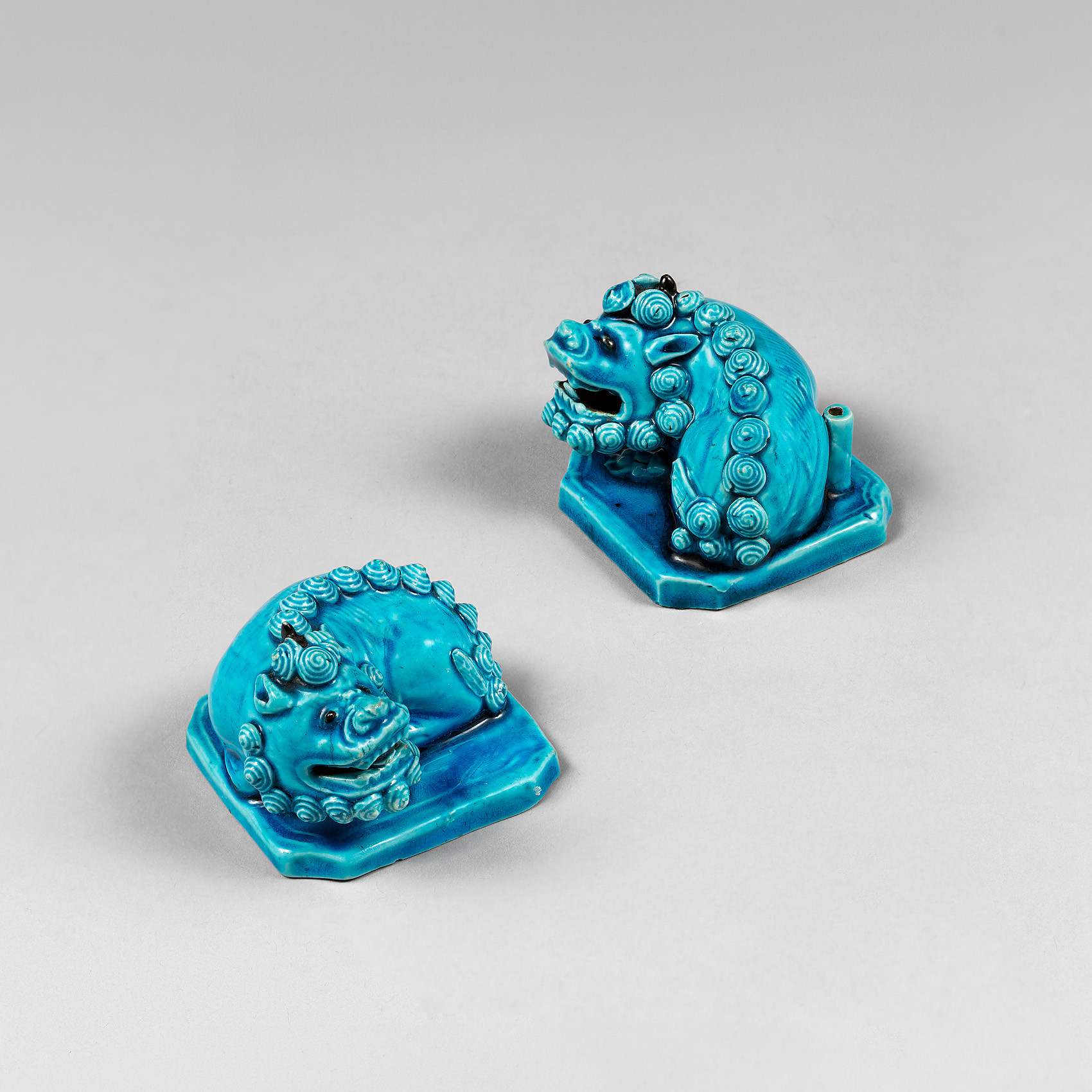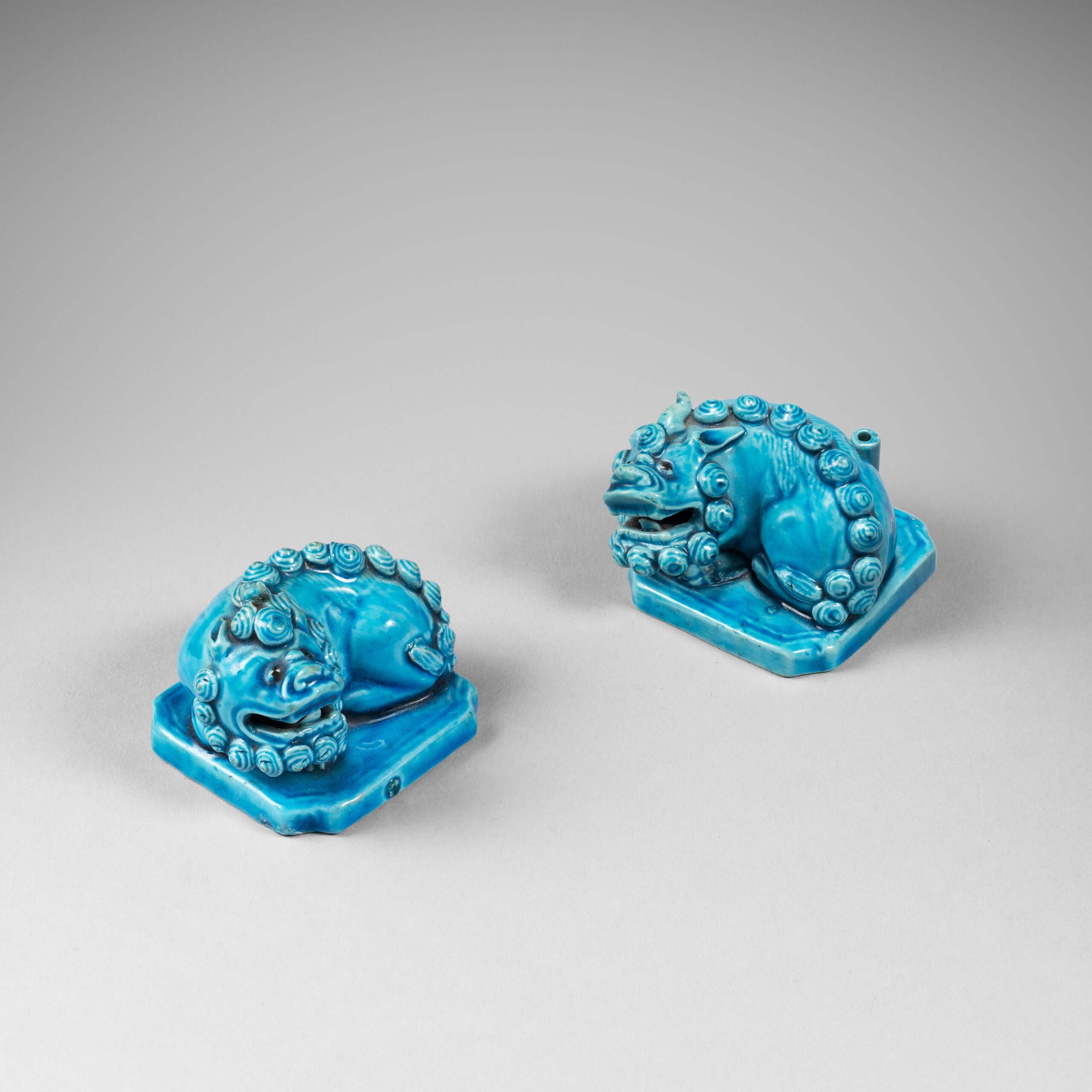
A pair of turquoise-glazed Buddhist lions joss-stick holders. China, Kangxi

Modelled as recumbent Buddhistic lions, heads facing left, their open mouths revealing their fangs and tongues, with whiskers, mane, and tails molded in naturalistic curls, set on a rectangular base, and with a cylindrical joss stick holder at their back.
COUNTRY : China
PERIOD : Kangxi period (1662-1722)
MATERIAL : Porcelain
SIZE : 5,5 cm x 5,5 cm
REFERENCE : E399
STATUT : sold
Related works :

Two identical Buddhist lions were in the collections of Auguste The Strong and are in the Dresden collection (inventory PO 4503 / PO 4504).

Two identical Buddhist lions are in the collection of the Musée d’Ennery (Paris).

Additonal informations :

Originally made for the domestic market in various sizes and glazes, Buddhist lions became popular in Europe during the 18th century. Although lions are not indigenous to China, they were introduced through Indian Buddhism and became a classic theme in Chinese art. From the Ming dynasty onward, Buddhist lions, often referred to as Dogs of Fô or Dogs of Buddha, began to appear in Chinese art and were used as guardians at Buddhist temples. They reached the zenith of their popularity during the early Kangxi period (1662-1722), coinciding with a marked increase in interest in Buddhism in China.

Buddhist lions were frequently depicted in pairs, one male and one female. The prevalence of these animated creatures at the time denoted their integral role in Chinese iconography. Symbolically, the lions represent bravery and loyalty; these mythical creatures also appeared on military badges of the first and second rank. Made to hold an incense stick, they were often placed on dining tables as decorations in Europe.

Demande de condition report

Question about condition report