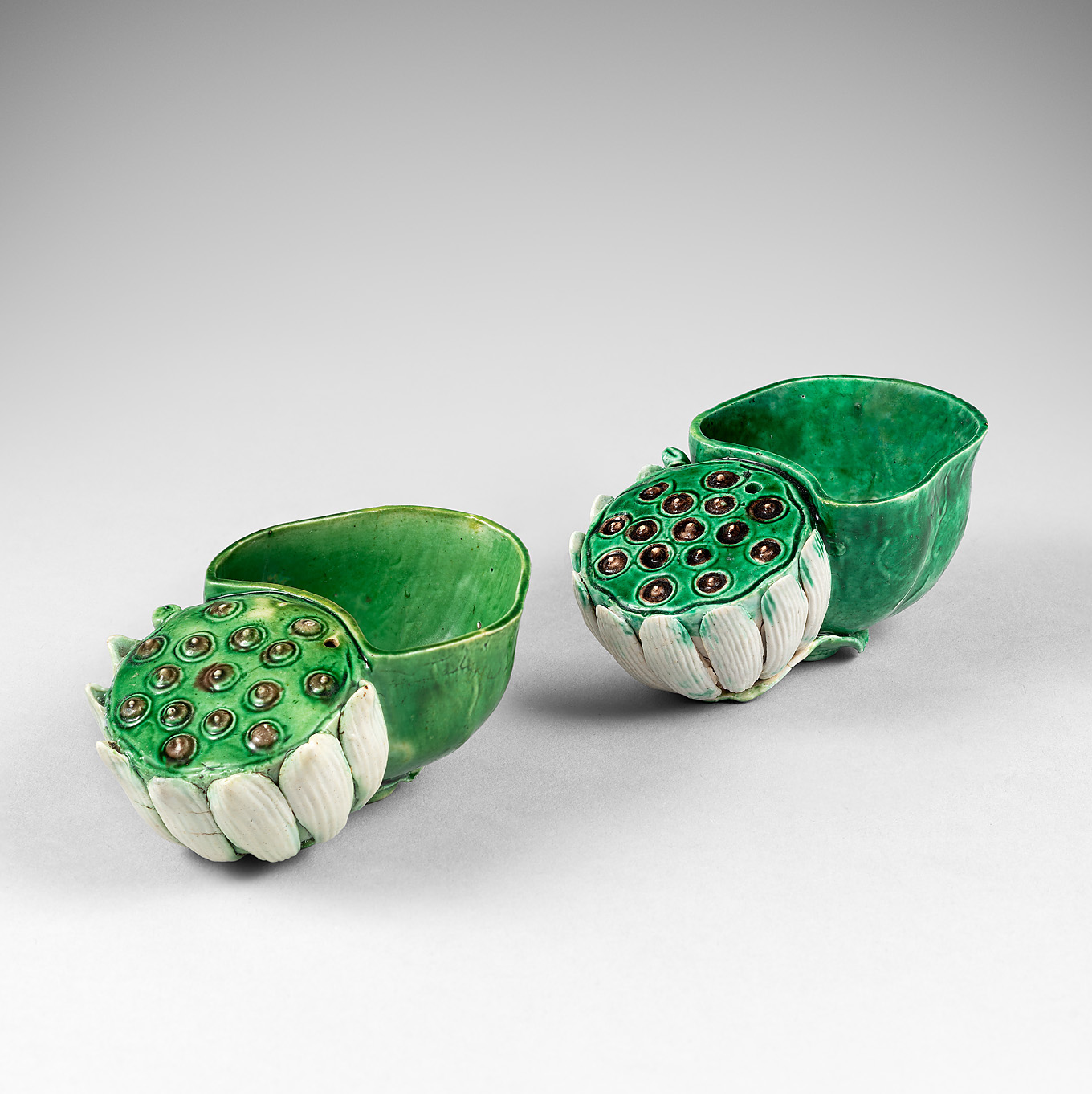
A pair of famille verte lotus water droppers. China, Kangxi

Naturalistically modeled in the form of a lotus leaf and seedpod, each water dropper is formed with a bowl from the upturned leaf. The piece is decorated in famille verte enamels on the biscuit, the exterior and interior covered in translucent green, while the tops of the seedpods are picked out in aubergine. A long stem curls around the base and up the side of the bowl. Applied to the interior, at the bottom of the bowl, is a small crab enamelled in aubergine-brown.
COUNTRY : China
PERIOD : Kangxi (1662-1722)
MATERIAL : Porcelain (biscuit)
SIZE : 5 cm / 12 cm
REFERENCE : E179
STATUT : sold
Related works :

A comparable water dropper is illustrated by John Ayers in The Chinese Porcelain Collection of Marie Vergottis, Lausanne, 2004, no.87.

For two water droppers of this model, see Jorge Welsh, Biscuit: Refined Chinese Famille Verte Wares, Jorge Welsh Books, London and Lisbon, October, 2012, pp. 112-117, no. 24,25, 26.

Additonal informations :

Water droppers were required for the scholar’s desk, in conjunction with several others items needed for writing. These included the essential ink, brush, inkstand and paper (known as the scholar’s “Four Treasures”), as well as a host of other objects such as brush pots and brush rests.

Water droppers were used to pour tiny droplets of water onto an inkstand in order to grind ink. It is possible that the bowls of these pieces were additionally used for washing brushes. Thought primarily intended for the scholar’s desk, it has been suggested than this type os small scholarly item became a fashionable collectable in the West, bought thought private trade.

Lotus was a particularly popular theme for small scholarly items and especially for brush washers and water droppers. it is often used as a metaphor for the poor scholar, who might be able to achieve success by working hard and passing the imperial examinations.

Demande de condition report

Question about condition report