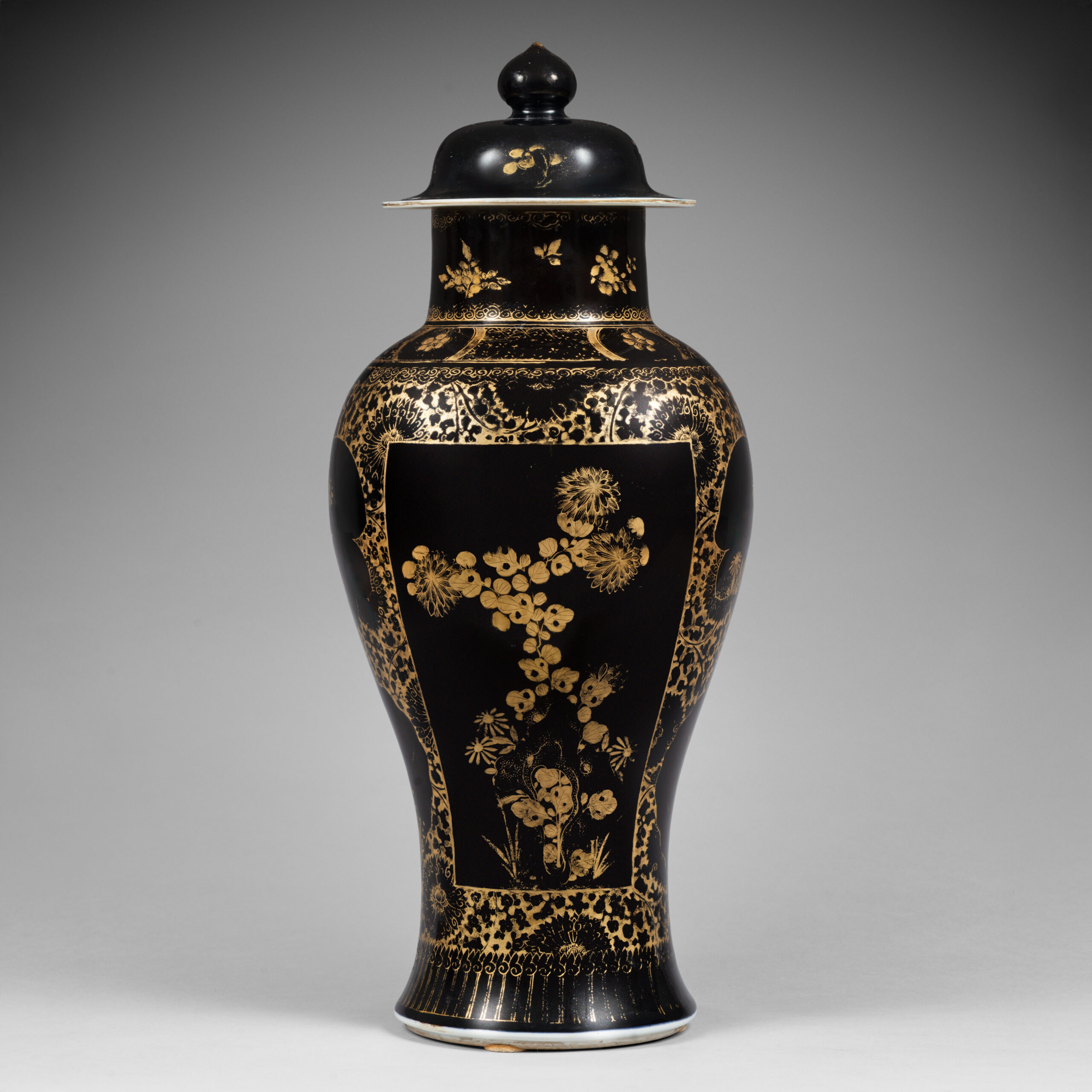
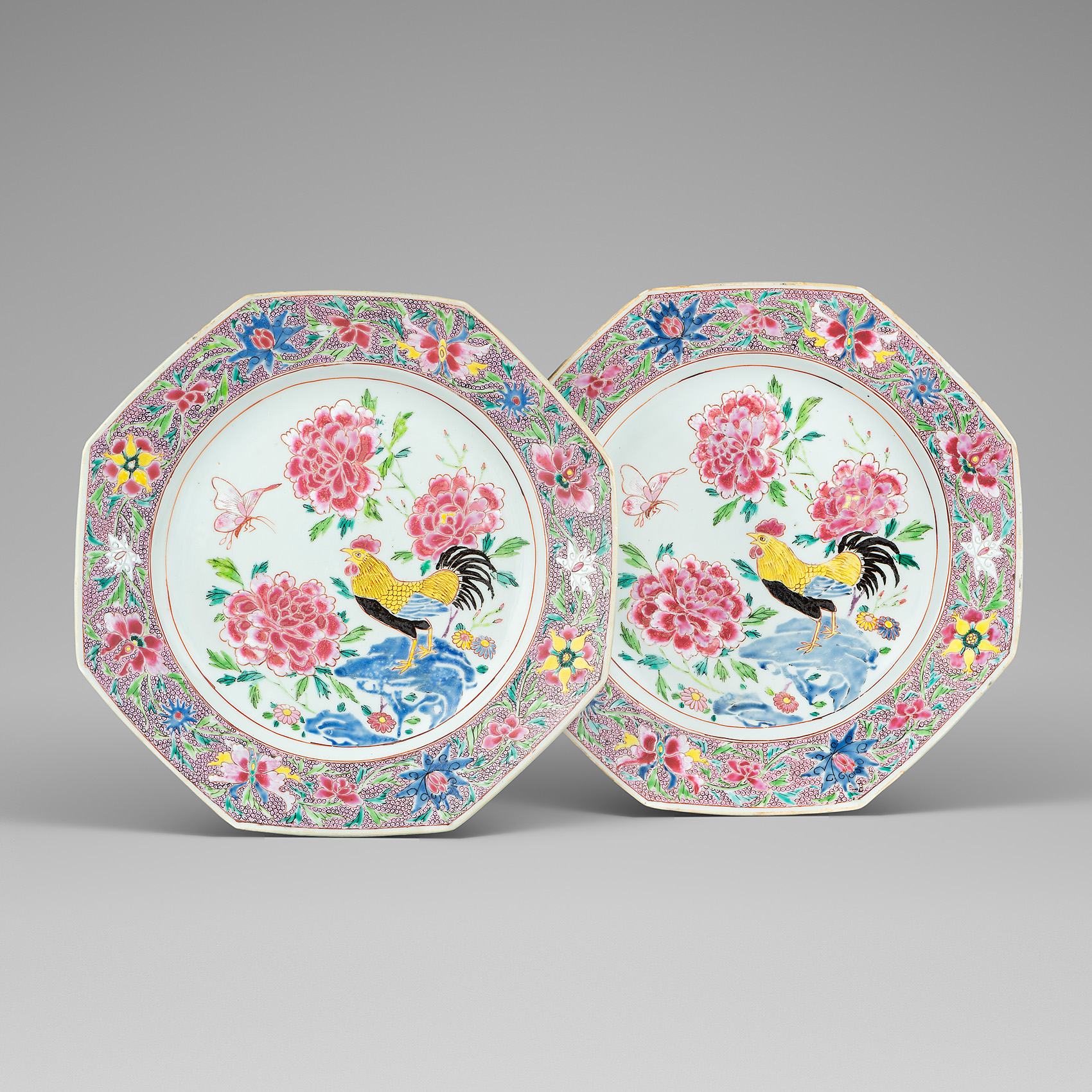
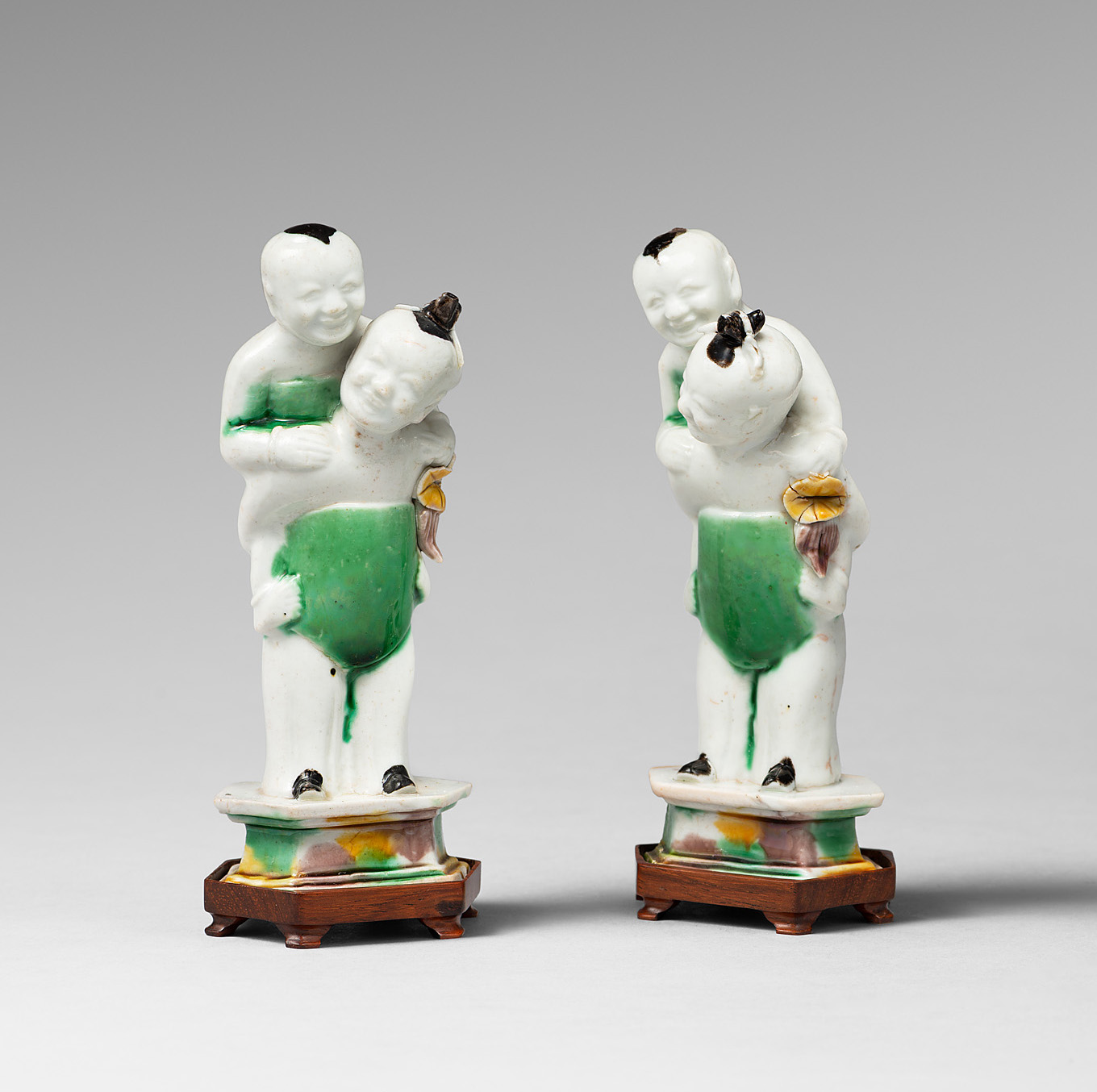
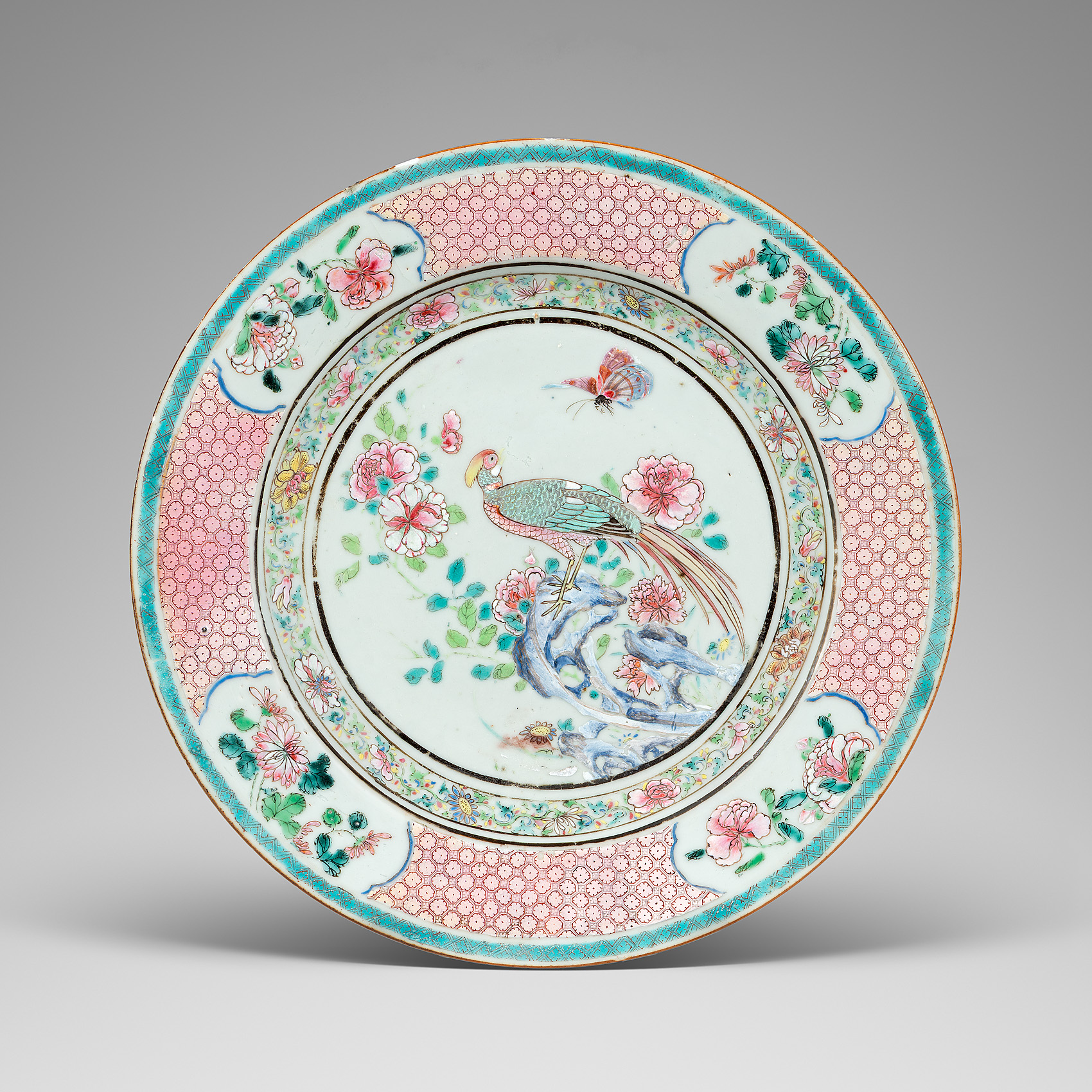
Additional information.This type of porcelain, with its striking contrast between the lustrous black glaze and the gilt decoration, is characteristic of the Kangxi-period production destined for export to Europe, where such wares enjoyed great success among princely and aristocratic collections. These pieces are distinguished by their exceptionally glossy and deep black glaze, often likened to a “mirror black”. Some were left monochrome, while others were embellished with gilt designs painted onto the glaze. The gilding, applied after the first firing and refixed at a low temperature, is often partially lost today due to its inherent fragility.
As early as the Tang dynasty (618–907), fine black monochromes were produced in the kilns of northern China. Their black colour derived from the high concentration of iron in the glaze. To achieve a brilliant black, the firing temperature had to reach around 1200°C. The resulting tone was dense and velvety, whereas lower firing temperatures produced browner or greenish shades. Black monochromes reached their height between the 11th and 13th centuries, during the Song and Jin dynasties, when they were used at the table alongside highly refined black lacquers.
Falling out of fashion in subsequent centuries, they returned to prominence in the 18th century, when the Qing emperors commissioned the kilns at Jingdezhen to reproduce earlier glazes. These new blacks were called “mirror black” or “metal black” (wujin in Chinese). Unlike earlier wares, their composition included not only iron but also cobalt and manganese. Many Kangxi mirror black vases were further decorated with gilt motifs applied over the fired glaze and then refired at a low temperature (ca. 700–750°C) to set the gilding.
Such porcelains were regarded as extremely rare and sought after in early 18th-century France. The Jesuit missionary Père François-Xavier d’Entrecolles (1664–1741) described their manufacture at Jingdezhen in a letter of 1 September 1712, later published in the Lettres édifiantes. He noted that the black glaze, which he compared to oil, was composed of iron oxide together with cobalt and manganese—substances usually employed in smaller quantities for brown and blue glazes respectively. The wares were dipped several times into this glaze and fired at a high temperature until the surface was saturated with colour and appeared entirely black. Once polished, the glaze acquired a brilliant metallic sheen, hence the term mirror black.
Porcelains with this glaze are most frequently encountered in the form of rouleau vases, yenyen vases, bottle vases, and baluster vases.
It is noteworthy that these black-and-gold decorations echo Japanese and Chinese black lacquers ornamented in gold, which were highly prized at the same time. Art historians have often drawn a parallel between the rise of gilt-decorated mirror black porcelains and the contemporaneous vogue for black-and-gold lacquer in East Asia and Europe in the late 17th century. The smooth, polished finish of the porcelain and the style of the gilt painting, reminiscent of lacquered screens and boxes, underline this deliberate imitation.
The quality of mirror black glazes declined over the course of the 18th century, becoming less brilliant and shifting towards a duller brownish tone.
Mirror black porcelains appear to have experienced a revival of interest in the latter half of the 18th century, when some were fitted with neoclassical gilt-bronze mounts (see for example the pair of vases in the J. Paul Getty Museum, Los Angeles, illustrated in Clarissa Bremer David et al., Decorative Arts: An Illustrated Summary Catalogue of the Collections of the J. Paul Getty Museum, Malibu, California, 1993, pp. 156–157, no. 264). Such wares may even have inspired the production of black-ground porcelains at Sèvres under Louis XVI.
During the Daoguang–Guangxu period (ca. 1820–1900), there was a renewed demand from European and American collectors for so-called famille noire porcelains. The term famille noire, coined by French collectors in the 19th century, refers to porcelains with black grounds enriched with polychrome enamels or gilt, prized as rare curiosities. To meet this demand, Cantonese workshops produced new black-ground wares or repainted earlier porcelains in black during the 19th century.