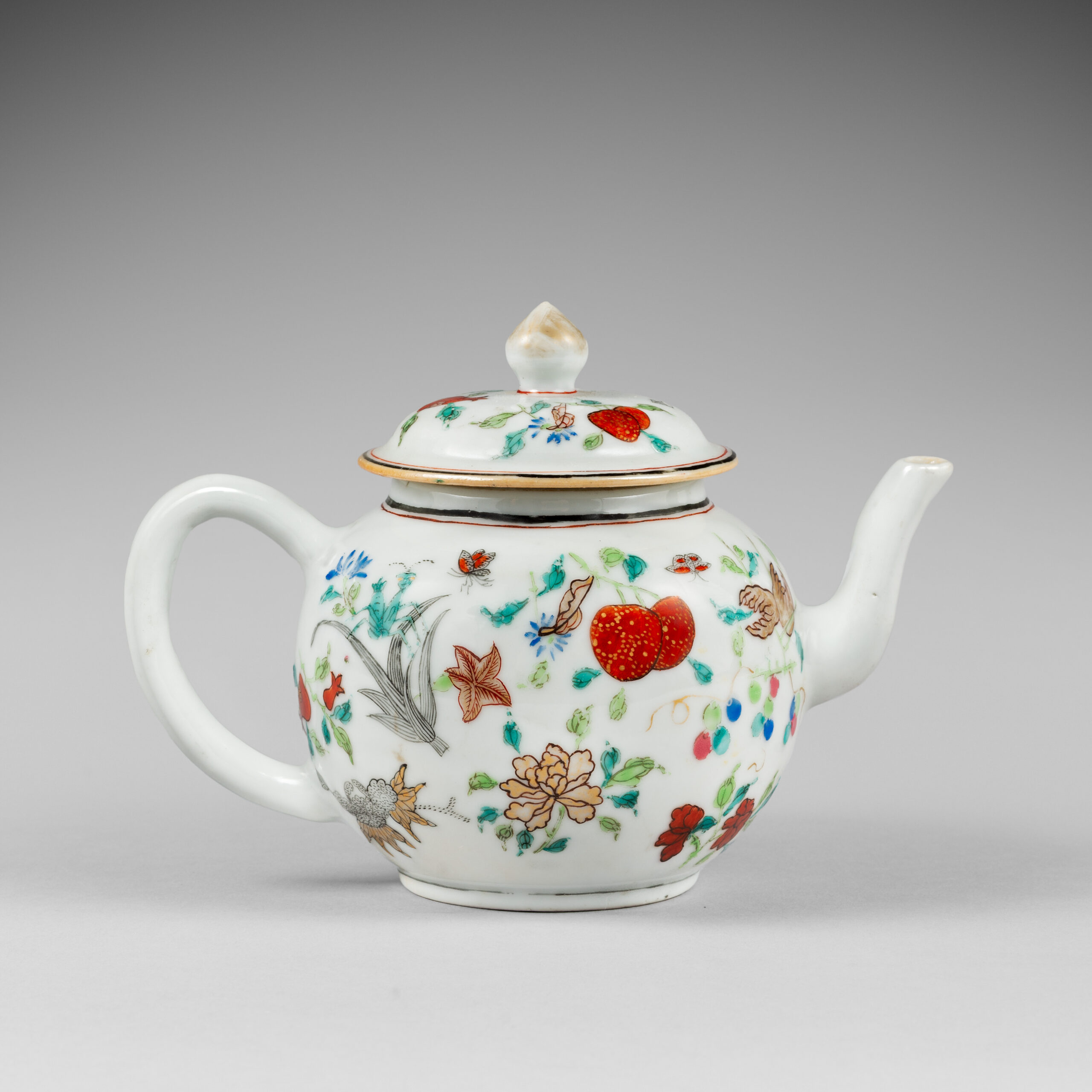
Additional information.This teapot is decorated with auspicious motifs, each carrying symbolic meanings of prosperity, longevity, and harmony.
The apricots (xing 杏) allude to scholarly success, recalling the metaphor of the “apricot grove” as a gathering place for the learned and the virtuous.
The digitated lemons, or Buddha’s hand citrons (foshou 佛手), serve as rebuses for blessings and long life, their very name echoing fu shou (happiness and longevity).
The pomegranates (shiliu 石榴) is a vivid emblem of fecundity and the wish for numerous descendants.
The peonies (mudan 牡丹), long celebrated as the “queen of flowers,” stand for wealth, honor, and social distinction.
At the base, a lotus blossom (lian 莲) executed in gilt and silver symbolizes purity and harmony, its name also punning on continuity (lian nian 连年, “year after year”), thus expressing the desire for unbroken prosperity.
Interwoven vines of grapes (putao 葡萄), heavy with fruit, reinforce the blessing of abundant progeny.
Among the foliage, two butterflies (die 蝶), whose name is homophonous with “longevity,” flutter gracefully, while a praying mantis (tanglang 螳螂) symbolizes vigilance, courage, and perseverance. The domed cover continues this rich vocabulary, with motifs of lotus, apricots, and pomegranates echoing those on the body.
The motifs are arranged in pairs, a deliberate choice that reinforces the auspicious connotations of harmony, marital union, and fruitful abundance.
Through this sophisticated ensemble of motifs, the teapot expresses a constellation of auspicious wishes: for abundance, prosperity, noble rank, scholarly attainment, purity, longevity, and the flourishing of generations.