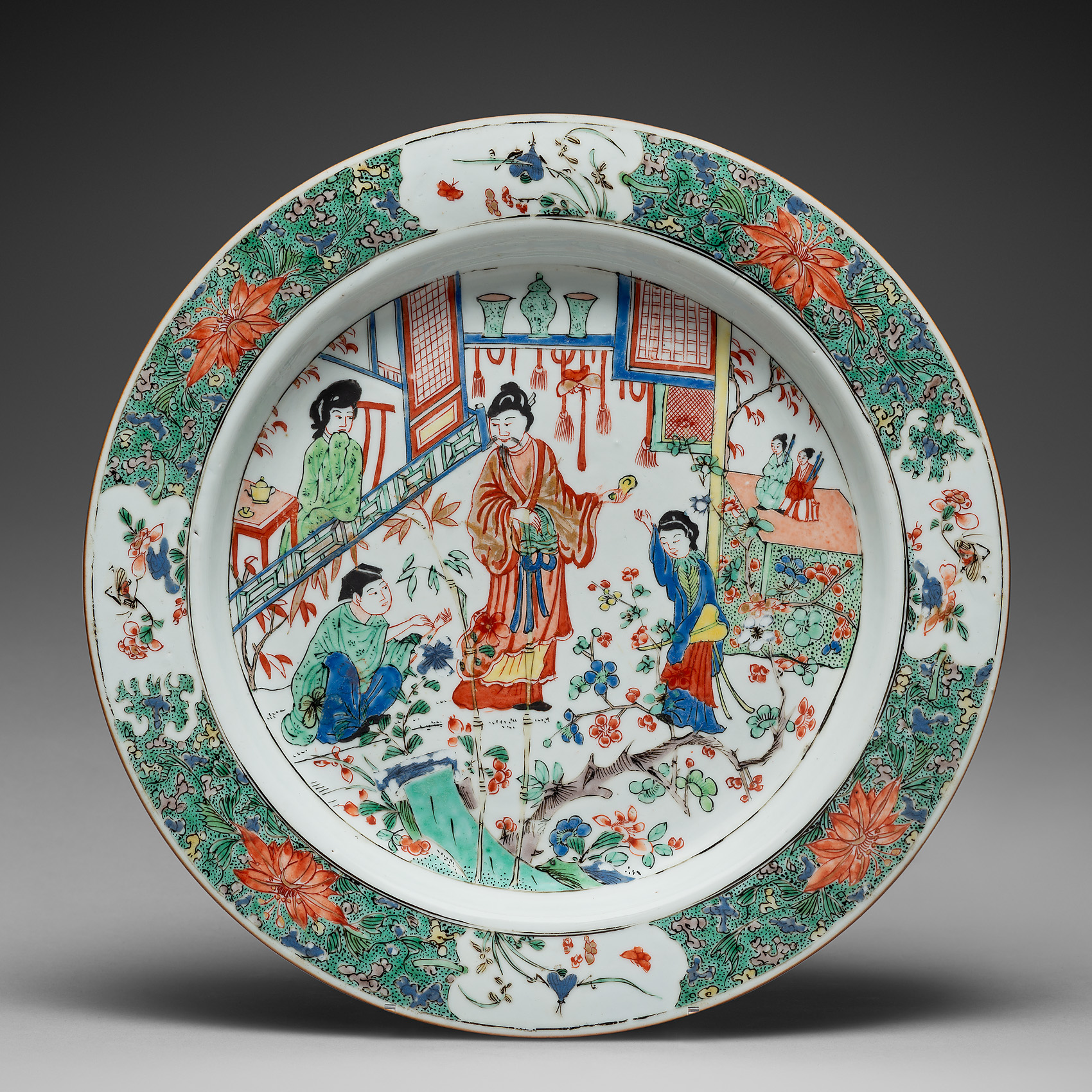
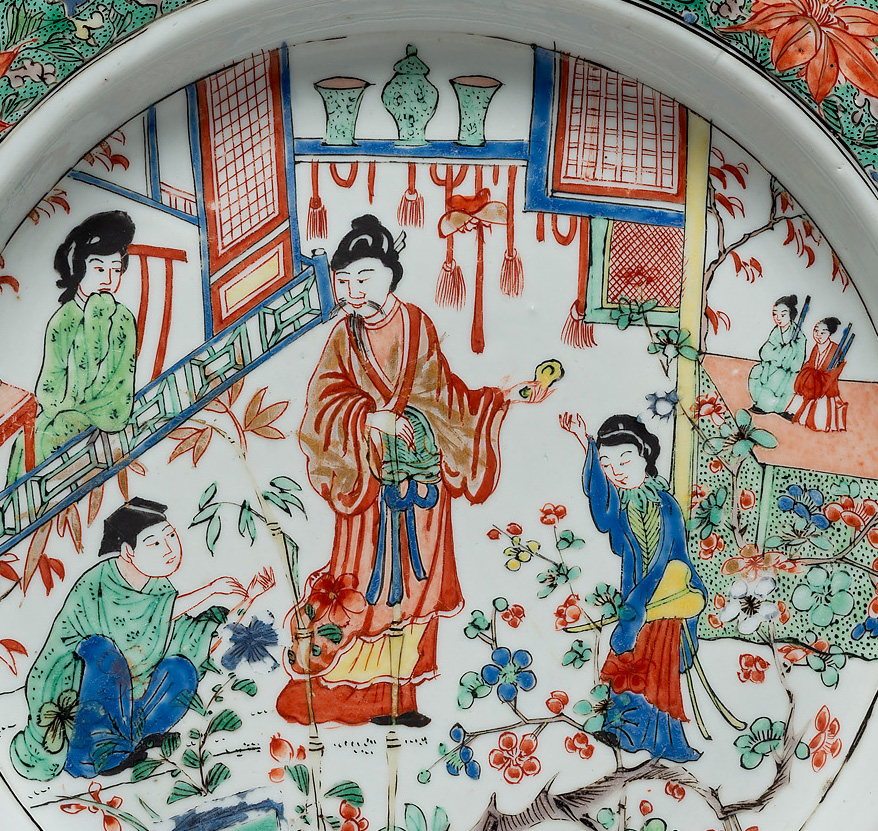
Additional information.The scene depicted on this dish probably illustrates the Chinese story of The Magistrat and the Kind Couple. In a small village surrounded by rolling hills lived a humble couple, Mei and Lian, known for their kindness and compassion. During a harsh winter famine, they shared their last food with an elderly couple unable to fend for themselves. Unbeknownst to them, a wise magistrate, Li, disguised as a traveling merchant, observed their generosity. Deeply moved, he later returned in full official dress, gathered the villagers, and praised Mei and Lian for their virtue and selflessness. He then presented them with a silk pouch filled with gold ingots (yuanbao), symbols of prosperity and good fortune, as a reward for their exemplary conduct.
In certain versions, it is the magistrate himself who tests the couple, seeking to measure the purity of their hearts before offering them assistance or a reward. This story appears in illustrated moral compilations published in the seventeenth century (Bao Lian Deng, Yuanfeng Leizuan).
The exact model that served as inspiration has not been identified, but it may have derived from a Chinese porcelain now lost or unidentified.The scene depicted here may also have been painted after the designs of several porcelains, whose elements were combined to form a single composition.
This dish belongs to the stylistic movement of Chinoiserie, which reflects the European fascination with the art, motifs, and objects of China—and, more broadly, of East Asia. The movement emerged at the end of the seventeenth century, when European maritime companies (VOC, EIC, and the French East India Company) began importing large quantities of Chinese porcelain.
These porcelains inspired an exotic imagination in which China was perceived as a refined, peaceful, and orderly empire—an idealized and often fanciful vision. Asian artworks, initially collected as curiosities, soon became decorative elements that were copied or reinterpreted by European artists and craftsmen. Chinoiserie was not a faithful imitation but rather a Western decorative invention inspired by Oriental models.