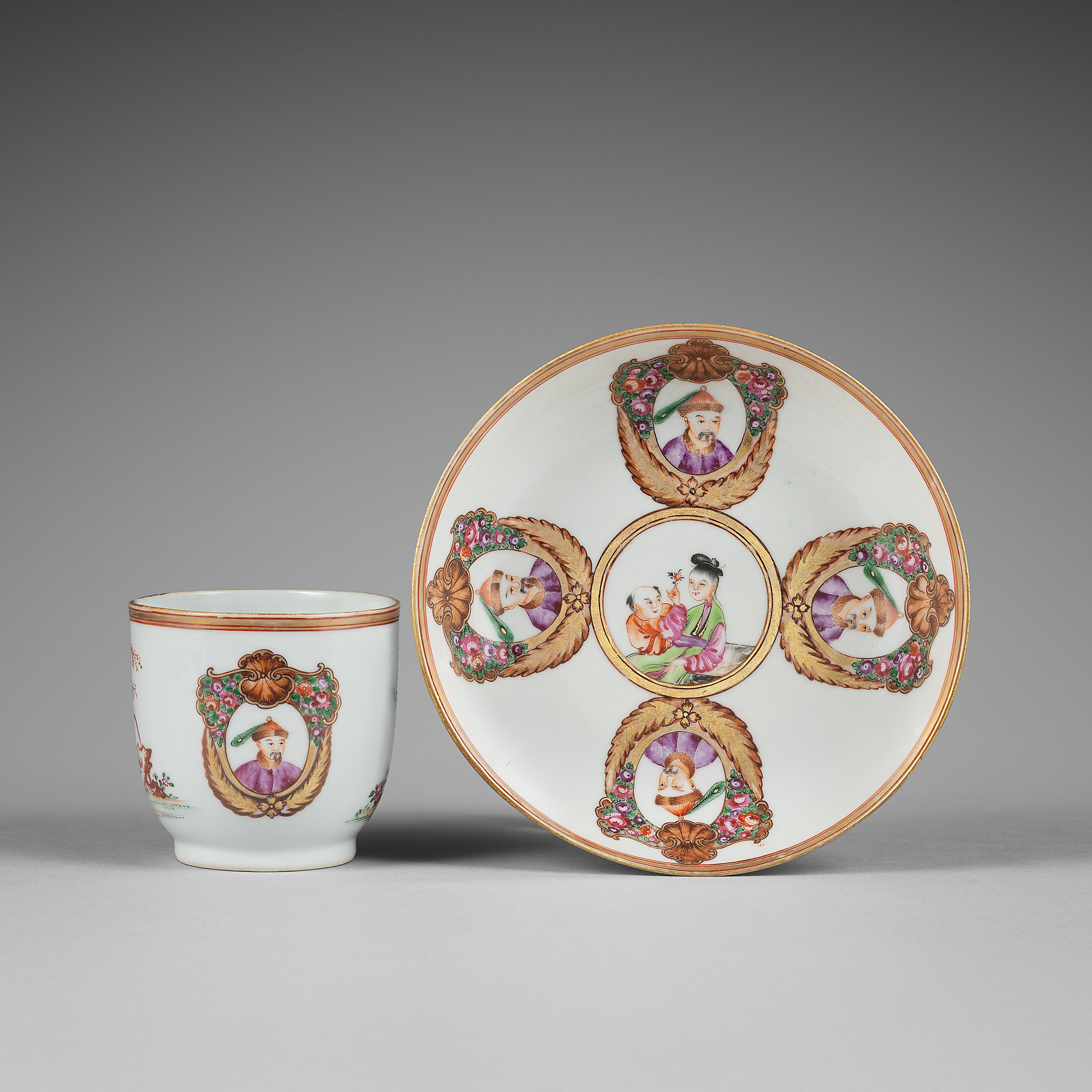
A fine famille rose “Chinese official” cup and saucer. Qianlong

The cup and saucer are decorated in the famille-rose palette. The cup bears a single medallion, while the saucer carries four medallions arranged around a central reserve depicting a mother and child. Each of the four medallions contains the portrait of an official shown in three-quarter view, attired in a long violet robe and wearing the official cap to which a peacock feather—an honorific distinction bestowed by the Emperor—is affixed. The bust is set within an elegant rocaille oval cartouche composed of gilt foliate scrolls and floral sprays.
COUNTRY : China
PERIOD : Qianlong (1735-1795)
MATERIAL : Porcelain
SIZE : 12 cm
REFERENCE : E714
STATUT : sold
Related works :

A punch bowl with an identical medallion is illustrated by Hervouêt & Bruneau in La Porcelaine des Compagnies des Indes à Décor Occidental, 1986, p. 32, 1.38 (the figure described as a Chinese merchant). This bowl is also illustrated by David Howard in China for the West: Chinese Porcelain and Other Decorative Arts for Export Illustrated from the Mottahedeh Collection, 1987, Tome I, p. 212, no. 210.

One related example published, also with Chinese portraited cartouches reserved on a café-au-lait ground, includes a sugar bowl, cover and stand, and a large plate, illustrated in Jorge Getulio Veiga, Chinese Export Porcelain in Private Brazilian Collections, London, 1989, pp. 94-95, pl. 66 and 67.

A Chinese armorial tea set for the French market bears the same medallions (Magon de Saint-Élier – Magon du Bos) set within the same decorative scheme.

Additonal informations :

Although ‘mandarin’ decorations are encountered on Chinese export porcelain, examples executed with such refinement are unusual and rare. Both Howard and Ayers, as well as Hervouët and Bruneau, suggests that this may have been a parting gift, given by Chinese merchants to British and especially American trading partners when they were about to depart. Additionally, the chair and empty gown may also symbolize the absence of the Western trading partner.However, upon further examination, the Chinese portrait exposes a few further details which may provide some further clues to the identity of the person pictured.

Firstly, the half length portrait depicts a Chinese official wearing a robe with a fur collar and fur hat. It is unusual for merchants to chose to represent themselves in winter dress, given the weather in Canton (Guanzhou) remains moderately warm throughout the year. Secondly, the figure wears a dan yan hua ling, a single-eyed peacock feather hat decoration. Examples of plume hat decoration is illustrated in Gary Dickinson and Linda Wrigglesworth, Imperial Wardrobe, Hong Kong, 2000, pp. 112-113, pls 94 and 95.

Only conferred by the Emperor, wearers of such peacock feather hat decorations were distinguished members of the court. The single-eyed plum, dan yan hua ling, was awarded to Chinese nobles and officials down to the sixth rank. Therefore, the sitter in the portrait, appears to be of high social status and could possibly be an official based elsewhere such as Beijing.

Demande de condition report

Question about condition report