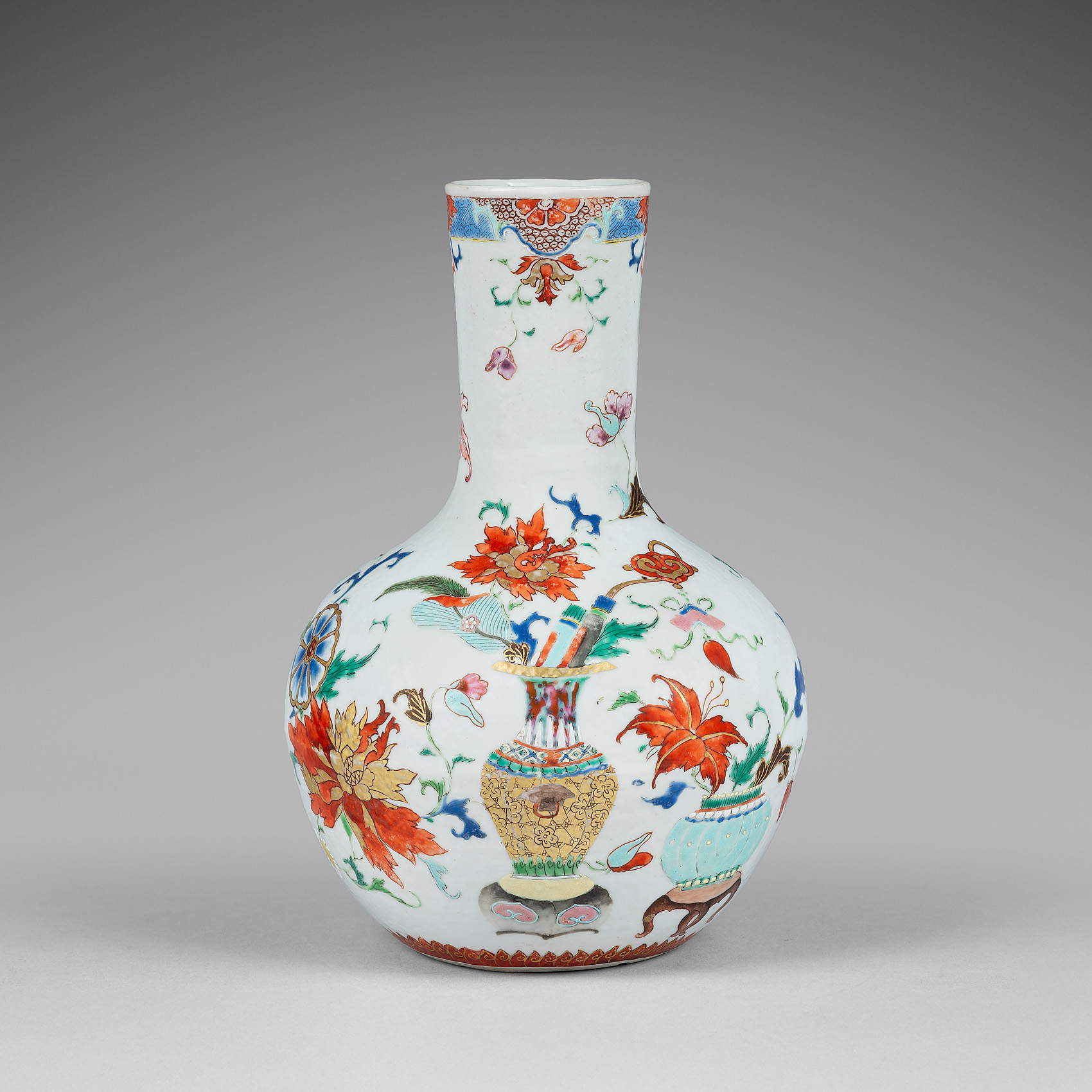
An unusual Chinese famille rose vase, tianqiuping decorated with the “Hundred Antiquities”. Yongzheng

The vase, of an unusual globular form with a tall cylindrical neck, is decorated in famille-rose enamels with a rich ‘Hundred Antiquities’ motif. At the center, a brocade-patterned vase rests upon a stylized stand and contains an assortment of scholarly objects—brushes, a ruyi scepter, a folded fan, and scrolls—symbols of the literary arts and cultured refinement. To either side, additional vessels filled with large, vibrant blossoms—peonies, lotus flowers, and autumnal leaves—unfold in asymmetrical compositions. The neck is encircled by a brocade-like floral border executed in a palette combining iron red, turquoise, yellow, and gilt highlights, while the foot is trimmed with a frieze of red lappet leaves.
COUNTRY : China
PERIOD : Yongzheng (1723-1735)
MATERIAL : Porcelain
SIZE : 22 cm
REFERENCE : E807
STATUT : sold
Additonal informations :

The Hundred Antiquities (baigu / bogu) ranks among the major themes of the Chinese scholarly repertoire. It brings together a range of objects associated with the veneration of antiquities and with the cultivated world of the literati: archaistic vases, incense burners, ritual bronzes and bells, ruyi scepters, brushes, seals, painting and calligraphy scrolls, fans, and other accoutrements of the scholar’s studio. Often accompanied by auspicious blossoms, lingzhi fungi, or other emblematic motifs, these elements form a visual vocabulary celebrating erudition, moral refinement, and intellectual elegance.

Emerging in the late Ming period and widely disseminated in the early Qing, this motif reached particular prominence under the Yongzheng and Qianlong emperors, notably on porcelain decorated in famille rose enamels. Workshops at Jingdezhen and Canton developed especially refined interpretations, in which the objects appear to float freely across the surface or to gather in balanced, harmonious arrangements. Evoking both the continuity of tradition and the taste for classified antiquities, this decorative theme conveys wishes for prosperity, longevity, and cultural accomplishment, while reflecting the aesthetic ideals of the eighteenth-century Chinese literati.

The tianqiuping (天球瓶), literally “heavenly globe vase,” is defined by its perfectly rounded globular body rising to a tall cylindrical neck. Introduced during the Ming dynasty and revived with particular distinction under the Qing, this elegant silhouette ranks among the most emblematic forms of imperial porcelain. Its pure geometry, evoking celestial harmony and cosmic order, made it a favored shape for the most ambitious decorative programs, especially during the Yongzheng and Qianlong reigns. Intended primarily for display, the tianqiuping was often placed in reception halls or imperial cabinets, where its commanding presence and formal balance embodied both aesthetic refinement and the technical virtuosity.This form is rarely encountered in Chinese export porcelain.

Demande de condition report

Question about condition report