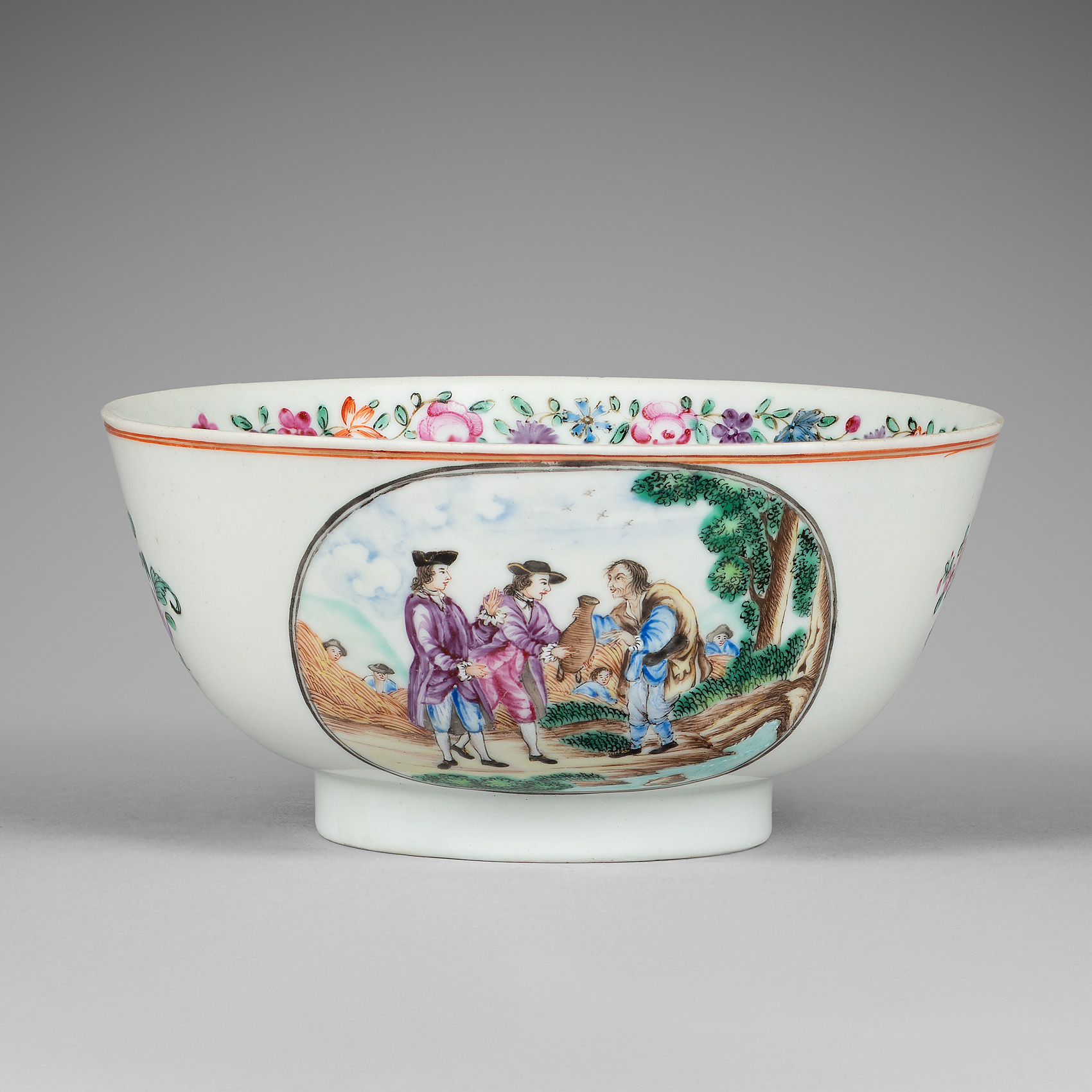
A Chinese “European subject” bowl. Qianlong

The bowl is decorated on the exterior with a large oval medallion containing a finely painted scene. The scene shows three standing figures set in an outdoor landscape: two men dressed in long purple and pink coats with tricorn-style hats, and a third man wearing a blue garment and carrying a large sack on his back. Behind them, additional figures are visible working in fields with stacks of straw. The scene is framed by a tree on the right and a lightly clouded sky.

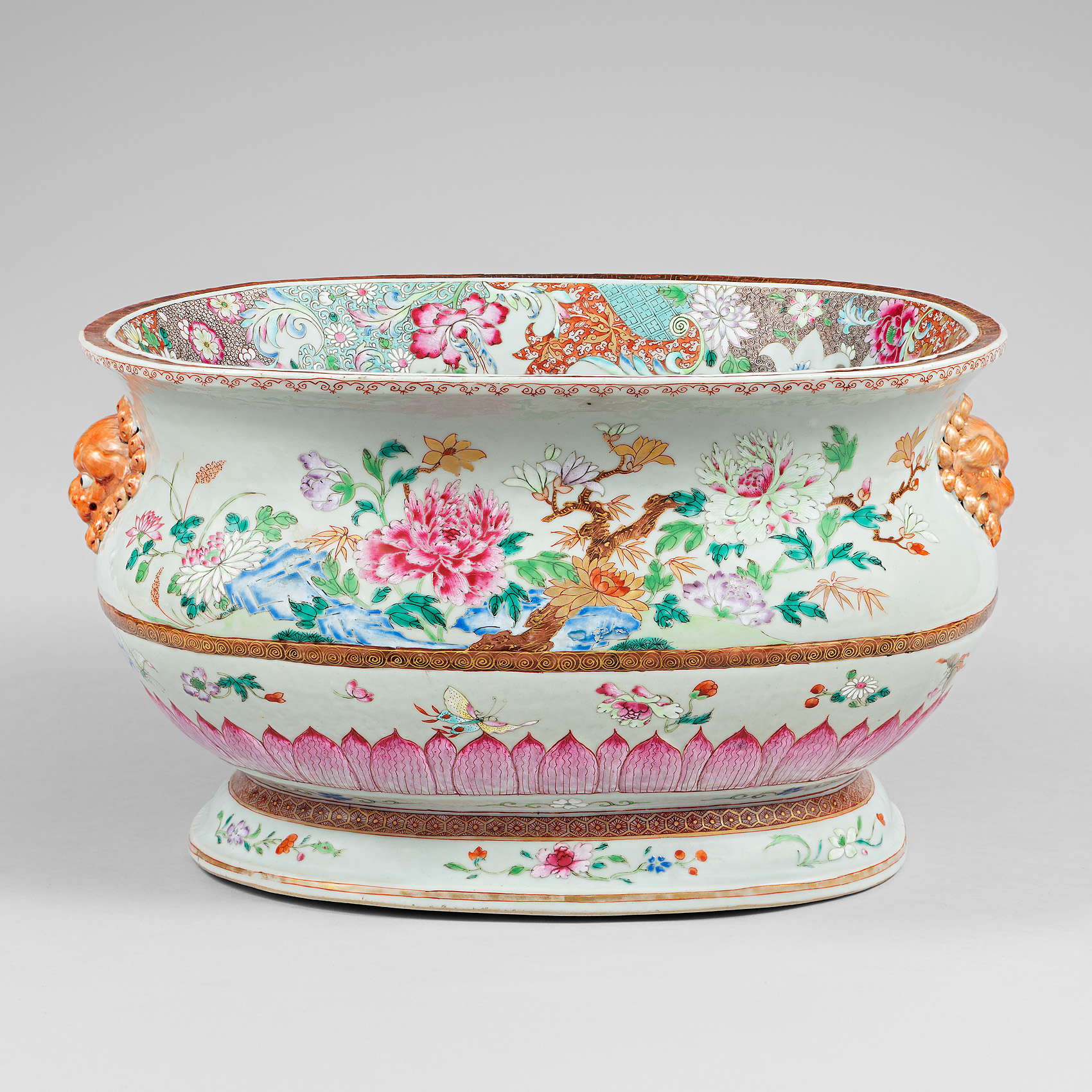
The rim of the bowl is encircled by a narrow iron-red line. Just below the interior rim runs a continuous band of richly coloured flowers, including pink, purple, blue, and red blossoms with green leaves.
COUNTRY : China
PERIOD : Qianlong (1735-1795), ca. 1775
MATERIAL : Porcelain
SIZE : 14 cm x 7 cm
REFERENCE : E578a
PROVENANCE : The Angelo Castelo Branco Cerqueira Caldas Collection, 1990, no. 183
STATUT : available
Additonal informations :

This decoration was formerly attributed as a representation of Ferdinand IV of Bourbon, King of Naples, whose pleasures included travelling through the countryside with his retinue to offer wine to the peasants.

For a tray with this decoration, see Hervouët & Bruneau, La Porcelaine des Compagnies des Indes à décor occidental, 1986, p. 220, no. 9.76

The engraved model used as the source for this scene was identified by Will Motley as Les Moissonneurs (1768) — The Reapers. This is an opéra comique by Charles-Simon Favart (1710–1792) with music by Egidio Romualdo Duni (1708–1775). A small suite of prints was produced by Charles Eisen to illustrate the story, though they were also appreciated simply as pastoral genre images.

The suite of six drawings by Charles-Dominique-Joseph Eisen (1720–1778) was published in 1768 by Chez Petit, rue du Petit-Pont, Paris, in small ovals accompanied by verses from the opera. Some were engraved by Pierre-Adrien Le Beau (1748–1810), and at least one by Emmanuel Jean Nepomucène de Ghendt (1738–1815), who was active in Paris from 1766 and engraved many book illustrations after Eisen. The engravings appear to be rare, and no edition of the text containing them has yet been located, suggesting that they were probably issued and sold independently.

Of the six prints, four are found on Chinese famille rose tea services from the 1770s with varying borders. On exemple of the prints VI, depicted on our bowl is in the collection of the Rijksmuseum, Amsterdam (RP-P-OB-52.616).

Demande de condition report

Question about condition report