
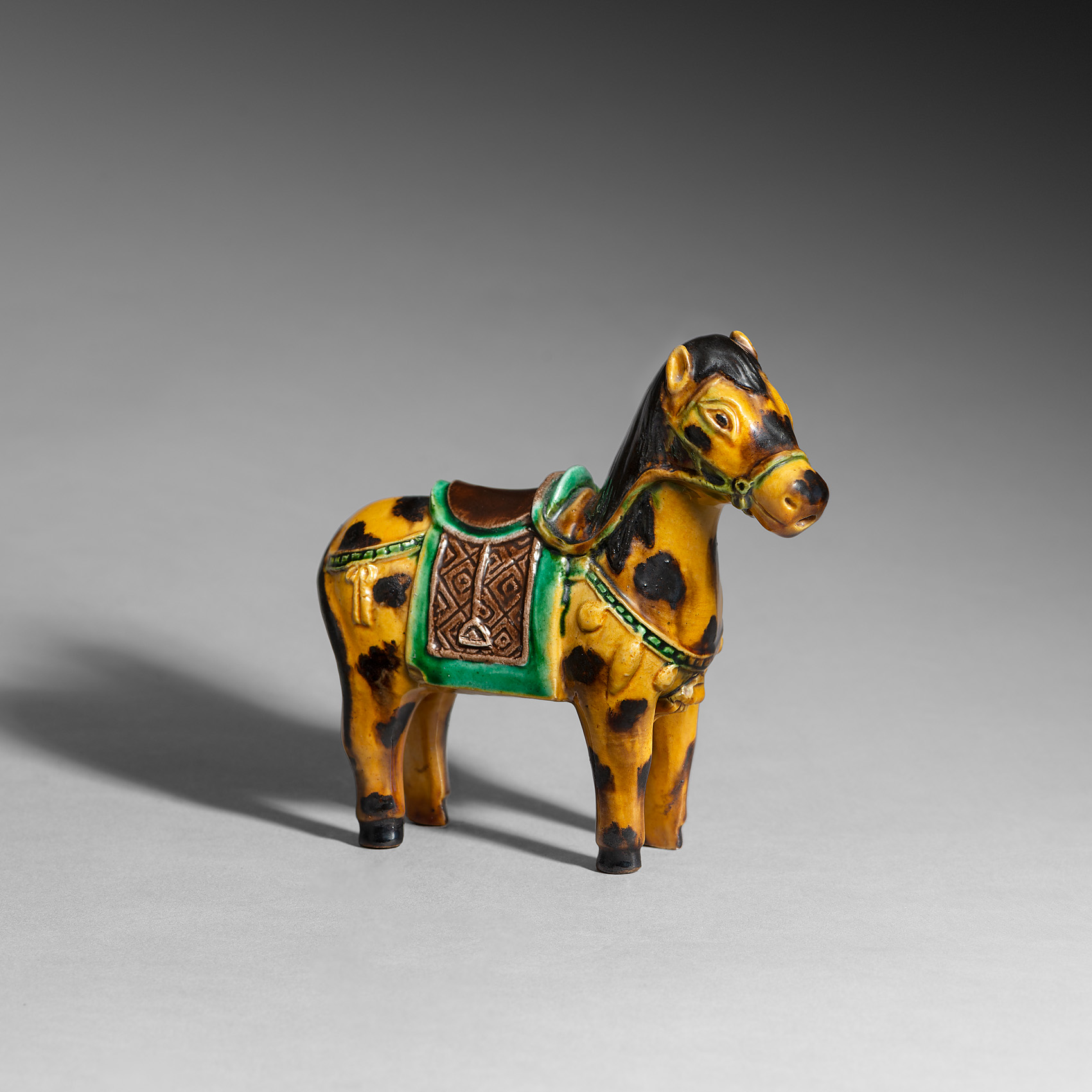
A Chinese famille verte water dropper in the form of a horse (shuizhu), Kangxi

The water dropper, moulded and modelled in porcelain, is formed as a standing horse shown harnessed. The animal is depicted in profile, with the head slightly turned and the legs set beneath the body. The surface is covered with a slip and polychrome enamels applied directly onto the biscuit, in tones of ochre-yellow, green and dark brown, characteristic of so-called famille verte wares of the Kangxi period.

The horse’s coat is mottled with dark markings, while the mane and tail are rendered in black. The harness is picked out in green, with a rectangular saddle decorated with incised geometric motifs highlighted in brown enamel. The anatomical details—nostrils, eyes and hooves—are rendered in a restrained and stylised manner. The filling aperture is concealed within the harness, and the spout is discreetly integrated into the animal’s mouth.

COUNTRY : China
PERIOD : Kangxi (166-1722)
MATERIAL : Porcelain (biscuit)
SIZE : 11,5 cm x 11,5 cm
REFERENCE : E759
STATUT : vendu
Related works :

Very closely related horse figures from the collection of Augustus the Strong are preserved in the Dresden collections (inv. nos. PO 4332 and PO 3362).

Comparable horse figures were also included in the collection of the Hon. Mrs Nellie Ionides (1883–1962).

A small group of related figures is published by Regina Krahl in Chinese Ceramics: The Anthony de Rothschild Collection, including an example with an archer and two equestrian figures (1996, nos. 217 and 218, pp. 391–393).

Further comparable equestrian figures are recorded in the Copeland Collection and published by Bill Sargent in The Copeland Collection: Chinese and Japanese Ceramic Figures, 1991, p. 67, no. 22.

Related horse figures, decorated with an underglaze-blue saddlecloth, were recovered from the Dutch East Indiaman Geldermalsen, which sank in 1752 (Christie’s Amsterdam, April–May 1986, lots 5748, 5751 and others). Smaller famille verte biscuit figures were also recovered from the Ca Mau shipwreck (Sotheby’s Amsterdam, Made in Imperial China: 76,000 Pieces of Chinese Export Porcelain from the Ca Mau Shipwreck, 29 January 2007).

Additonal informations :

In China, the horse is an ancient and highly auspicious symbol, associated with speed, mobility and the ability to traverse great distances. It embodies controlled strength and military power, while also being closely linked to imperial authority and exchanges with Central Asia. In the symbolic language, the horse conveys the idea of rapid success and advancement, notably through the expression ma shang cheng gong (“immediate achievement”). In mythology, the horse may assume a celestial dimension, capable of travelling between heaven and earth, thereby expressing transcendence and longevity. In the decorative arts, horses are frequently depicted in motion, emphasising vital energy and continuity, and appear on scholar’s objects as motifs combining practical function with symbolic meaning.

Question about condition report

Question about condition report