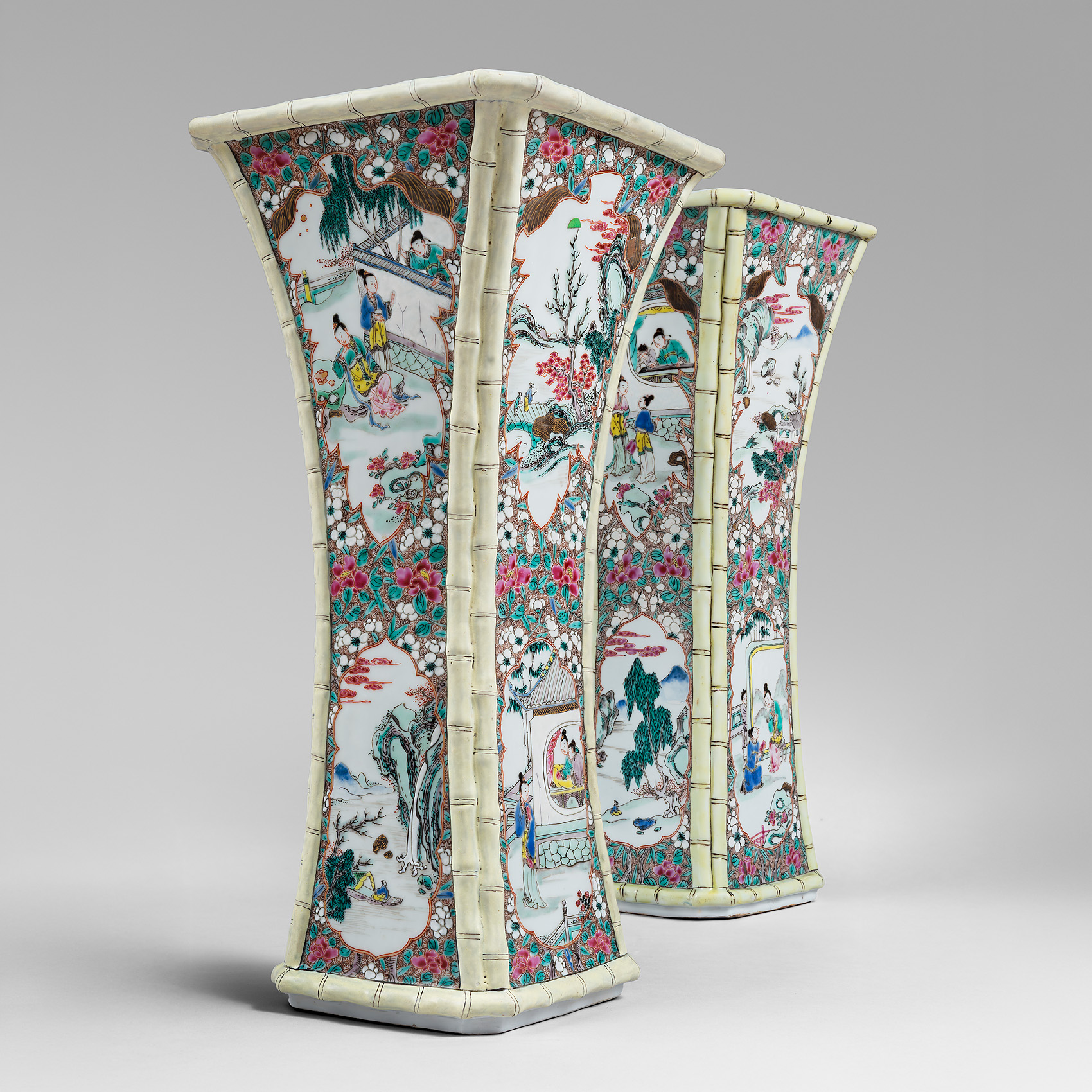
The square-section vases are decorated in famille rose enamels. Each face is painted with scenes arranged within vertical leaf-shaped reserves. The scenes depict figures moving through structured settings of pavilions, bridges, and trees, set against more rugged landscapes or intricate rock formations. The edges of each vase are modelled in imitation of bamboo. The reserves are decorated with scenes from the Romance of the Western Chamber. The story originated in China, at the end of the 12th century, when a certain Dong Jieyuan compiled existing textual variants of popular theatrical plays, romances and ballads recounting a well-known love story. This work was published as the Xixiang Ji Zhugongdiao (Romance of the Western Chamber in All Keys and Modes). The narrative was subsequently adapted and expanded by the playwright Wang clandestine romance defying familial opposition Shifu (c. 1250-1300), who published it as a comedyin eight volumes, entitled Xixiang Ji (Romance of the Western Chamber). While the work earned a permanent place in the literary canon, the story itself remained immensely popular across all social strata. This enduring appeal persisted well into the 20th century, with the theme adapted for opera and film in 1980s Beijing. Xixiang Ji stands as an indispensable pillar of the theatrical heritage of China.
