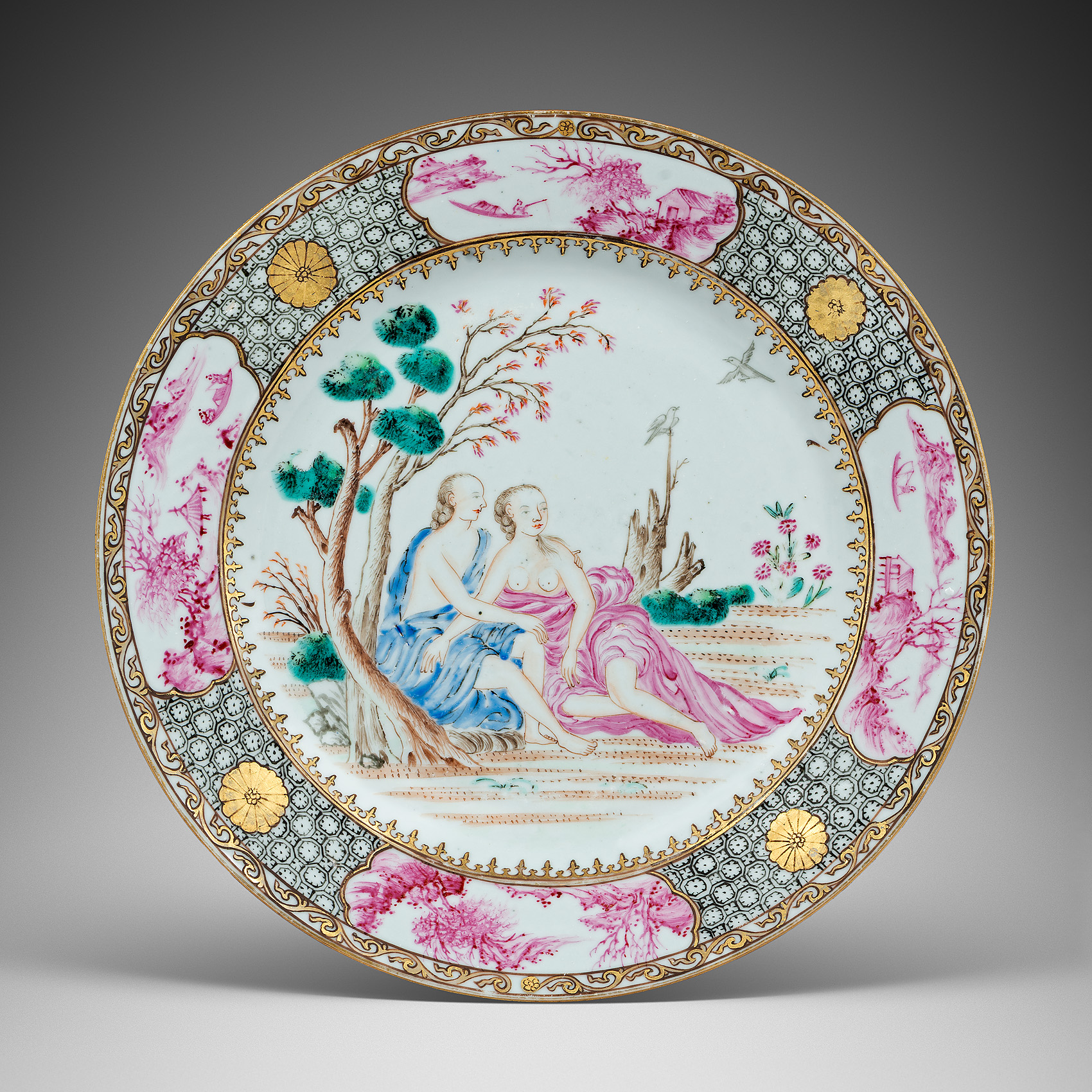
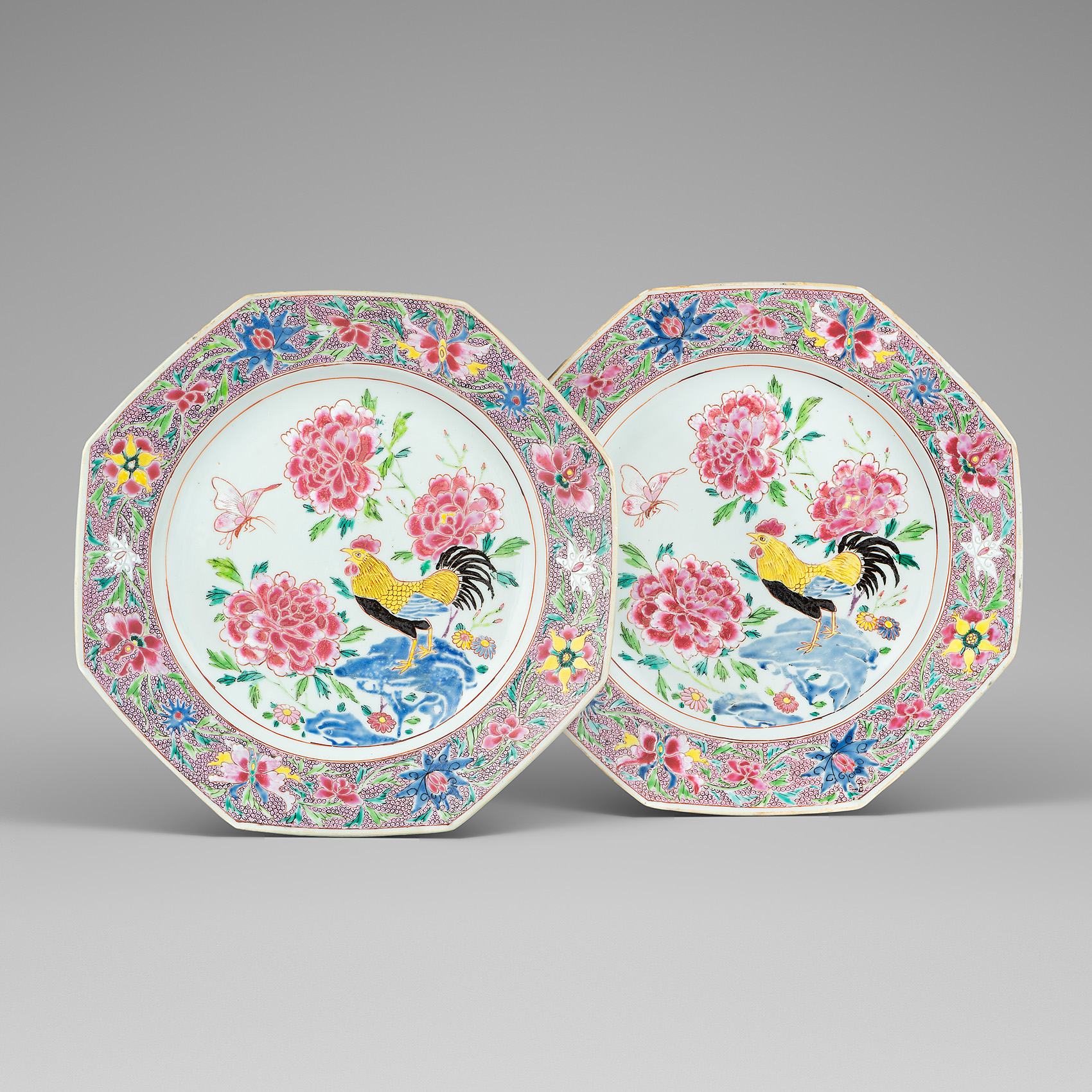
A Chinese famille rose plate with a European subject. Qianlong
The plate is decorated in the famille rose palette, with an amorous couple, Acis and Galatea, the rim with puce panels reserved on a grisaille cell diaper.
COUNTRY : China
TIME: Qianlong (1736-1795), circa 1745
MATERIAL : Porcelain
SIZE : 23 cm
REFERENCE : E853
PROVENANCE : Christie’s, Amsterdam, 10 October 1989, lot 158 (to Dreesmann).
Dr Anton C.R. Dreesmann (inventory no. J-8), The Netherlands, 2002
Collection Maude da Conceição Santos Mendonça de Queiroz Pereira, Lisbon, 2021
An identical plate is in the collection of the Royal Museums of Art and History, Brussels, exhibited Hong Kong 1989-90, Chinese Export Porcelain, catalogue no.85, pp.217-8.
Another plate is illustrated by D. S. Lunsingh Scheurleer, Chinese Export Porcelain – Chine de Commande, London, 1974, no.231
See also Cohen & Cohen, A game of bowls, 2014, n.. 69, p. 100.
Additional information.
The figures once thought to represent Cupid and Psyche, are now identified from a scene depicting Galatea and the shepherd Acis. The image is derived from a print by Edmé Jeaurat (1688-1738)in 1722, after a painting by Charles de la Fosse (1636-1722).
The original image included Polyphemus who is omitted on the porcelain. He is in love with Galatea and is about to kill Acis with a rock. The whole scene can be found on 18th century tapestries.
The story of Acis and Galatea is recounted by Ovid in the Metamorphoses, Book XIII (lines 738–897). It tells of the pastoral love between the sea-nymph, daughter of Nereus and Doris, and the young Sicilian shepherd, son of Pan, soon disrupted by the jealousy of the Cyclops Polyphemus. Discovered together, Acis is killed by the giant, crushed beneath a rock. Grief-stricken, Galatea transforms her lover’s blood into a river, granting him a form of immortality.
In the eighteenth century, mythological decoration became highly fashionable in Europe, reflecting a renewed interest in Antiquity and in classical culture. This development was closely linked to the Grand Tour and the rise of the academies, where ancient history was seen as both a source of artistic inspiration and a model of refinement. European elites, particularly in France and England, sought objects that could express both their cultural awareness and their social standing.
The appeal of these subjects also lies in their narrative quality. Unlike purely decorative motifs, they tell a story, offering a point of conversation within the salon. Mythology thus became a shared visual language, easily recognised by a cultivated audience. These scenes also sit naturally within Rococo and later Neoclassical interiors, where references to Antiquity blend with decorative elegance. Chinese export porcelain played an important role in spreading such imagery more widely, bringing themes once largely confined to painting and engraving into everyday use.