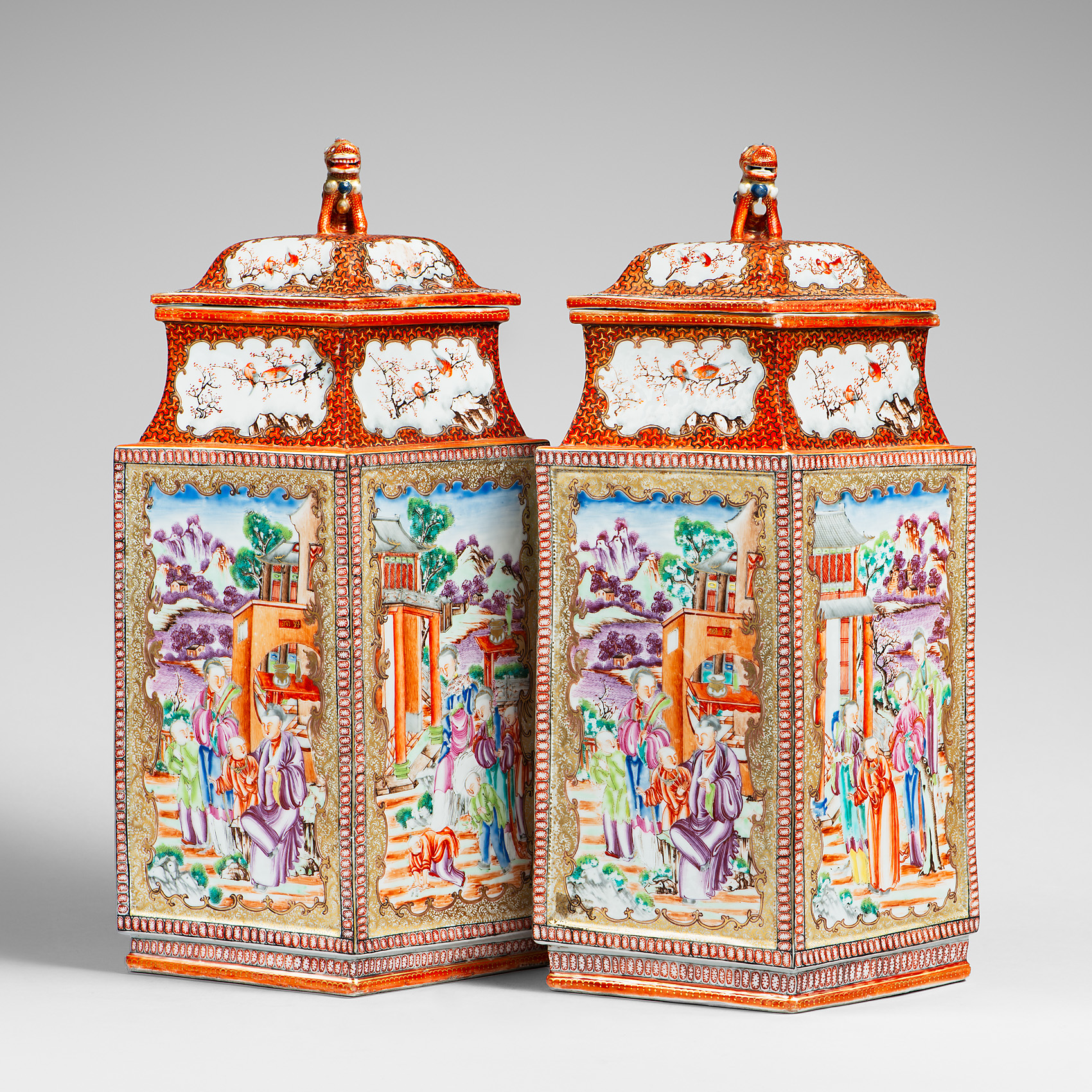
Additional information.These scenes serve as a visual manifestation of Confucian values—order, hierarchy, and sound governance. The style is distinguished by dense, highly structured compositions and a narrative tone that is markedly more ceremonial and formal than the fluid, poetic depictions of the preceding Yongzheng reign.
Produced for both the domestic and export markets—notably in Canton—these wares retained their traditional Chinese iconographic vocabulary while embracing a more pronounced decorative flair. As such, they stand as compelling visual witnesses to the administrative culture and ruling ideology of 18th-century China.
The fanghu shape originates from archaic ritual bronzes of the Shang and Zhou dynasties. During the late Qianlong reign, this form was reimagined with a diamond-shaped outline, a technical feat significantly more complex than standard square or circular vessels. Beyond its structural tension, the diamond section serves as a three-dimensional manifestation of the fangheng (方胜) symbol—the double lozenge. Traditionally representing victory and marital harmony, this geometry elevates the vases from decorative objects to powerful emblems of success and dual prosperity.
The distinctive Y-shaped basketweave or chainmail pattern on the borders carries profound historical resonance. This motif, found on ancient armour, was famously depicted on the waistcoat worn by the Yongzheng Emperor in his celebrated ‘Tiger Hunt’ portrait. In this unusual painting by the Jesuit artist Giuseppe Castiglione (known in China as Lang Shining), the Emperor is portrayed in full European dress, complete with a perruque, at a time of mutual fascination and sophisticated cultural exchange between East and West that defined the 18th-century porcelain trade.
An intriguing iconographic detail is the small red plaque (门第, mendi) affixed to one of the pavilions, signifying the “noble status” or “illustrious lineage” of the household. The plaque and its colour evoke the world of the contemporary Chinese masterpiece Hong Lou Meng (Dream of the Red Chamber). The opulent red colour is a visual shorthand for the ‘Red Mansions’ of the high aristocracy and the opulent lifestyle of the ruling class. One of the main characters of the novel, the spoiled aspiring scholar Baoyu, famously engages in the elegant pursuit of naming newly-built pavilions of the family park—a practice of cultural branding that mirrors the elite status of the officials depicted on these vases.
While the early 18th century saw a cautious, economical use of the newly discovered famille rose enamels, this pair represents the peak of enamelling luxury. The palette is used lavishly, covering the surface with dense, layered compositions that reflect the immense wealth of the late Qianlong era. The use of archaic dragon borders, reminiscent of the duobaoge (treasure cabinets), demonstrates a taste for associating diverse historical repertoires.
While ‘Mandarin’ decorations appear on various vessel forms, most commonly the baluster shape, the diamond-section fanghu remains undoubtedly the rarest and most striking iteration. A vase of this form was notably included in the renowned Hodroff Collection.