By Christiaan J.A. Jörg
Among the many chine de commande porcelains, a special group is decorated with elaborate chinoiseries, i.e., designs conceived in the West that include Chinese or Oriental elements, combined, interpreted and augmented in a European way. This chinoiserie style became highly fashionable in the West during the 18th century and appeared on European ceramics, furniture, wallpaper, prints and paintings, and even influenced garden design and music.
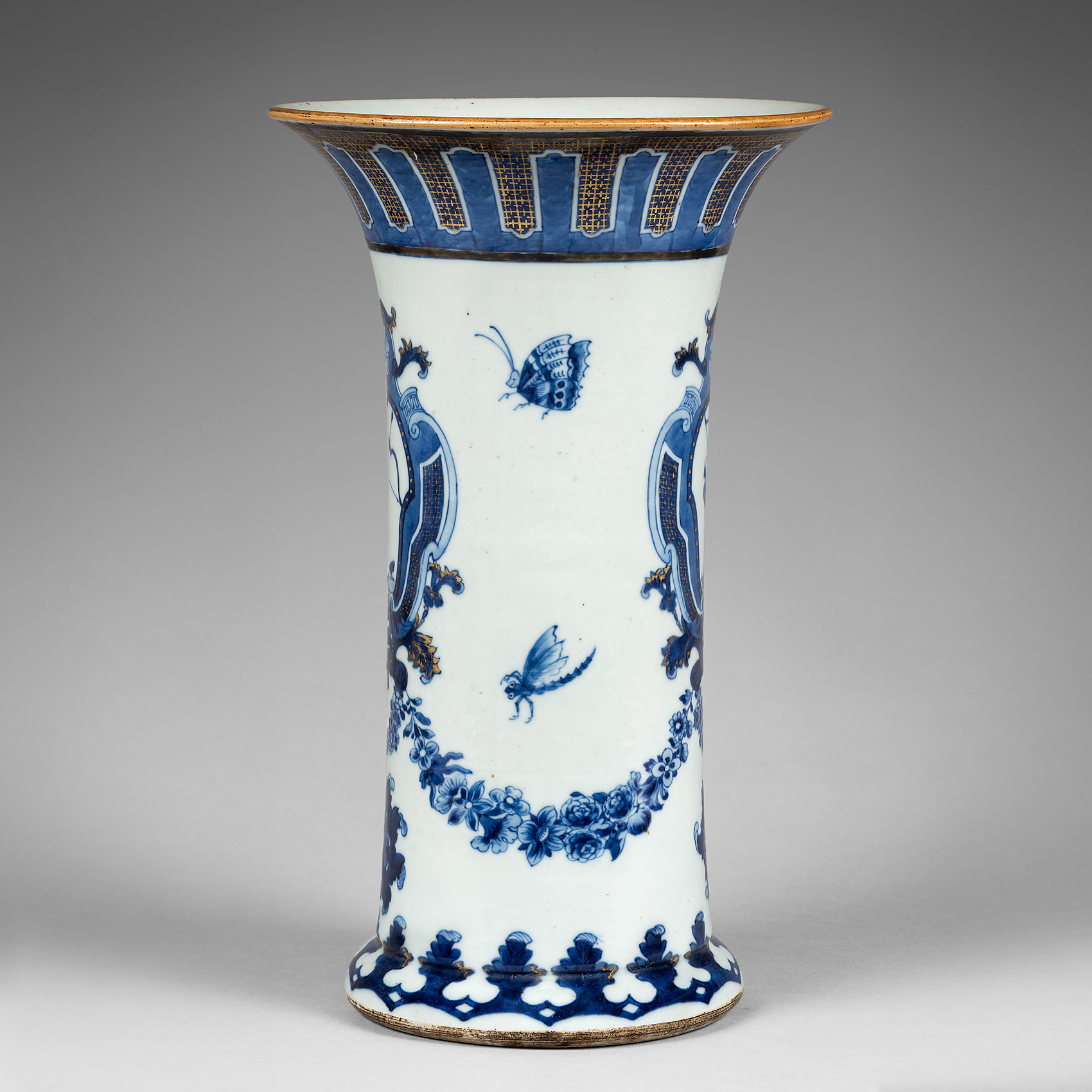
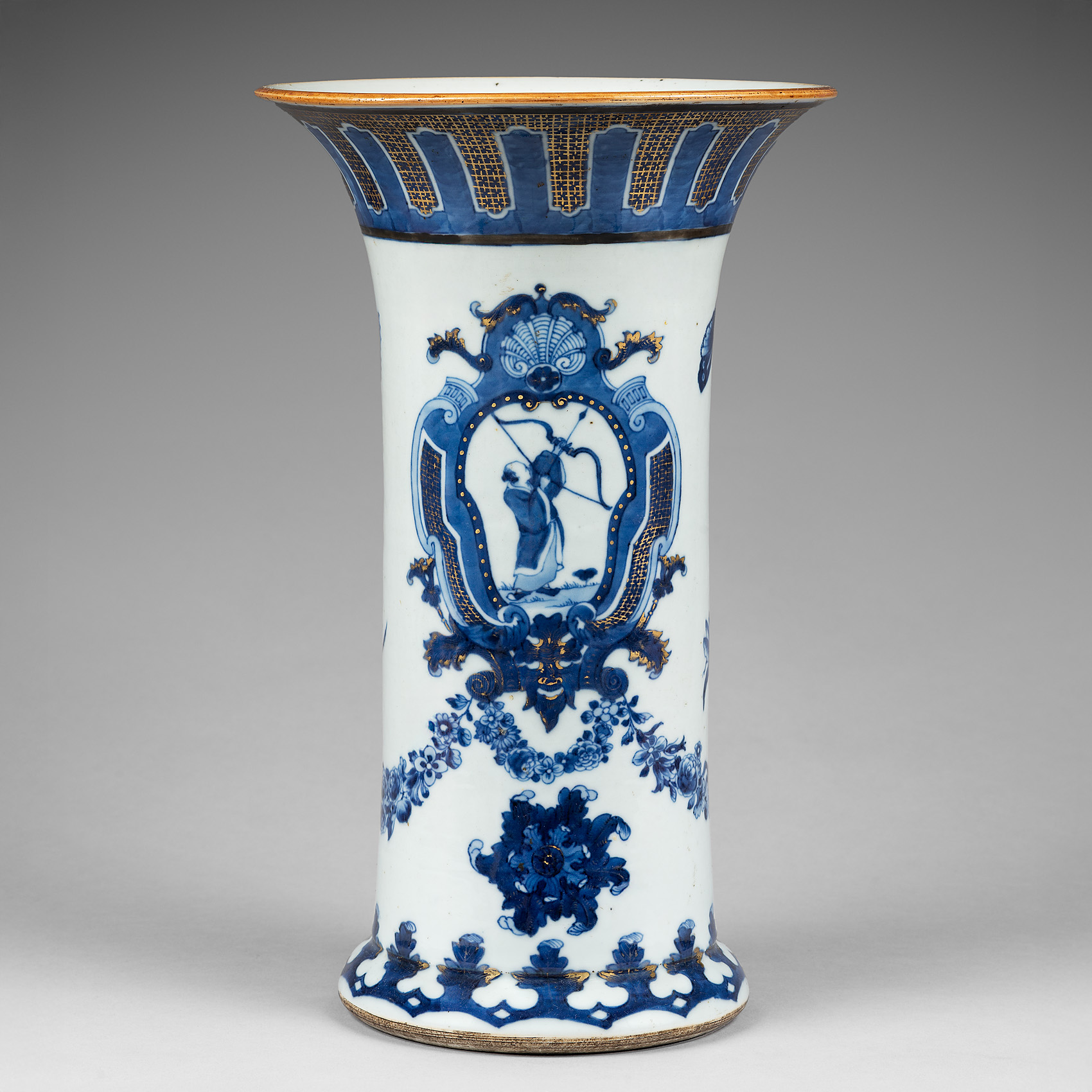
This beaker vase belongs to that category (figs. 1, 2). It has a cylindrical body, a spreading foot and a trumpet-shaped mouth. The height is 32 cm; the diameter of the mouth 20 cm, and the base 14,5 cm. The base is unglazed.
The decoration portrays a figure in Chinese dress standing in a landscape and aiming a bow and arrow at something above him. The scene is surrounded by an elaborate oval cartouche with a stylised acanthus motif on top and a mask or satyr’s head below, with some details highlighted in gold. A large part of the spreading mouth is covered in monochrome underglaze blue with reserved pending lappets with a pattern of tiny squares or latticework in gold. The same cartouche with the Archer is repeated on the other side of the vase and the two masks are connected by a flower garland. There is a large rosette below the cartouches, and a continuous chain with upturned leaves or shrubs around the spreading foot. The inside of the vase is undecorated.
This is a very rare piece and as far as I know, is the only beaker vase in existence with the Archer motif. Originally it was in an old French collection and has never been published.
The Archer motif is also known from a few baluster-shaped covered jars. One is in the collection of the Rijksmuseum Amsterdam, decorated in overglaze enamels (fig. 3), together with two basins with a matching decoration – one enamelled that actually is too small to belong to the jar, and another decorated in underglaze blue. Such jars have an opening in the centre of the rosette for a tap and therefore the jar and basin were likely placed on a buffet or table and used for washing hands. An example in underglaze blue was auctioned in November 1980 as part of the contents of the Chateau Neuville-sur-Oise in France (fig. 4).[1] Another covered jar with the Archer decorated in blue is in the Metropolitan Museum, New York. [2] Several covered jars (or fountain pots) figured in the past decennia in auction catalogues and in fact they are not particularly rare. In my catalogue of the Rijksmuseum collection I suggested a link between pieces with the Archer motif and other porcelains with chinoiserie decorations, namely those that were drawn by the Dutch artist Cornelis Pronk (1691-1759) for the Dutch East India Company (VOC).[3]
The story of the Pronk porcelains has become well known since the publication of my catalogue on the subject,[4] and it suffices to say that three of the four different designs by Pronk have been identified. The Parasol Ladies was the first one he made, the Doctors (in two versions) was the second, and the Arbour was the fourth. The third remained unidentified, although for a long time the Archer was among the candidates. Recently it was found, however, that most likely the Handwashing was the third design, which certainly conforms to Pronk’s preference for chinoiseries that depict a coherent group of people, not single figures or motifs.[5]
Therefore the Archer was not part of VOC orders, but as a chinoiserie it certainly is ‘in the style’ of Pronk, similar to porcelain decorated with the motifs we call the Flame Dancer, the Phoenix, the Potentate and possibly the Palmette.[6]
Large beaker vases with the established Pronk designs, or painted in his style are not known. The letters of the directors of the VOC to Batavia, the location of the Company’s headquarters in Asia (present-day Jakarta), dealing with the Pronk designs, specify which shapes should be ordered from the kilns in Jingdezhen. Unfortunately, they only refer to the serial numbers of the Pronk drawings and do not give names for his specific drawings. In those orders they ask for ‘small mantlepiece sets, consisting of three small bottles and two beakers’ (schoorsteenstelletjes, bestaende uit 3 flesjes en 2 beeckers; note the diminutive ‘tjes’ in Dutch). Large five-piece garnitures of which this beaker vase must have been part are not mentioned at all.
In conclusion, it can be stated that the porcelains decorated with the Archer were not copied from a drawing Pronk made for the VOC. However, the design is closely related in style and may have been created in his workshop or by someone in his circle. It is the only known example of a beaker vase within this specific chinoiserie category of Pronk and Pronk-related objects. It also indicates that large garnitures must have existed in this group as well, although this beaker vase might be the only remaining representative.
Illustrations
Fig. 1 Beaker vase with the Archer in underglaze blue. Height 32 cm.
Fig. 2 Detail.
Fig. 3 Covered jar with the Archer in overglaze enamels. Rijksmuseum Amsterdam, inv. AK-RBK 1959-17. Height 51.5 cm.
Fig. 4 Detail of the announcement of the sale of the contents of Chateau Neuville-sur-Oise on November 23 in the Gazette de l’Hotel Drouot, Paris, 7 November 1980, showing the covered jar with the Archer.
[1] The covered jar was sold together with an underglaze-blue basin decorated with the Four Doctors after the second design by Cornelis Pronk and therefore were a ‘marrtiage’. The present whereabouts of the two pieces is unknown. With many thanks to Martin van Calcar for this information.
[2] Metropolitan Museum of Art, New York, inv. no. 2021.321, height 68.6 cm. See https://www.metmuseum.org/art/collection/search/854455.
[3] Christiaan J.A. Jörg & Jan van Campen, Chinese Ceramics in the Rijksmuseum, Amsterdam. The Ming and Qing Dynasties, London/Amsterdam 1997, pp. 285-286, cats. 331-333.
[4] C.J.A. Jörg, Pronk Porselein. Porselein naar ontwerpen van Cornelis Pronk / Pronk Porcelain. Porcelain after designs by Cornelis Pronk, exhibition catalogue Groninger Museum / Haags Gemeentemuseum, Groningen 1980.
[5] Forthcoming publication by the author.
[6] See for these designs David Howard & John Ayers, China for the West. Chinese Porcelain and other Decorative Arts for Export illustrated from the Mottahedeh Collection, 2 vols, London/New York 1978, vol. 1, pp. 292-296.