
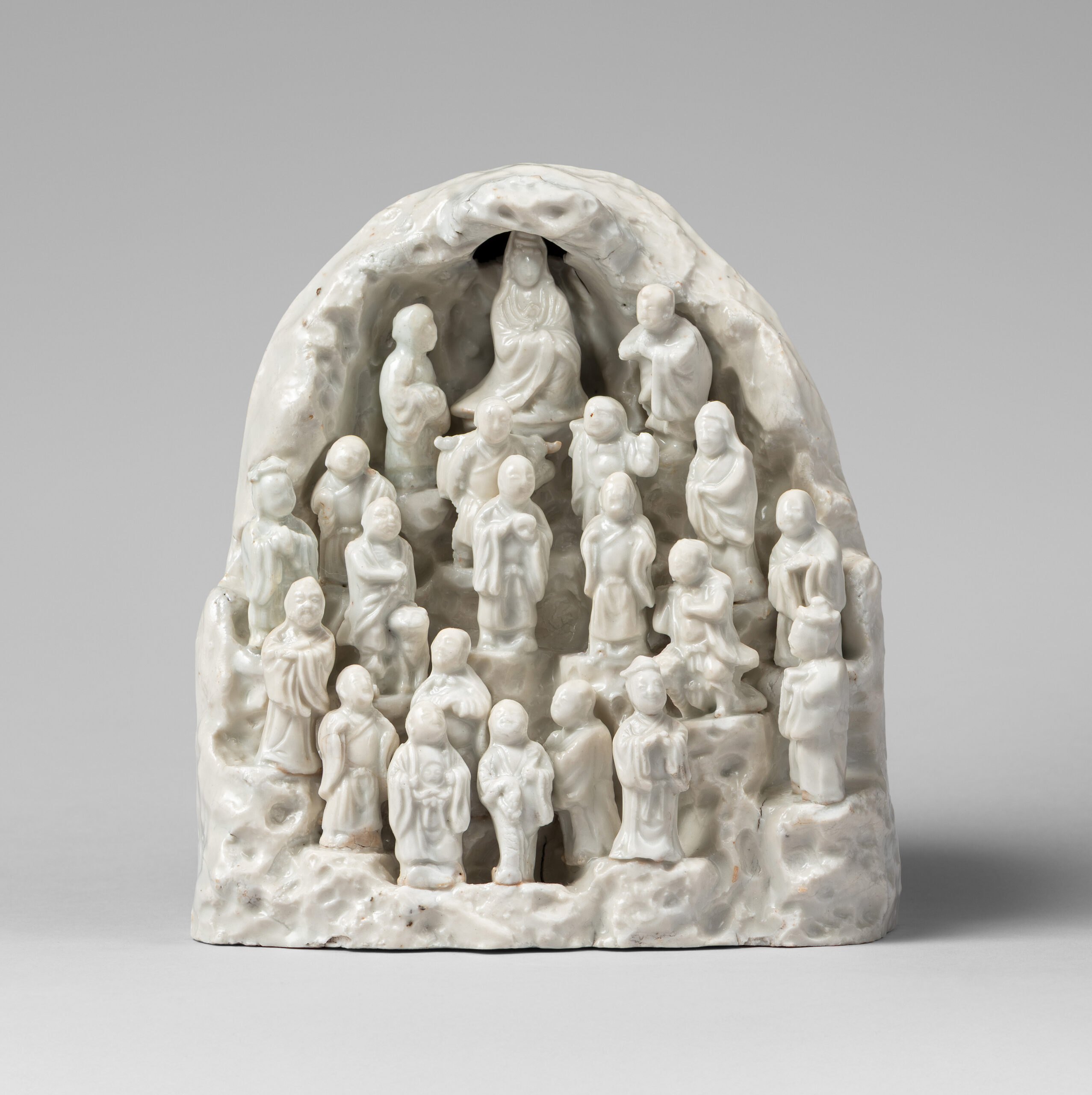
A rare Blanc de Chine Buddhist group depicting Mount Putuo. China, Kangxi

The composition is designed as a rocky niche, open at the front. The deeply hollowed interior is occupied by a dense assembly of small figures in high relief. These figures are arranged on several superimposed tiers and integrated into the inner wall. They wear long, flowing robes, rendered with soft, simplified folds. The sides of the niche are worked in irregular relief, evoking a rugged, rocky surface. The back is entirely solid, animated by continuous undulations. The base is flat yet uneven, showing minor firing imperfections and kiln-related irregularities. It is covered with the creamy white glaze with a slight blue tinge, distinctive to the Dehua kilns of Fujian province.

The sculpture depicts a Buddhist rockwork shrine in the form of a large grotto. At its centre is a seated Guanyin with her two standing attendants, Yunü (‘the Jade Maiden’), and Jintong (‘the Golden Youth’). They are surrounded by the Eighteen Luohans, most shown with their traditionalattributes, including Pindola with his tiger.

COUNTRY : China
TIME: Kangxi period (1662-1722), circa 1690
MATERIAL : Porcelain
SIZE : 22 cm
REFERENCE : E937
STATUS : vendu
Related works .

This sculpture is rare, with only a few comparable models known. Three were included by Marchant in their catalogue Blanc de Chine, 1994[1]; Blanc de Chine, 2006[2]; Blanc de Chine, 2014[3].

One group is preserved in the the Asian Civilisations Museum, Singapore[4]; and another is held by the Metropolitan Museum of Art, New York[5]. A further example is in the collection of the Landesmuseum[6], Zürich; while one more is recorded in a private Parisian collection.

[1] no. 13, p. 26

[2] no. 34, pp. 56–57

[3] No. 46, pp74/75

[4] Inv. 2015-00396

[5] Bequest of Josephine Bieber, 1973 ; 1973.155.6

[6] Inv.Nr. OP290

Additional information.

The Eighteen Luohans (Arhats) occupy a central place in Chinese Buddhist iconography, representingthe ideal of spiritual attainment through discipline and insight. Originally a group of sixteen enlightened disciples of the Buddha in the Indian tradition, the canon expanded to eighteen in China, reflecting the gradual sinicisation of Buddhism from the Tang period onward. Having achieved liberation from the cycle of rebirth, the Luohans are entrusted with the protection of the Buddhist Law until the advent of Maitreya, the Buddha of the Future. In Chinese art, they are depicted with highly individualised physiognomies, expressive gestures and distinctive attributes, emphasising their human presence and inner character. Often portrayed as aged, ascetic or even eccentric figures, they stand in deliberate contrast to the idealised serenity of Buddhas and Bodhisattvas. This combination of spiritual authority, psychological depth and visual diversity explains their enduring popularity in Chinese painting, sculpture and porcelain, from temple commissions to refined works intended for private devotion and contemplation. They are believed to reside on Mount Putuo, the legendary island home of the bodhisattva Guanyin, located off the coast of Zhejiang province.

The precise function of this sculpture invites speculation. It may have served as a portable shrine or as an object of domestic devotion, intended for placement in a private setting—such as a household altar or small oratory—or alternatively as a cultivated reception piece for a scholar’s studio. The grotto-like rocky form evokes a symbolic setting of withdrawal and meditation, while the multiplicity of figures provides a visual framework conducive to contemplation. Its purpose is both spiritual and representational: to recall a sacred assembly, to structure a space of prayer, and to accompany recitation and silent meditation, while quietly affirming personal piety and Buddhist learning.

Within the context of refined or affluent interiors, such pieces could also fulfil a role of discreet prestige, bearing witness simultaneously to devotion, aesthetic refinement and familiarity with religious iconography. They thus occupy a position at the intersection of private devotional object, contemplative sculpture and a work of connoisseurship.

Question about condition report

Question about condition report