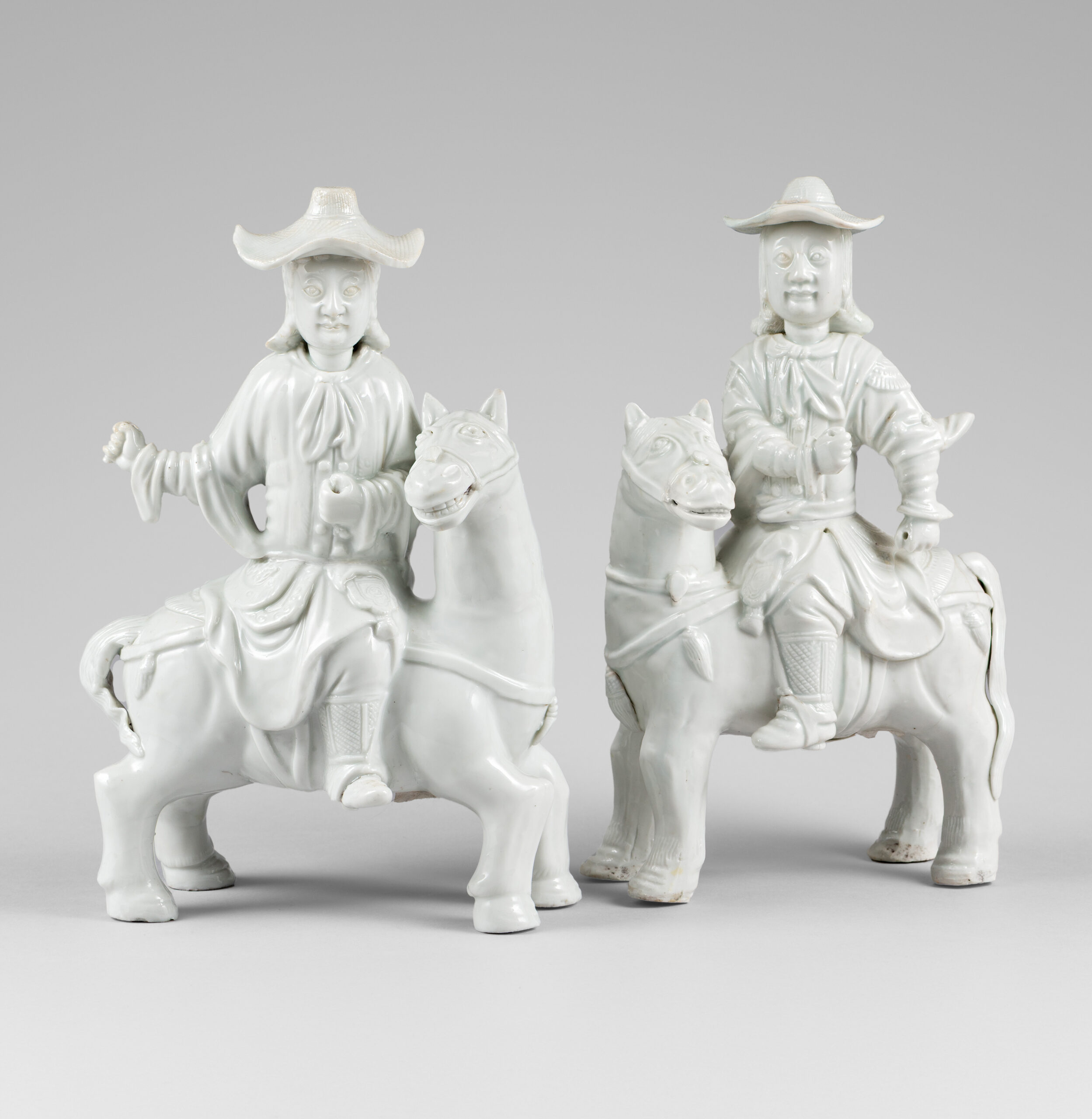
Two Blanc de Chine figures of Dutchmen on horseback. China, Kangxi

The two Dutch horsemen wear curled wigs and buttoned frock coats with wide turned-back sleeves. One figure is further distinguished by epaulettes. Both are depicted with knotted scarves, wide-brimmed hats, boots and gaiters, with a pistol holster at the waist. The horses are fully caparisoned with bridles, bits, and saddles. The riders and their mounts are depicted in complementary poses: one horse and rider turn to the right, while the other pair looks to the left. Each rider has one arm bent close to the chest, while the other is extended—to the left for the first figure, and downward for the second. Their clenched hands feature small apertures, probably intended to hold separate attributes such as reins or a sword, executed in a different material.
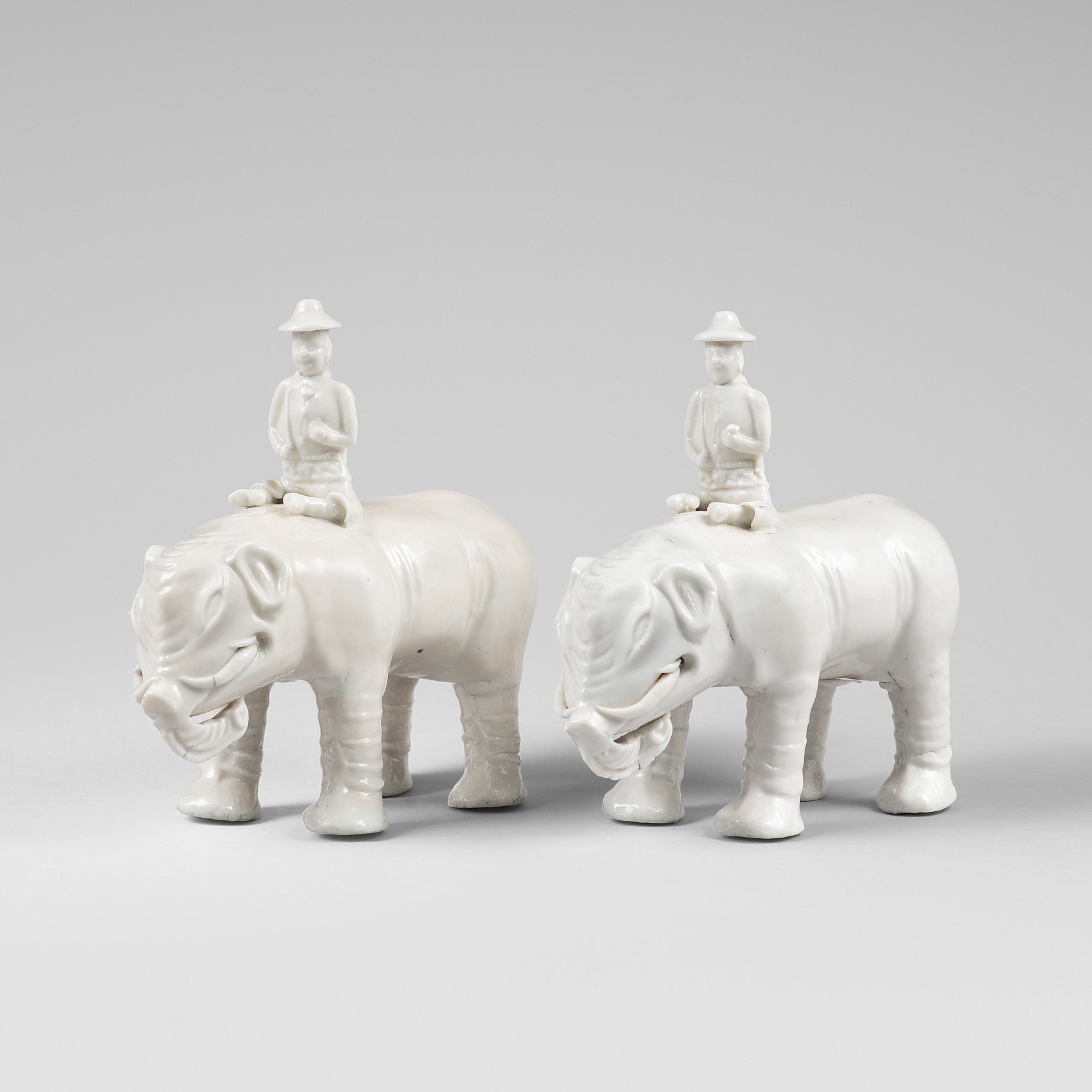
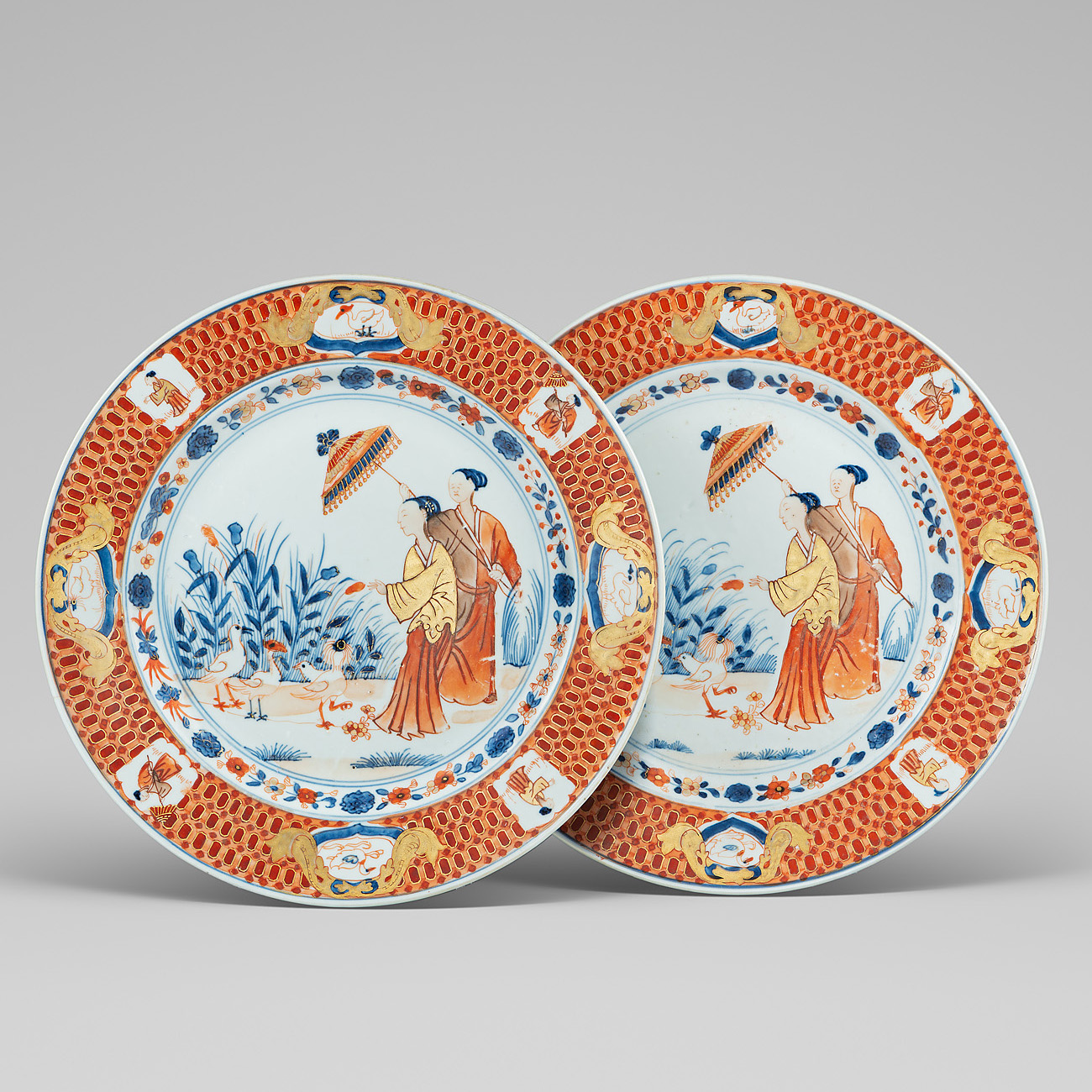
COUNTRY : China
TIME: Kangxi period (1662-1722)
MATERIAL : Porcelain
SIZE : 29,5 cm
REFERENCE : E761
PROVENANCE : New York, 2014
STATUS : vendu
Related works .

A closely comparable rider, depicted with its head turned to the right and decorated with red and black pigments, is held in the collections of the Staatliche Kunstsammlungen Dresden. It is recorded in the 1721 inventory and illustrated by P. J. Donnelly in Blanc de Chine[1]. Another rider, formerly in the Lucien Lelong collection, Paris, and subsequently in the Maret-Gould collection, Antibes, is reproduced in Michel Beurdeley and Guy Raindre, Qing Porcelain: Famille Verte, Famille Rose[2].

A further example is held in the Koger Collection at the the John and Mable Ringling Museum of Art, The State Museum of Florida, and is illustrated in John Ayers, Blanc de Chine: Divine Images in Porcelain[3]. A similar model is published by Marchant in their catalogue Blanc de Chine, 2014[4], while a closely related pair, with minor variations, appears in their catalogue, Blanc de Chine, 1994[5].

Another rider of the same model is illustrated by Jorge Welsh and Luisa Vinhais in Porcelain People: Figures of the Qing Dynasty[6]. A symmetrical pair is published by Marchant in their catalogue Blanc de Chine, 2006[7]. Of related interest is a rider of the same type, equipped with a sword and metal reins and corresponding to a later production, was sold by Alberto Santos.

[1] no. 116A

[2] no. 337, p. 244

[3] no. 59, p. 108

[4] no. 48, p. 78

[5] no. 33, p. 37

[6] no. 13, p. 84

[7] no. 46, p. 74

Additional information.

The representation of horsemen in ceramics is rooted in a long-standing Chinese tradition, with similar figures found in funerary contexts dating back as early as the seventh century. Equestrian motifs also appear on Ming dynasty tiles[1], while Guandi, the god of war, is frequently depicted on horseback, notably in groups from Dehua[2].

The originality of the present two equestrian figures lies in their depiction of Dutch horsemen. Smaller-scale groups were also produced, notably in the form of whistles[3]. This iconography of Dutch figures is closely related to other Dehua wares featuring Western characters. Two such examples—one representing a seated Dutchman with a monkey, the other depicting a seated figure flanked by musicians—are also included in the current catalogue.

[1] William R. Sargent, The Copeland Collection, 1991, p. 58

[2] John Ayers, Blanc de Chine: Divine Images in Porcelain, p. 96n no. 47

[3] William R. Sargent, The Copeland Collection, nos. 39–40 ; pp. 94–95

Question about condition report

Question about condition report