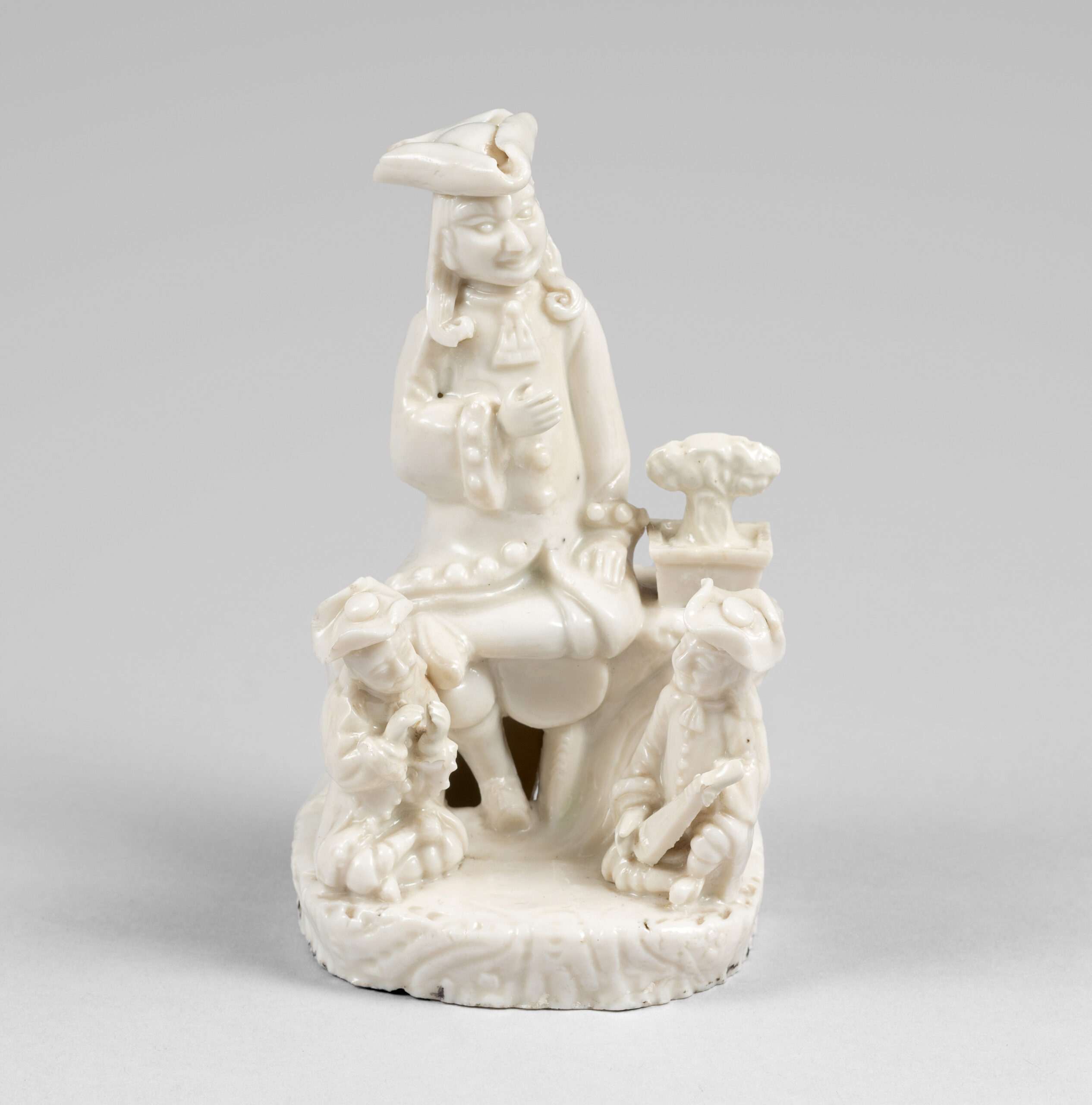
A Blanc de Chine group with European figures. China, Kangxi

This group depicts a Dutchman wearing a tricorne hat, seated between two children dressed as adults, in accordance with contemporary custom, and playing musical instruments. Resting on a small table beside them is a potted plant, or penjing—the Chinese art of creating miniature landscapes in a tray, which later gave rise to the Japanese bonsai.

COUNTRY : China (Dehua)
TIME: Kangxi (1662-1722)
MATERIAL : Porcelain
SIZE : 14 cm
REFERENCE : E761
PROVENANCE : -Reproduced in William Sargent, Porcelana China en la Colección Conde, 2014, p. 178
-Provenance : Gift from Khalil Riad Rizk, The Chinese Porcelain Company, New York, to Álvaro Conde
STATUS : vendu
Related works .

An identical group is preserved in the collection of the Porzellansammlung[1], Dresden. Other groups were formerly in the Leo & Doris Hodroff Collection[2] and in the Mottahedeh Collection[3].

Related groups are also in the Victoria and Albert Museum[4], in the Blumenfield Collection[5], in the Groningen Museum[6]. A pair of groups were formerly offered by S. Marchant & Son[7].

[1] Donnelly, Blanc de Chine: the porcelain of Têhua in Fukien, Faber, London, 1969, p. 119B

[2] David Howard in The Choice of the Private Trader. The Private Market in Chinese Export Porcelain illustrated from the Hodroff Collection, London, 1994, p. 249, no. 295

[3] David Howard, John Ayers, China for the West: Chinese Porcelain and Other Decorative Arts for Export Illustrated from the Mottahedeh Collection, London, Sotheby Parke Bernet, 1977, vol. I, p. 94, no. 56

[4] C.111-1963

[5] Blumenfield, BLANC de CHINE. The Great Porcelain of Dehua, Ten Speed Press, Berkeley, 2002, p. 77

[6] 1994/75

[7] S. Marchant & Son, Exhibition of BLANC DE CHINE, 1994, nos. 42 and 42a

Additional information.

The principal male figure is essentially identical to that found in all such so-called “Dutch family” groups, as they were described in ship registers of the period. The motif of a seated man with one leg crossed over the knee recurs consistently throughout these groups and may derive either from informal postures observed in daily life or from the tradition of the Buddha being depicted in this seated position. The child on the right holds a pipa, a traditional plucked string instrument comparable to the Western lute. In China, the pipa is one of the four accomplishments of the scholar, together with chess, literature, and painting. In early European shipping records, such figures were commonly described as “toys.”

Groups of this type were produced using press moulds, generally composed of two main sections per figure, with additional elements such as hats applied separately. This method of construction allowed for the rapid and efficient manufacture of numerous models, while also permitting a wide range of combinations. By assembling figures, workshops could create groups of various sizes, or produce individual figures intended as more easily marketable commodities.

Question about condition report

Question about condition report