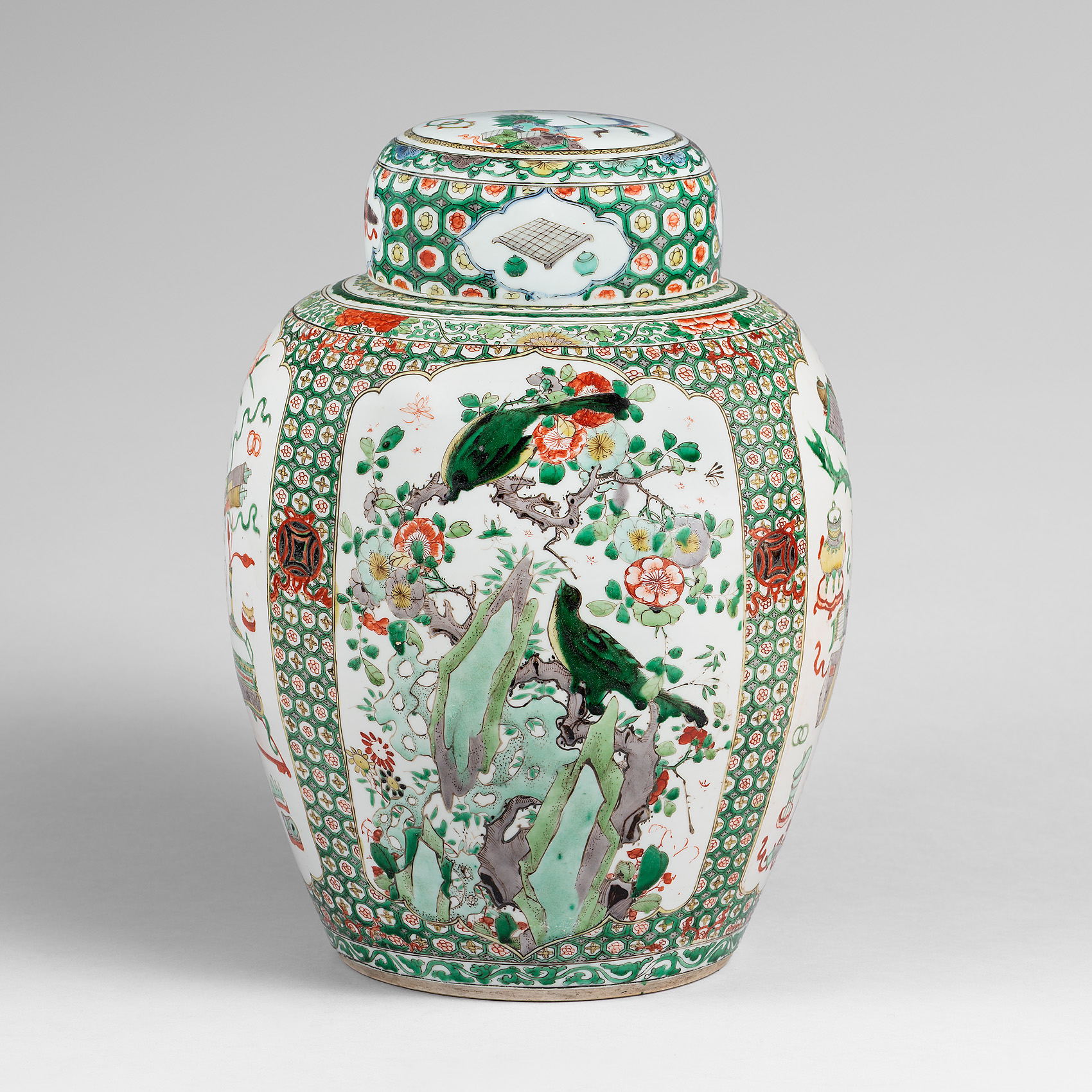
Additional information.The Hundred Antiques (Baigu 百古), sometimes also referred to as the Hundred Treasures, constitute one of the most celebrated decorative themes in Chinese art. Rather than depicting a precise set of one hundred objects, the motif brings together a rich assortment of auspicious and scholarly emblems drawn from Chinese culture. These include the Eight Precious Things (Babao), the Four Treasures of the Scholar’s Studio—brush, ink, paper and inkstone—as well as symbols associated with the Four Accomplishments of the Literati: music, chess, calligraphy and painting. The repertoire further incorporates archaic ritual bronzes, censers, vases, books, scrolls, musical instruments, flowers, fruits and auspicious animals. Closely associated with the world of the scholar and collector, the theme reflects the ideals of learning, refinement, antiquarian taste and moral cultivation that were central to elite Chinese society. During the Kangxi and Yongzheng periods, representations of the Hundred Antiques became particularly popular on porcelain, where they transformed the vessel into a symbolic evocation of the scholar’s studio and its cultured pursuits
The panels depicting magpies among blossoming prunus branches and pierced garden rocks allude to the rebus Xi shang mei shao (“Joy on the Plum Branch”), a popular Qing-dynasty auspicious motif conveying the arrival of good news, happiness and success. The scholar’s rocks further evoke longevity, refinement and the cultured world of the literati.
The Hundred Antiques panels celebrate the cultured world of the scholar, while the panels depicting magpies among blossoming prunus branches convey an auspicious message. Together, they form a coherent decorative programme intended to wish for success in study, social advancement, happiness and longevity.
The large ovoid jar and cover is one of the most characteristic forms of the Kangxi period (1662–1722). Derived from earlier Chinese storage vessels, it evolved during the Qing dynasty into an imposing decorative object intended for elite interiors. Its generous proportions provided an ideal surface for elaborate painted decoration, making it particularly popular for famille verte wares. Such jars were highly prized both in China and in Europe, where they were frequently displayed on cabinets, consoles or as part of porcelain garnitures. The covered form enhanced their prestige and visual presence within an interior. Together, the form and decoration evoke the cultured world of the scholar and the ideals of prosperity, learning and longevity so highly valued during the Qing dynasty.