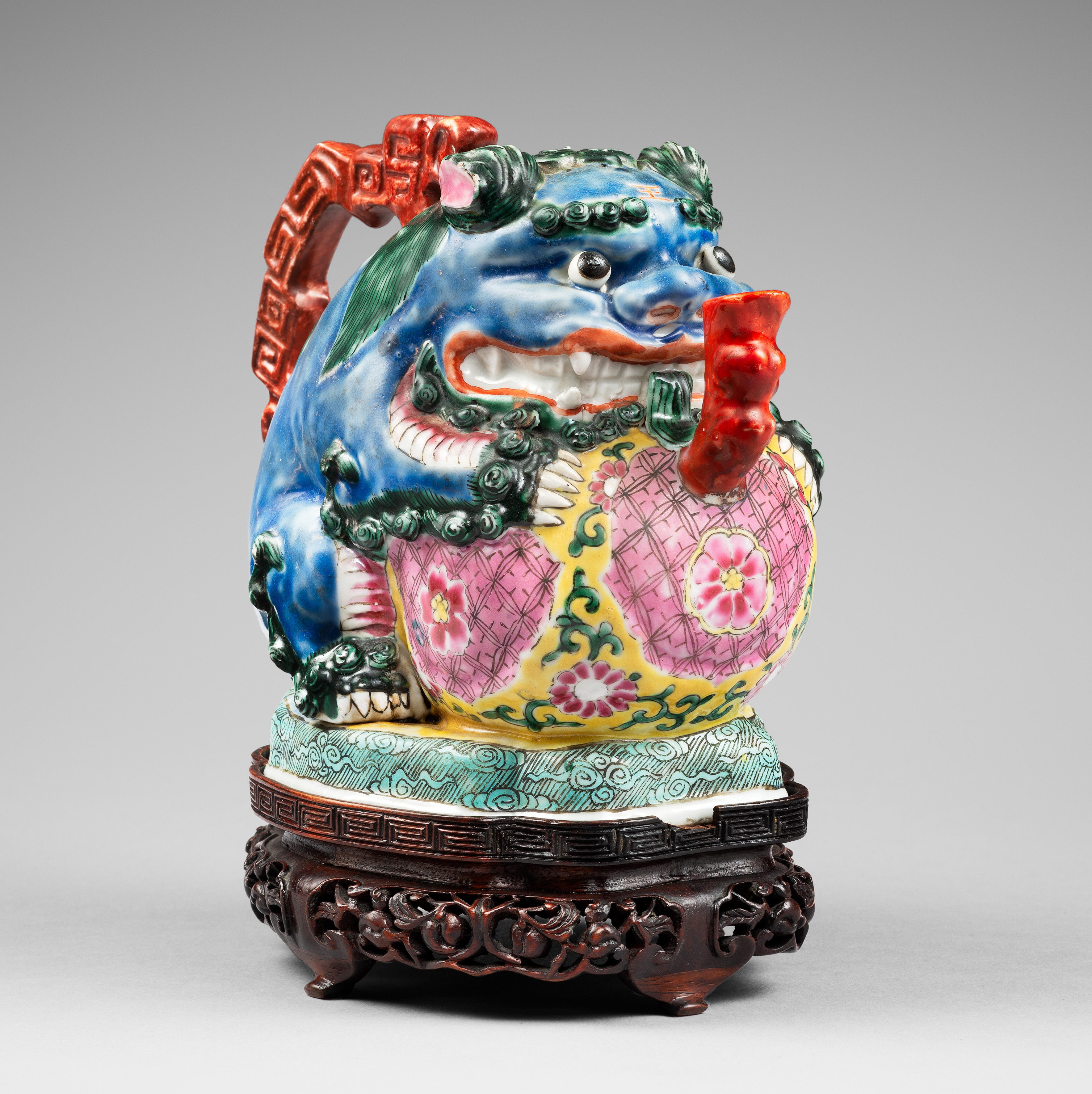
A famille rose Buddhistic lion-form Cadogan ewer. China, Qianlong

Amusingly modelled as Buddhistic lion holding a large brocade ball, the beast with blue body, green mane and iron-red handle emerging from its back, the brocade ball decorated with pink panels on a yellow ground, applied with a short iron-red spout. The lion is standing on a wooden base.
COUNTRY : China
TIME: Qianlong (1736-1795)
MATERIAL : Porcelain
SIZE : 18 cm
REFERENCE : F001
PROVENANCE : Jean Nicolier, Paris
STATUS : disponible
Related works .

A very similar cadogan ewer is in the collection of the Musée Sandelin, Saint-Omer, France.

Additional information.

The ‘Cadogan’ wine pot has no lid and is filled upside down through a hole in the base leading to a tube inside the pot which prevents a back flow. Known in China as ‘dao guan hu’ (‘upside down filling wine pot’), these ewers first appeared during the Kangxi period and were used for pouring wine or hot water rather than tea, as tealeaves would have been difficult to remove from the interior after use.

They were often made in the shape of a peach; a visual reference to the longevity of the Daoist Immortals, who were said to feast on the immortal peaches grown in the garden of Xiwangmu once every three thousand years. Alluding to the Immortals on a vessel for drinking wine could be a playful nod to the parody poem ‘Eight Immortals of the Wine Cup’ (Yingzhong baxian), written by the Tang poet and lover of wine Du Fu to celebrate eight Tang literary figures and their drinking habits.

This type of ewer, also called ‘puzzle pot’, is said to be named after William Cadogan, 1st Earl of Cadogan (1675-1726) who was the first to own a wine pot of this shape. He and his wife brought an example to Britain where they used it as an entertainment piece.

Question about condition report

Question about condition report