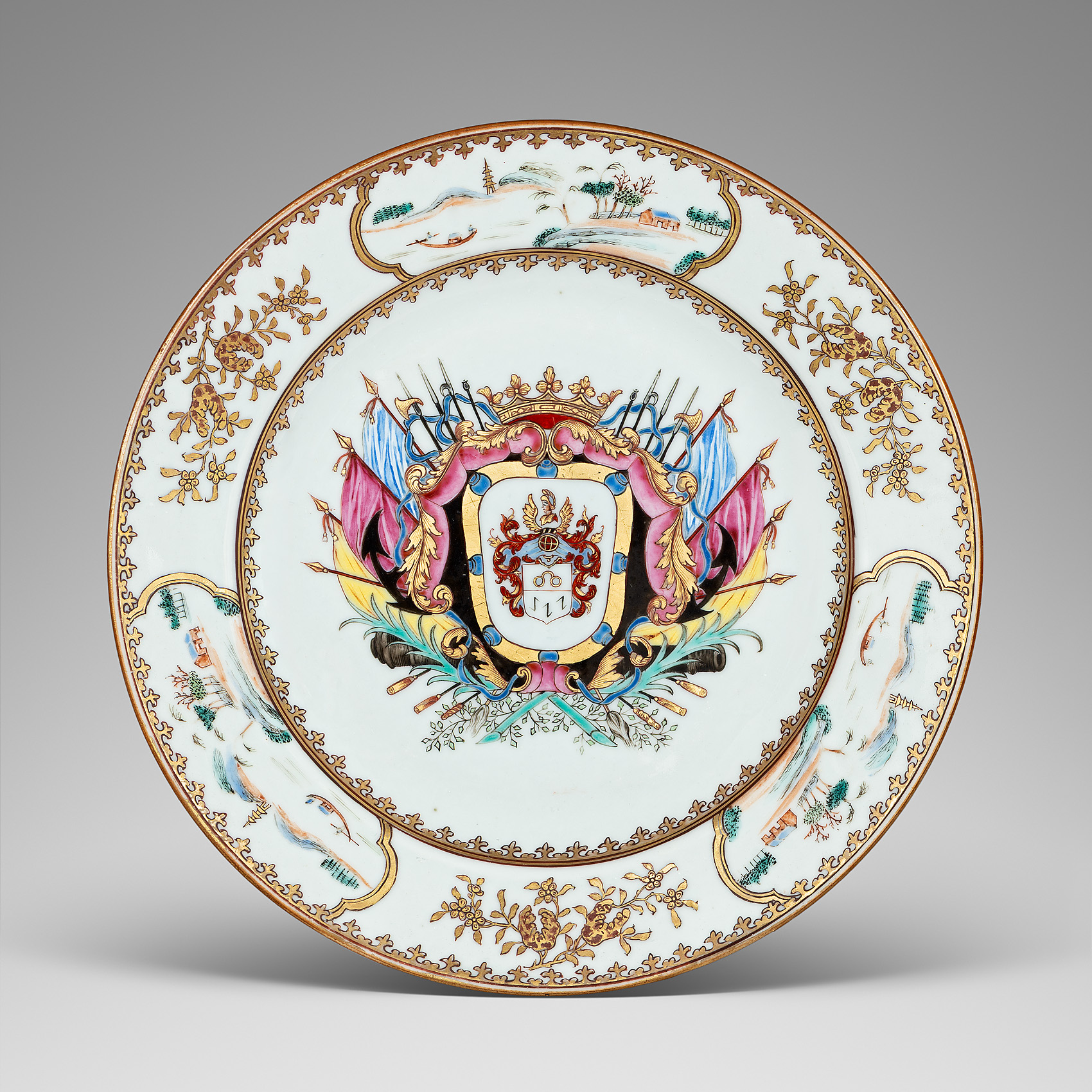
A Chinese armorial plate for the Dutch market (Ver Huell). Qianlong

The plate is decorated in the famille rose palette with a colourful, bold and large coat of arms in the centre of the plate in a trapezoid medallion, surrounded by an array of military banners and spears and is parted per fess, A. a gold pair of spectacles, B. three black cramps (two-one), the first tourné, the others contourné; the crest a bust with a Roman helmet between a pair of gold wings. The rich mantling has finely painted scrolls and volutes with three banners and spears on either side and below two pale green palm fronds, two green arrows, two cannons, several ribbons and green foliage. There are three large sprays of Buddha’s hand citron in gold and rouge de fer with three cartouches of Chinese mountain and water landscapes in grisaille, green and blue on the rim, with a spearhead border at the well and on the outer rim.

COUNTRY : China
TIME: Qianlong (1735-1795), circa 1745
MATERIAL : Porcelain
SIZE : 22,5 cm
REFERENCE : E957
PROVENANCE : From a private French collection
STATUS : disponible
Related works .

This order is illustrated by Dr. Jochem Kroes, Chinese Armorial Porcelain for the Dutch Market, The Hague, 2007, p. 224-5, no. 135.

Kroes also points out that the many of remaining pieces from this service are now in museums in The Netherlands, such as the Rijksmuseum (Christian J.A. Jörg, Chinese Ceramics in the collection of the Rijksmuseum, Amsterdam, 1997, p. 306-307), the Zeeuws Museum (two) and the Princessehof in Leeuwarden (two). A slightly larger plate is in the Musée de la Compagnie des Indes in Lorient, France.

A large dish from this service was in the Peter H. B. Frelinghuysen, Jr. Collection.

Additional information.

As early as 1923 this armorial was attributed to the Ver Huell family, a principal family of the town of Doetinchem in eastern Gelderland in the latter half of the 17th century, ennobled in the 19th century. It is notable that the armorial setting of banners and trophies was painted on two other services: the first with a quarterly coat of arms belonging to the Spanish D’Ensenada family and commissioned by a senior Spanish official, Zenon Somodevilla y Bengoechea (1701–1781), who became Marquis d’Ensenada in 1736. The second has a cipher instead of the armorial, with the letters ‘A’ and ‘C’ and others. One of these plates is in the East India Museum in Göteborg, Sweden, thus, the commissioner might have been a native of that country

But there are doubts as to the identification of this coat of arms. The Ver Huell arms differ from the porcelain. According to Lunsingh Scheurleer, the Chinese painter made an error and misinterpreted the rings as a pair of spectacles. However, this is unlikely, because at that time the Chinese painters were already accustomed to armorials. Moreover, Lunsingh Scheurleer dated this porcelain to the late 18th century which is also incorrect, because the style of both rim and armorial decoration dates to the mid-1740s. There were no military or naval officers within the Ver Huell family at that time; some joined the navy later, such as Carel Hendrik Ver Huell (1764–1845), vice-admiral under Napoleon, and Christiaan Anthonij Ver Huell (1760–1832) in the Dutch East Indies (1784–1785).

But there is another Dutch family who bore a coat of arms per fess with a pair of spectacles, although this is not an exact match either. It is the Brull family from ’s-Hertogenbosch and in Maastricht during the 18th century. They bore several armorials, one of them resembling this porcelain: parted per fess, A. on a red background a pair of silver spectacles with green glasses, B. on a blue background three gold stars, borne this way in 1639 by Mathijs Brull(e) as councillor of ’s-Hertogenbosch. His descendant Mattheus Brull, from 1708 until 1763 notary in Maastricht, bore arms with the spectacles in the lower part in 1752. Another member of this family was Jan Abraham Brull who was VOC assistant in the East Indies from 1739 and died in Ternate in 1750.

Question about condition report

Question about condition report