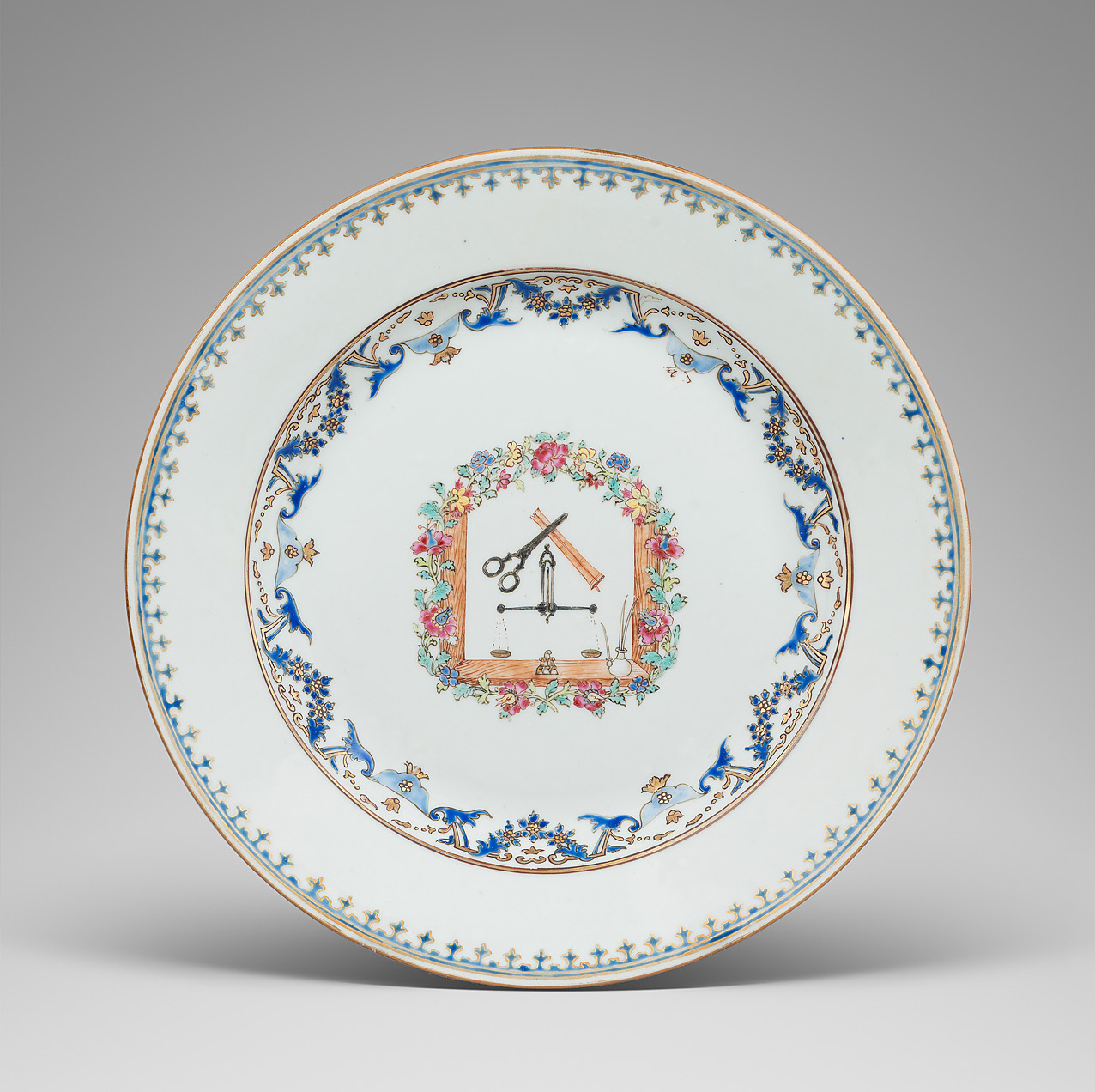
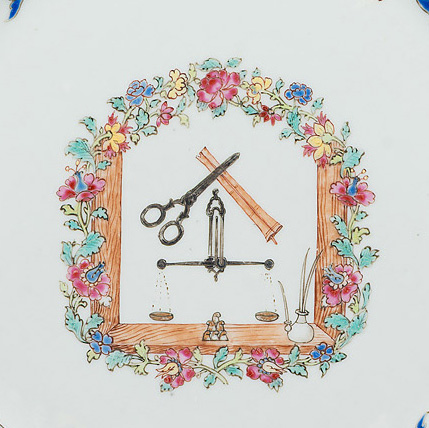
Additional information.The subject of this plate may be read as a visual shorthand for the China Trade itself. The “window sill” encloses scales, a stamp, shears, and a pile of scrapings to be assayed, all of which are emblems of the Chinese shroff, or money changer. In the eighteenth century Spanish silver dollars were the currency used for international trade, and this design commemorates this important element of world commerce. All silver coinage would be weighed and stamped by a money changer so that, over time, the coins would become defaced—“chopped dollars” or “cut money,” as William Hunter described them, following the Cantonese phraseology.
*Pieces of silver as well as dollars were shroffed and weighed before being deposited in the treasury. When that was done, the dollars no longer had a distinct existence. . . . There is no Government interference in the manufacture of these bars and shoes for purposes of trade. . . . The guarantee of their purity and value is simply the stamp of the Shroff.
The money changers of Canton (commonly known in English as shroffs, from the Arabic ṣarrāf, meaning “money changer”) played an essential role in the China trade during the eighteenth century. Yet, they have rarely been studied in detail. They were far more than simple money changers: they acted as bankers, experts in precious metals, assayers of coinage, and financial intermediaries.
Trade between China and the European powers relied almost entirely on payments in silver bullion. China exported far more goods than it imported and required payment in silver. When the ships of the East India Companies arrived at Canton, they brought Spanish dollars (pieces of eight), Mexican dollars, silver ingots and, more occasionally, gold. These precious metals could not be used directly. The shroffs were responsible for authenticating the coins, testing their fineness, weighing them, converting them into Chinese silver in the form of sycee (yuanbao 元宝), and making payments to the Chinese merchants.
At that time, China did not use a uniform fiduciary currency. Its economy relied on a dual monetary system: copper cash coins were used for everyday transactions, while larger payments were made in silver by weight. Shroffs therefore used highly precise balances, standardised weights, touchstones and, occasionally, small scissors to cut a fragment of metal for testing. They routinely examined the weight, purity and any alterations of the coins, and regularly rejected foreign currency considered to be of insufficient fineness
Europeans almost invariably referred to them as shroffs. Every major Chinese trading house (hong) employed several of them, reflecting the confidence placed in their expertise. Their certification was often sufficient to validate a payment. When the East India Companies purchased tea, silk or porcelain, the sums involved were immense. European merchants entrusted their chests of silver to the shroffs, who opened them, examined each batch, verified the coins and recalculated the entire payment, a process that could take several days.
Shroffs earned commissions on currency exchange, weighing and, in some cases, on the refining of precious metals. They became powerful financial figures, and some families amassed considerable fortunes. The famous Cohong merchants relied heavily upon their services. By overseeing the circulation of silver, settling debts and providing advances of credit, they fulfilled functions comparable to those of private bankers.
Contrary to common belief, gold played only a limited role in the China trade. Silver remained the principal medium of exchange, while gold was mainly reserved for the largest transactions, certain stores of wealth and the production of luxury goldwork. Shroffs therefore occupied a central position in the commercial system of Canton. They also contributed indirectly to the development of Chinese export porcelain, which transformed European silver into Chinese goods and ultimately into profit. Without their expertise, commercial transactions between the European East India Companies and the merchants of Canton would have been far more difficult.
It is important to distinguish between two groups that are often confused: the shroffs, specialists responsible for handling, assaying, weighing and converting precious metals, and the hong merchants of the Cohong, the only Chinese merchants officially authorised to trade with Europeans. The best-known names, such as Puankhequa, Houqua and Tan Suqua, all belonged to the latter group.
Unlike the Cohong merchants, the shroffs left very few personal records. Their role was essentially technical: they examined coins, tested the fineness of precious metals, carried out official weighings, and acted as private bankers and money lenders. The journals of the English, French and Dutch East India Companies mention them frequently, but almost always simply as the shroff, our shroff or the Hong shroff, rarely recording their personal names.
Every major trading house employed its own shroffs. When a European ship arrived at Canton carrying hundreds of thousands of Spanish dollars, they opened the chests, weighed each batch of coins, tested their fineness, estimated losses caused by wear, and calculated their actual value. It was a highly specialised profession.
No great dynasties of shroffs comparable to the merchant families are known today. By contrast, the principal Cohong families—including the Pan 潘, Tan 陳, Ye 葉, Liang 梁, Zhang 張 and Yan 顏 families—almost certainly employed successive generations of shroffs, although these men remained largely anonymous in the surviving records.
The shroff was not a merchant but a financial officer whose authority rested upon his reputation for honesty and expertise. European traders sometimes entrusted him with silver worth several million livres tournois, making his responsibilities immense, since an error of only a few tenths of a gram on each Spanish dollar could amount to a considerable fortune. European travellers consistently praised their remarkable speed in calculation, exceptional accuracy, ability to detect counterfeit coins instantly, and unrivalled expertise in assessing the fineness of silver.