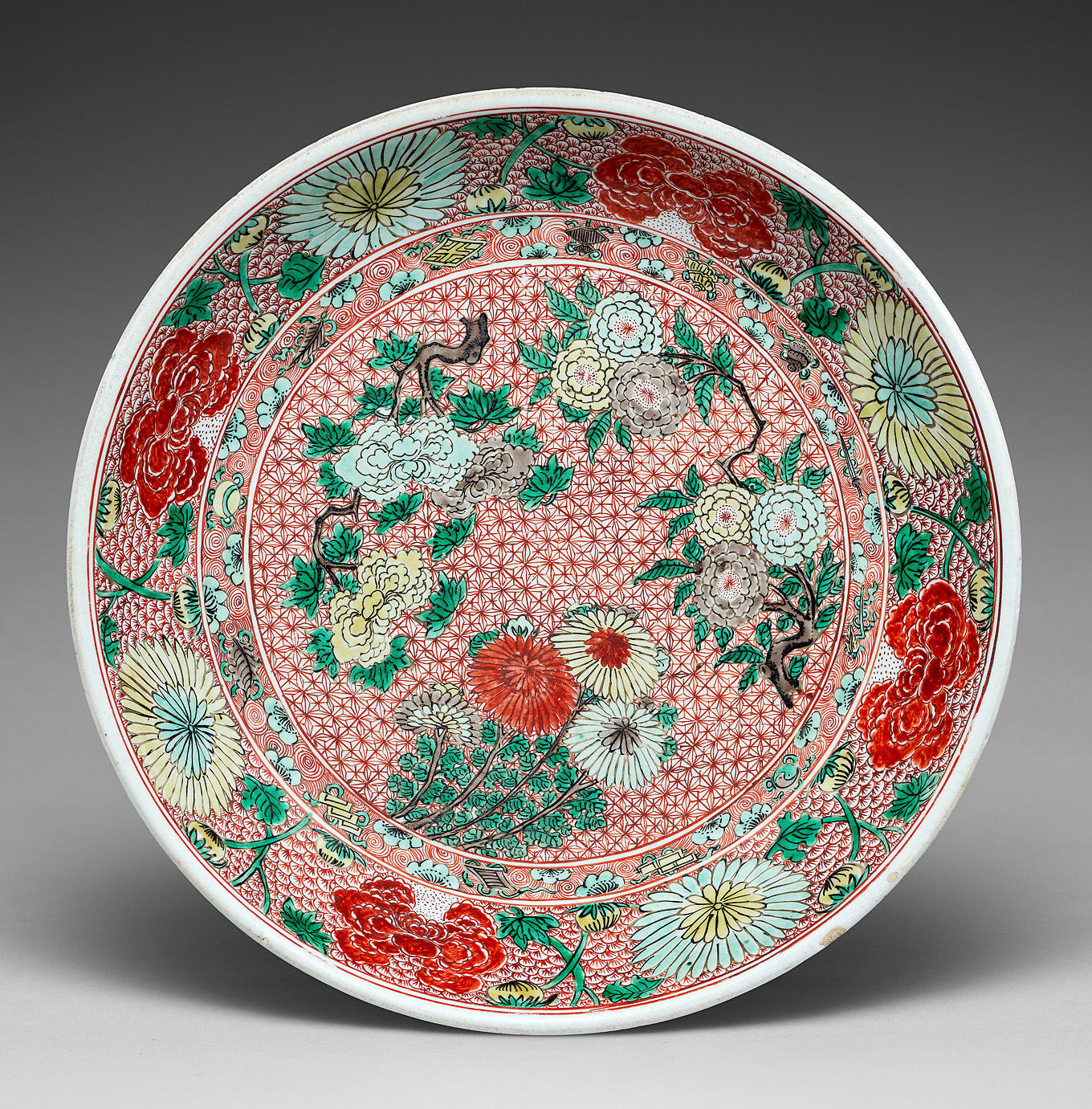
A fine famille verte saucer-dish decorated with flowers. China, Mid 17th century

The large circular dish, with a broad, gently flaring rim, rests on a short circular foot. It is entirely decorated in the famille verte palette against a finely executed red diaper ground. The central medallion is painted with three floral species, comprising peonies, chrysanthemums and camellias, reserved against a geometric red diaper ground. It is encircled by a band of scrolling foliage, stylised chi clouds and auspicious emblems (babao). The broad rim is decorated with an alternating arrangement of large flowering peonies and chrysanthemums, linked by leafy scrolling stems reserved against the same red diaper ground. The composition is enriched with abundant vegetal ornament and punctuated by reserves enclosing the Eight Buddhist Treasures.

COUNTRY : China
TIME: Mid 17th century, Shunzi (1644-1661) / early Kangxi (1662-1722)
MATERIAL : Porcelain
SIZE : 33 cm
REFERENCE : F019
PROVENANCE : Duchange Garmigny, 19 rue de Beaune, Paris
STATUS : vendu
Related works .

Canepa, Teresa & Butler, Katharine, Leaping the Dragon Gate. The Sir Michael Butler Collection of Seventeenth-Century Chinese Porcelain, London, Ad Ilissum, 2021

Butler, Michael, Curtis, Julia B., and Little, Stephen, Treasures from an Unknown Reign: Shunzhi Porcelain 1644–1661, Alexandria, VA, Art Services International; Seattle and London, University of Washington Press, 2002.

Additional information.

The combination of peonies, chrysanthemums and camellias brings together three of the most highly esteemed flowers in the Chinese decorative repertoire. This composition forms a particularly auspicious assemblage of symbolic motifs. The peony (mudan 牡丹), revered as the “Queen of Flowers”, symbolises wealth, honour and high social status (fugui 富贵). The chrysanthemum (ju 菊), emblematic of autumn and closely associated with the reclusive scholar, represents longevity, perseverance and moral integrity. The camellia (shanchahua 山茶花), which blooms in late winter, is associated with elegance, harmony and happiness. Together, these three flowers convey the wish for a prosperous, honourable and enduring life, marked by virtue, abundance and fulfilment. Their successive flowering, extending from late winter to autumn, may also be understood as an evocation of the cycle of the seasons and the continuity of blessings throughout the year.

Question about condition report

Question about condition report