The cup decorated with the coat of arms of the Le Loup de la Billais, De gueules, à deux fasces d’argent, chargées, une de trois étoiles de sable (ici d’azur), la deuxième de deux étoiles de sable (ici d’azur).

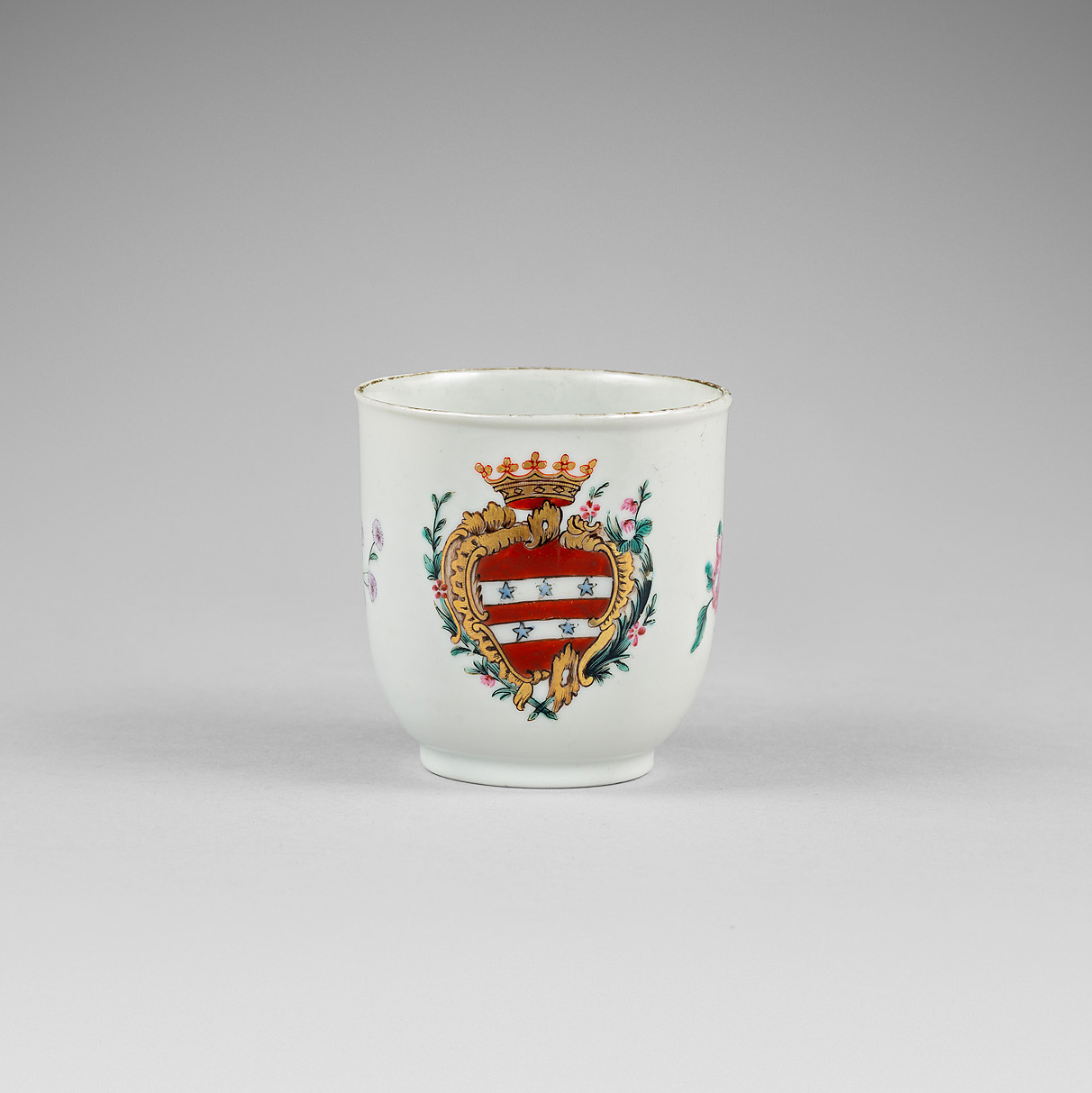
The cup decorated with the coat of arms of the Le Loup de la Billais, De gueules, à deux fasces d’argent, chargées, une de trois étoiles de sable (ici d’azur), la deuxième de deux étoiles de sable (ici d’azur).
An identical cup is in the collections of the Château des Ducs de Bretagne in Nantes (France).
This tea service was commissioned by Louis-Antoine Le Loup (or Le Lou) de la Billais, born in Nantes in 1733 and deceased in the same city in 1794. He was a counsellor at the Parliament of Brittany. When privileges were abolished during the night of 4 August 1789, at the instigation of the Breton Club of Paris — later known as the Jacobins Club — the private laws of Brittany disappeared, along with its Parliament and all related offices. Monsieur Le Loup de la Billais retired to his estate near Saint-Étienne-de-Montluc.
From 13 September 1791, he became the target of harassment by the municipal authorities of Saint-Étienne-de-Montluc, “because masses celebrated by refractory priests have become the occasion for large gatherings of five to six hundred people, representing a threat to public order. Masses must only be celebrated in private chapels. The priests involved — Abbés Auffray, Blanchet, Bizeul, and Urien — are required to withdraw to Nantes, otherwise they will be taken there by armed force.
Despite numerous vexations which he bore with courage, Louis-Antoine Le Loup de la Billais was denounced to the National Guard of Savenay on Thursday, 28 November 1793: informers claimed to have seen, in the darkness, a priest entering the Château de la Billais. Around eleven o’clock, soldiers arrived, searched the house, found nothing at first, then discovered in the pavilion — the one on the left in the image — a portfolio containing religious papers and “symbols of fanaticism and superstition” (images of the Sacred Heart). Summoned to reveal the priest’s identity, Monsieur de la Billais refused. He, his wife, and their two daughters were arrested, bound, and taken to the communal house — the former presbytery — where reigned Jourdan, an apostate priest, informer, and enemy of the Le Loup family.
Louis-Antoine was imprisoned in the Saintes-Claires (opposite Nantes City Hall) and was guillotined on the orders of Jean-Baptiste Carrier on 17 January 1794. His wife and their two daughters were confined in the Bon Pasteur (now the presbytery of Saint-Nicolas Church in Nantes). They were “tried” at the Hôtel de Bellisle and guillotined on 7 March 1794.
He was the son of Louis-Antoine Le Loup (1696–1763), knight, lord of La Billais, and Marie Berthrand de Coeuvres. He married in 1761 Anne-Claire Cottineau de la Cassemichère (1745–1794). The couple had six children — two daughters and four sons — three of whom emigrated. The fourth, Jean-François, hid during the search of the house along with Abbé Camaret, who had taken refuge there.
The Le Lou (or Le Loup) family, now extinct, was originally from Brittany. It first became known in the 16th century through its activities in international trade, and later held important civic offices such as master of accounts and mayor of Nantes.