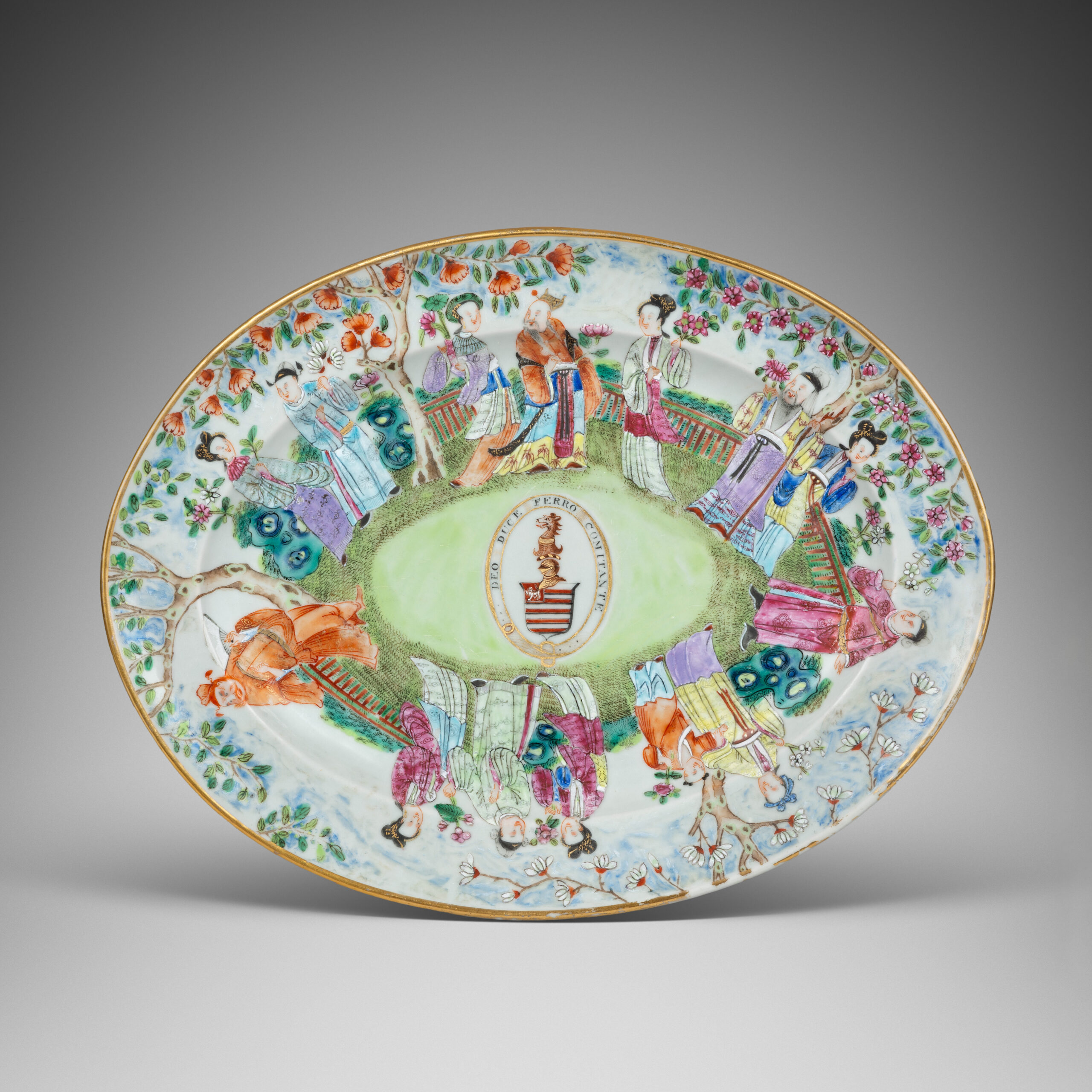
Additonal informations :
The arms are as borne by Caulfeild, Viscounts Charlemont, descended from Sir Toby Caulfeild, born near Oxford in 1565. A successful soldier in Ireland, he was knighted in 1603 after settling there, and was appointed to the Council of Munster in 1615, being created Baron Charlemont in 1620. The 5th Baron was advanced to the Viscounty of Charlemont in 1665, and from the 2nd Viscount descend a number of cadet lines, any of which could, in theory, have ordered this service in the 19th Century.
According to Angela Howard, this service may have been commissioned for James Caulfeild (1782–1852), the younger brother of Commander Thomas Caulfeild—who himself ordered a service around 1802. James Caulfeild served in Bengal with the East India Company’s military establishment continuously from 1799 until 1841. He was the son of the Venerable John Caulfeild, Archdeacon of Kilmore, County Cavan, and the grandson of the Hon. Toby Caulfeild, younger son of William Caulfeild, 1st Viscount Charlemont. His mother was Euphemia Gordon.
In 1819, Caulfeild was appointed First Assistant to the British Resident at Indore, after which he pursued a distinguished career in the East India Company’s Political Service. He served as Political Agent in Haraoti (the territories of Bundi and Kotah in the Rajputana Agency) from 1822 to 1832, was Superintendent to the Mysore Princes in 1836, and became Resident at Lucknow in 1839. Alongside his political appointments, his military rank advanced by seniority: Captain in 1818, Major in 1823, Lieutenant-Colonel in 1829, and Brevet Colonel in 1834; he was made a Companion of the Bath (CB) in 1831. That same year, he published Observations on our Indian Administration, Civil and Military (Calcutta, 1831). Caulfeild left India on furlough in 1841, never to return. Promoted Major-General in 1841 and Lieutenant-General in 1851, he served as Director of the East India Company between 1848 and 1851. He unsuccessfully contested the parliamentary seat of Abingdon in 1845 and 1847, before being elected in July 1852. His career in Parliament was brief, however, as he died at Copsewood on 4 November 1852.
After the death of his first wife, he married secondly, around 1826, Anne Rachel Blake, who was born in Lucknow and was the daughter of another Indian Army officer—an occasion that may have prompted the commissioning of this service.
Rather than reflecting heraldic traditions, the design of many nineteenth-century services with so-called ‘mandarin’ decoration indicates that they were intended for officers residing or serving in India, with orders placed directly from there rather than through Britain. By around 1800, Chinese imports were subject to prohibitive tariffs of up to 109%, imposed to protect English manufactories such as Wedgwood and Worcester. As a result, a growing number of services were produced domestically rather than imported, as this proved both less costly and more expeditious. The trade embargoes associated with the Napoleonic wars further curtailed imports. For those resident in India, however, it remained far easier—and free from such duties—to continue ordering directly from China.
Two other services are known bearing the arms of Caulfeild.
The first, dating to around 1785, is decorated with an earl’s coronet and the Chain of St Patrick, and was made for James Caulfeild, who succeeded his father as 4th Viscount Charlemont and was created an earl in 1763.
The second, dating to circa 1802, bears the arms of Caulfeild impaling Talbot, made for Commander Thomas Caulfeild, RN, who in that year married Theodosia Talbot. His father, John Caulfeild, Archdeacon of Kilmore, was a second cousin of James, 1st Earl of Charlemont, making James and Thomas ‘second cousins once removed’. The shield of arms for both James and Thomas is identical, including the same motto, although the service for James displays a coronet rather than a crest, with supporters.
Elements of both the 1802 and 1825 services (though not of the 1785 service) descended together in the same branch of the family and, according to Howard (Chinese Armorial Porcelain, vol. II, p. 676), remained united into the twentieth century.