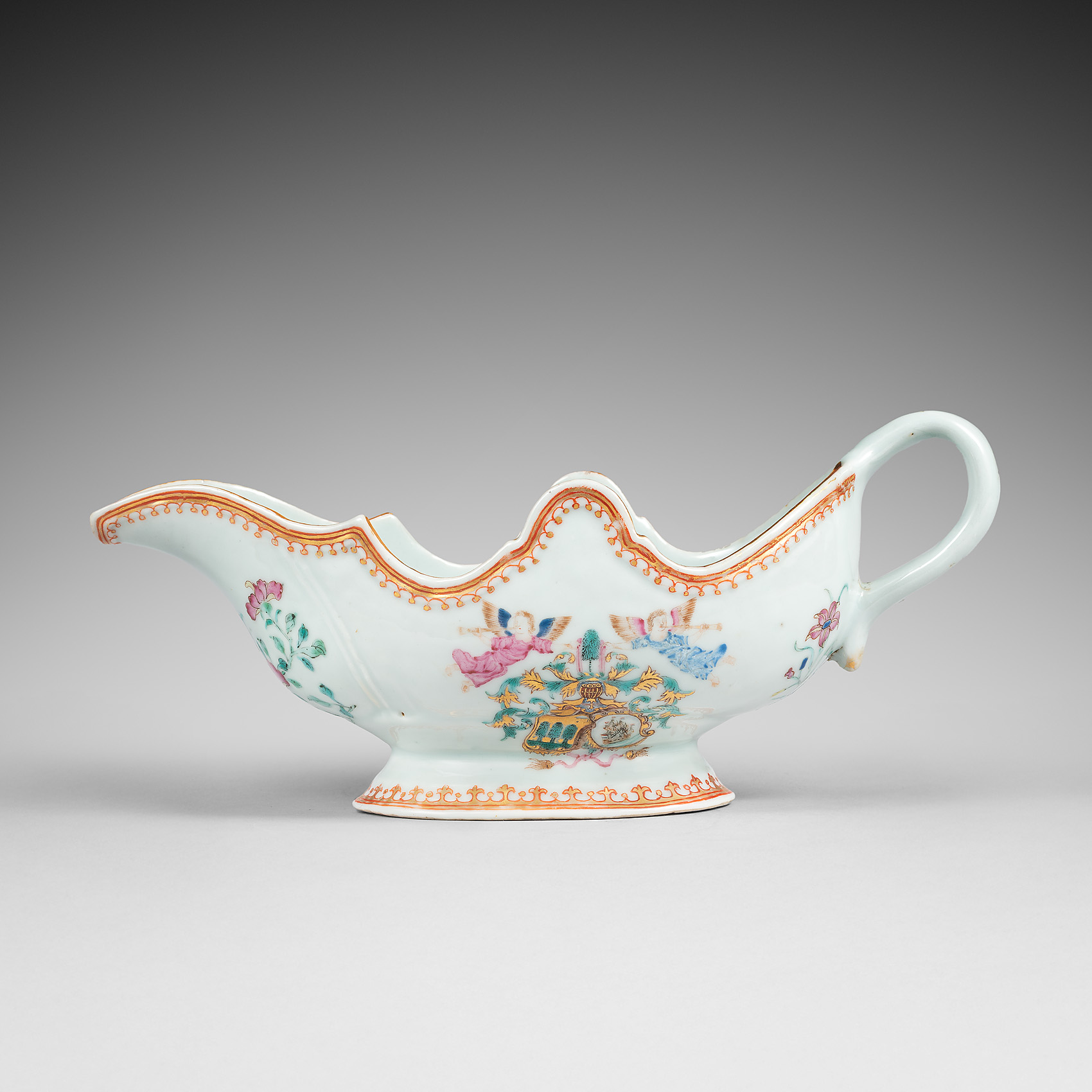
Additonal informations :It is interesting to note that there is a second Chinese work depicting this coat of arms accollé in exactly the same way: an oblong ivory plaque with indented corners that must have been made in the same period about 1756–1757.
The dexter arms are those of Rijzik borne by the ship’s captain Jacob Rijzik as shown on a drawing of 1760, with three withered trees or rijsjes (twigs) on a base, punning on his name. It was probably a personal coat of arms which Jacob made up himself. The sinister arms are those of Anna Schippers, Jacob Rijzik’s wife. As shown on a seal of 1785 the Schippers arms are: on a blue background a single-masted vessel with two sails and a flag at the top of the mast, borne this way by the Middelburg notary Adriaan Schippers.
This armorial service and the ivory plaque were made for Jacobus Rijzik (1723–after 1787) and Anna Schippers (died before October 1792) and the order must have been placed in the period between the summer of 1756 and the second half of 1757 when Jacob Rijzik was in Canton as a ship’s captain. Not much is known about his ancestors. He came from Brielle where he lived again from the 1770s with his wife. His family name (spelled variously Rijsick, Rijsik, Rijzik or Reijsik) was not a common one in the Netherlands. As mentioned above, it is derived from the word rijs which means twig and is possibly a corruption of Rijswijk, a village near The Hague.
Jacob Rijzik served the VOC Chamber Zeeland from 1741 making at least eight voyages to the Orient. He started in the position of quartermaster on the East Indiaman Eendracht in 1741–1742 being promoted second mate (Spanderswoud 1745–1746), first mate (Prinses Carolina 1749, Torenvliet 1752–1753) and master on the Barbara Theodora which left Zeeland on 13 August 1755 and arrived at Batavia on 27 May 1756. Shortly after he went to Canton as master of the East Indiaman Vrijburg, arriving in China during the course of the summer of 1756. The first mate on the ship was Christiaan Schooneman who died in Batavia on 13 November 1756, which means that soon after its arrival in Canton, the Vrijburg must have returned to Batavia again. The next year, in 1757, Rijzik was in Canton once more as the master of the Vrijburg and would have had more time to place his orders for personalized porcelain and other works of art. The Vrijburg and its crew left Canton on 12 December 1757, arriving at the Cape in April 1758 and at Rammekens in Zeeland on 8 September 1758.
During his first stay in Canton in 1756 Jacob Rijzik also ordered a set of plates painted with an attractive and finely detailed depiction of the East Indiaman Vrijburg with Dutch flags in the centre, on the rim a narrow band of fine pink enamels, scrollwork and a spearhead border at the well. There are two varieties: most of the plates show a ship sailing to the left or sinister side and some are sailing in the opposite direction. On the upper rim of all plates there is a green cartouche with a coronet above and with the inscription: ‘T: S: CHIP: VRIJBURG GEVOERT: DOOR CAPITEIN JAKOB RIJZIK IN CHINA: INT JAAR: 1756.’ (the ship Vrijburg mastered by captain Jacob Rijzik in China in the year 1756)
In 1758 Jacob Rijzik was appointed captain of the Admiralty of Zeeland serving both the VOC and the Admiralty at the same time and after that he made several more voyages to the Indies. From 1769 he stayed in the Cape Colony serving as equipagemeester or boatswain and his wife Anna Schippers joined him there, arriving in April 1767 as a passenger of the East Indiaman Azia. They probably returned home in or soon after 1770 and settled permanently in Brielle where Jacob was appointed alderman in 1779. He probably still lived there in February 1787 but is known to have predeceased his wife, who died in October 1792.
Jacob Rijzik married Anna Schippers before 1749.They had no children. Until 1766 they lived in Middelburg (Molenwater 1760–1762, Koornmarkt 1763–1766) and after their return from the Cape Colony about 1770 they moved to Brielle living in grand style. After Jacob’s years in the East Indies he had become very wealthy, his house being richly furnished with many Asiatic works of art. After Anna’s death in 1792 her estate was put up for auction comprising gold, silver, jewellery, Asian porcelain (oude blaauwe en gecouleurde porceleynen), Asian lacquer, Asian textiles such as satin and chintz (Satijne Chinese Spreijen, Chitse Spreijen en Dekens, diverse stukken Oost-Indische Chitzen…), as well as mahogany cabinets, a long-case clock with a musical box (een staand horloge spelende verscheide Airjes), all kinds of other furniture belonging to a very fashionable household (en ’t geene verder tot een zeer deftige en zindelyke Inboedel behoord) and finally four coaches. After 1792 the Rijzik name was no longer recorded in Brielle.