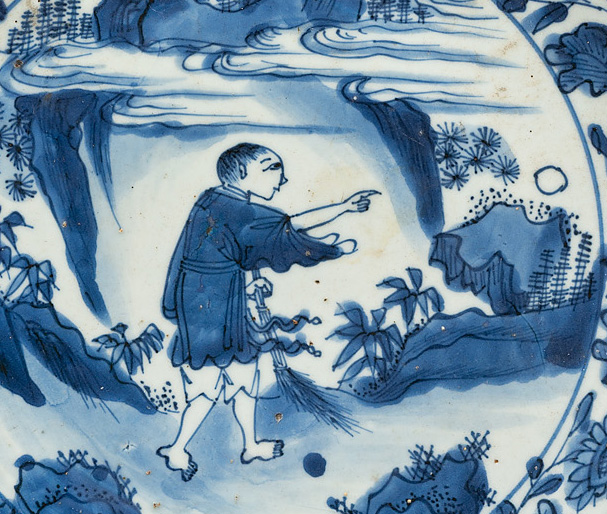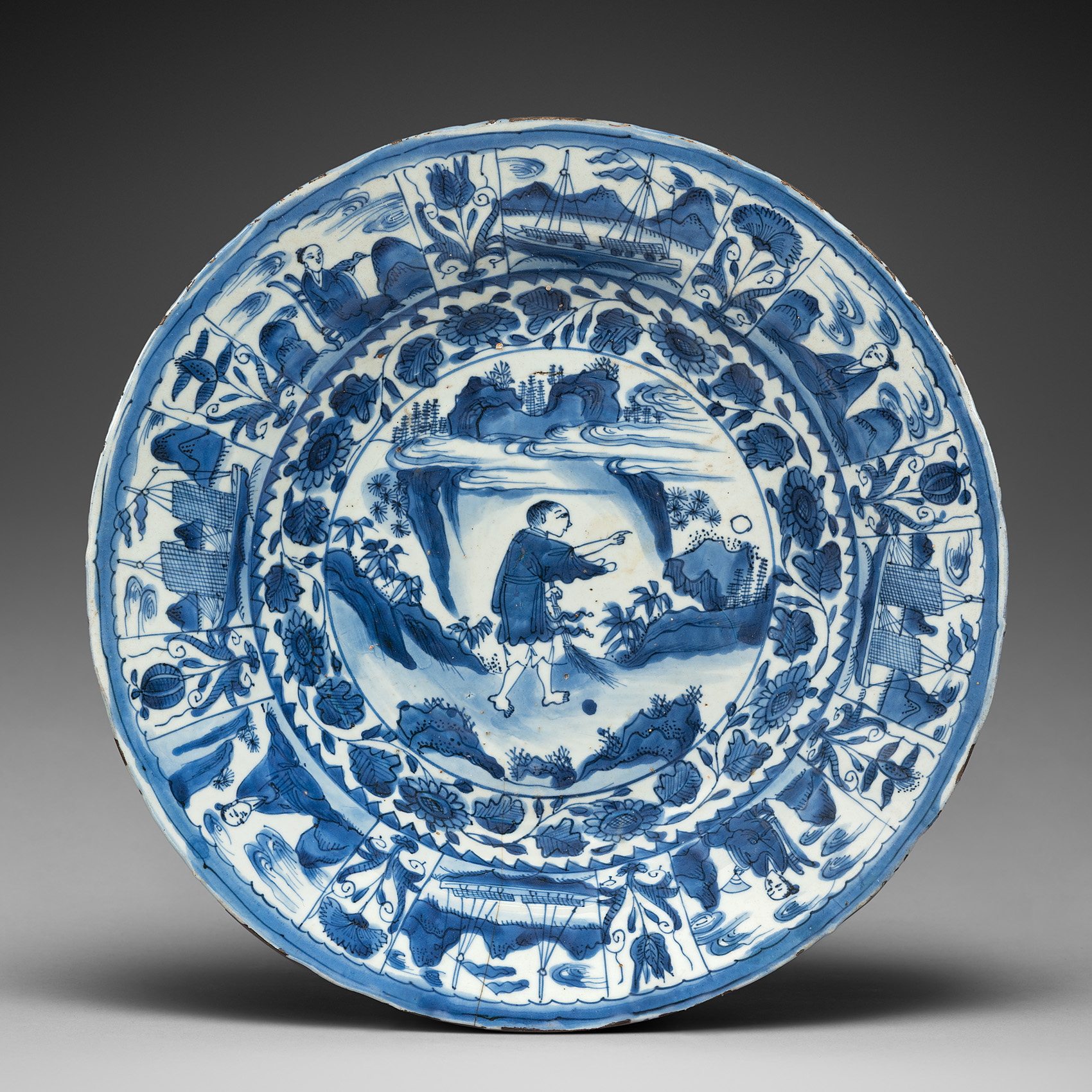
At the center of the medallion stands a barefoot Buddhist monk, holding a straw whisk (fuchen, 拂塵) in his left hand. With his right hand, he gestures toward a white disc in the sky — the moon — while a second, darker disc lies at his feet. This second disc represents the moon’s reflection on the ground. The monk’s gaze is directed toward the moon itself. Behind him, rugged rocks in a mountainous landscape form a natural arch above his head, pierced by stylized clouds. At the base of the medallion, a few twisted pines and aquatic flowers — including lotuses — grow along the shore. The entire scene is painted in a cobalt-blue monochrome on a white ground, with spontaneous brushwork and tonal shading typical of the Transitional style.
Encircling the central scene is a frieze of stylized lotuses — fully opened eight-petalled blooms with their leaves — framed by a scrolling border. The rim of the dish is divided into alternating panels featuring junks, paired figures in mutual regard, and vegetal motifs, including flowers reminiscent of Iznik designs.