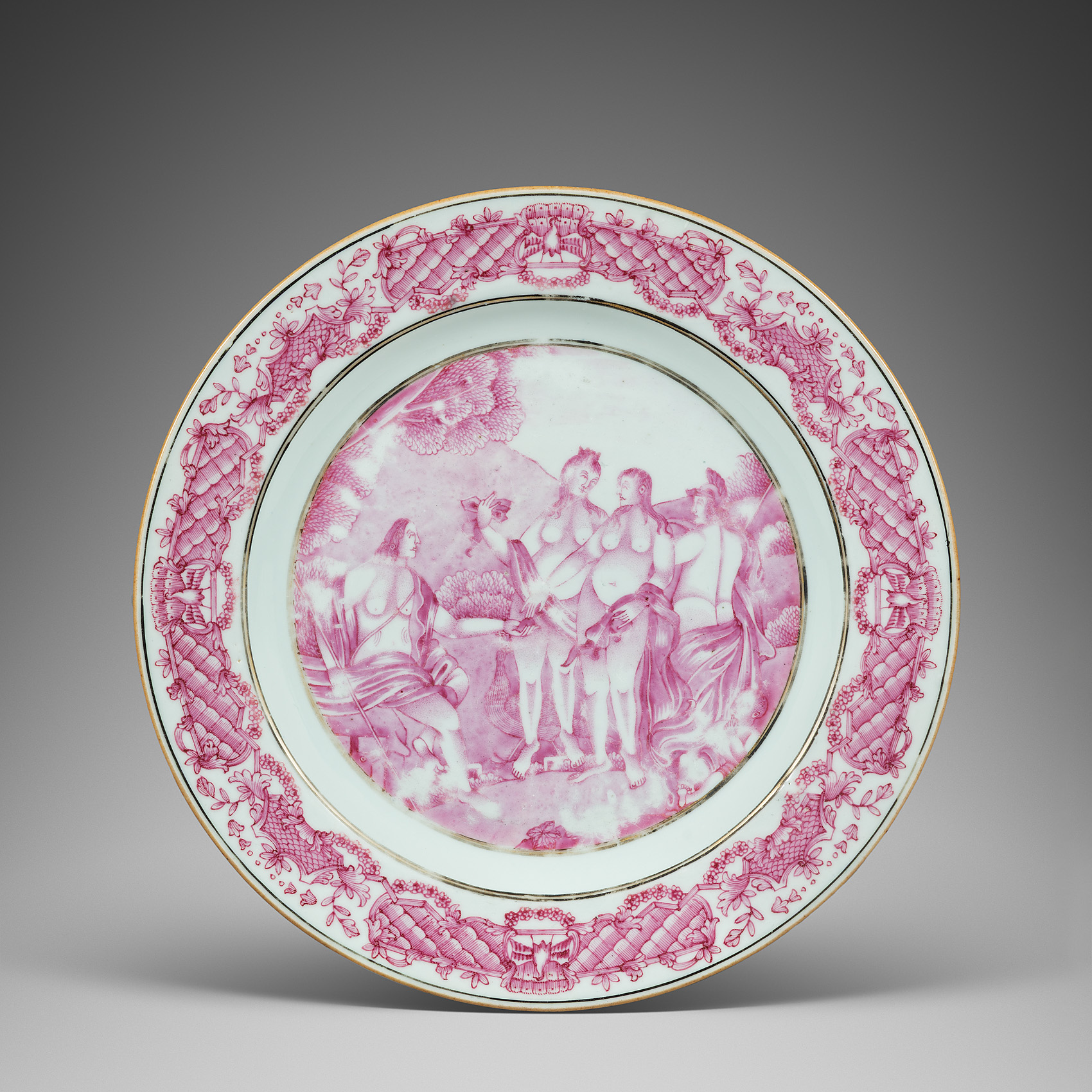
A Chinese “The judgment of Paris” puce plate. Qianlong period

Decorated in famille rose enamels, the centre depicting Paris holding a staff, seated on a rock beside his recumbent hound, offering a golden apple to Venus flanked by Juno and Minerva, with Cupid seated at their feet, the rim bordered by a frieze in the style of Du Pasquier.

COUNTRY : China
PERIOD : Qianlong (1735-1795), ca. 1740-1750
MATERIAL : Porcelain
SIZE : 23 cm
REFERENCE : E684
PROVENANCE : Collection Hervouët
STATUT : available
Related works :

An identical plate, from the collection of Louis Damon (1860-1947) is reproduced by Hervouët & Bruneau in La Porcelaine des Compagnies des Indes à Décor Occidental, 1986, p. 310, no. 1373.

Additonal informations :

The story depicted on this plate recounts the episode that, according to one version of Greek mythology, set in motion the chain of events leading to the Trojan War. The goddesses Hera, Aphrodite, and Athena were disputing which of them was the most beautiful. Paris, a prince of Troy, son of Priam, and reputedly the most handsome man in the world, was appointed to judge among them and award the prize: the golden apple of discord, inscribed with the legend kallisti (“to the fairest”). From its earliest appearances, this subject has been repeatedly treated in a wide range of media.

The visual source traditionally cited for this version of The Judgement of Paris is an engraving after a painting now in the National Gallery, attributed to Peter Paul Rubens (1577–1640). It has also been proposed that the composition ultimately derives from an engraving by Marcantonio Raimondi, c. 1510–1520, after a design by Raphael. Raimondi’s print inspired numerous later reinterpretations, both in print and on canvas, notably a composition by Rubens now in the Prado.

Multiple versions of this Chinese export porcelain pattern are known, differing in their colour schemes, arrangement of the figures, and in a wide variety of border designs—one notable variant even incorporating views of Plymouth. The central scene, however, remains comparatively consistent, unlike the borders. It is therefore highly likely that several distinct Chinese export services were produced over a span of years, each reinterpreting the same design. The period of production appears to range from the mid-1740s to perhaps as late as the 1760s. The puce decoration is one of the rarest pattern.

Demande de condition report

Question about condition report