The tea bowl and saucer are decorated with a parrot on a perch with a cherry branch and a small dog, painted in famille rose enamels with black outlines and gilt highlights, the rim embellished with a scrolling floral border.

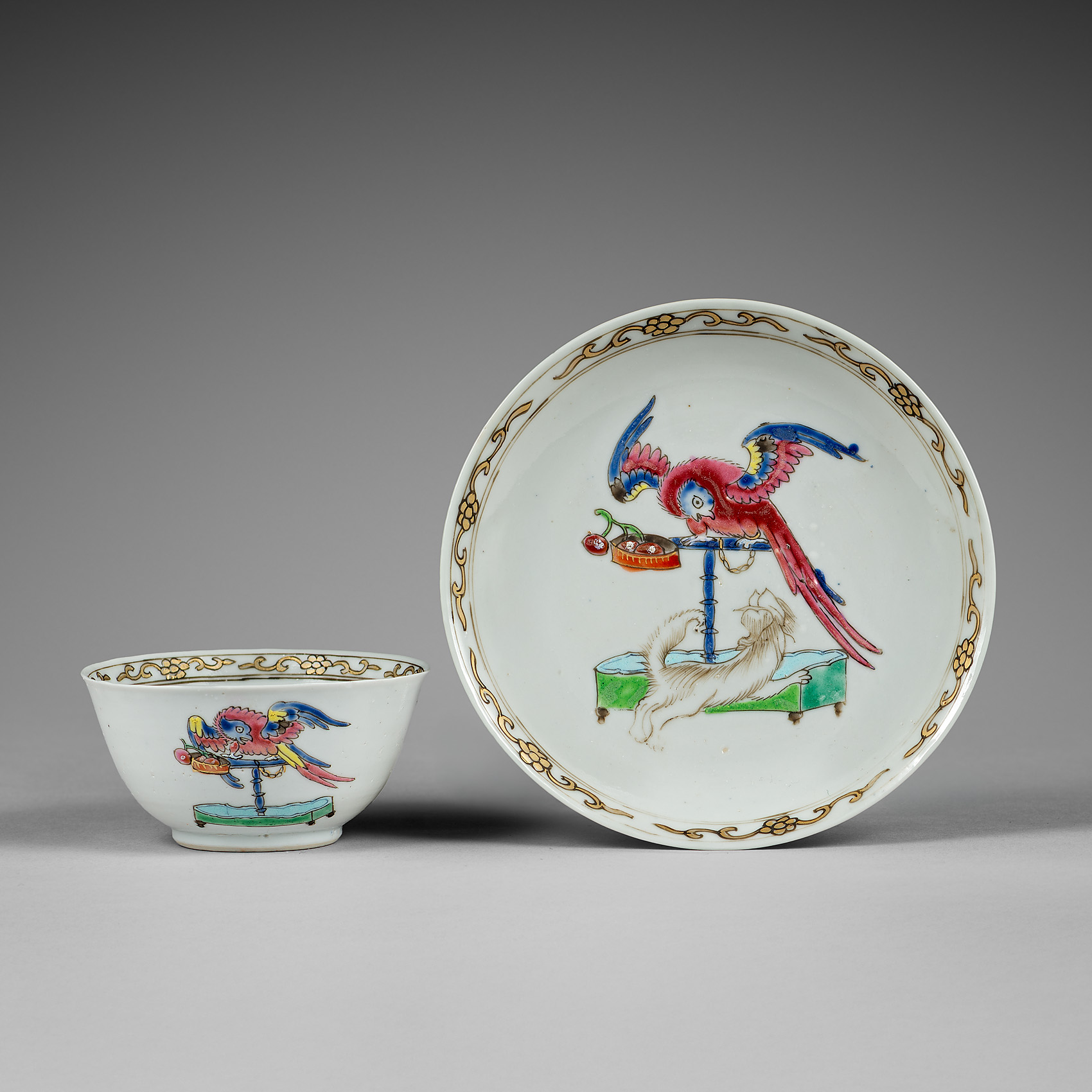
The tea bowl and saucer are decorated with a parrot on a perch with a cherry branch and a small dog, painted in famille rose enamels with black outlines and gilt highlights, the rim embellished with a scrolling floral border.
Famille rose tea wares with this design are rare.
This decoration is also known in overglaze blue enamels, combined with an elaborate border; see Cohen & Cohen, Baroque & Roll, 2016, p. 120, no. 76.
A tea bowl and saucer decorated in overglaze blue enamels are preserved in the collections of the Victoria and Albert Museum, London (inv. no. 642&A-1903).
Famille rose examples are also known with an elaborate border.
This is a rare pattern, attributed to the so-called Pronk workshop on account of its distinctive style. This attribution is further supported by the unusual shape of pieces decorated with the same design and bearing Pronk or Pronk-attributed patterns.
The design itself has been attributed previously to Pieter Schenck, owing to the existence of an important Meissen service decorated with this motif. Schenck’s prints of views and ornamental devices were extensively used by the Meissen manufactory. Schenck is known to have been sent to Japan by the VOC around 1700, although a definitive account of this episode has yet to be established.
Although not designed by Pronk himself, it is reasonable to assume that this piece originated from the same workshop. As the enterprise eventually ceased due to its lack of financial viability, a broader range of porcelains appears to have been assembled there, incorporating elements derived from Pronk designs as well as from other sources. These likely included patterns such as the Trumpeter, the Palmette, the so-called Insect pattern, various garnitures of square-section vases incorporating elements from Maria Sibylla Merian’s prints, and the present design.
The parrot from this composition is also known on certain garniture vases, though in a much reduced form. The spaniel likewise appears on some plates, accompanied by the parrot placed on the rim; these examples are clearly slightly later in date and more roughly drawn.