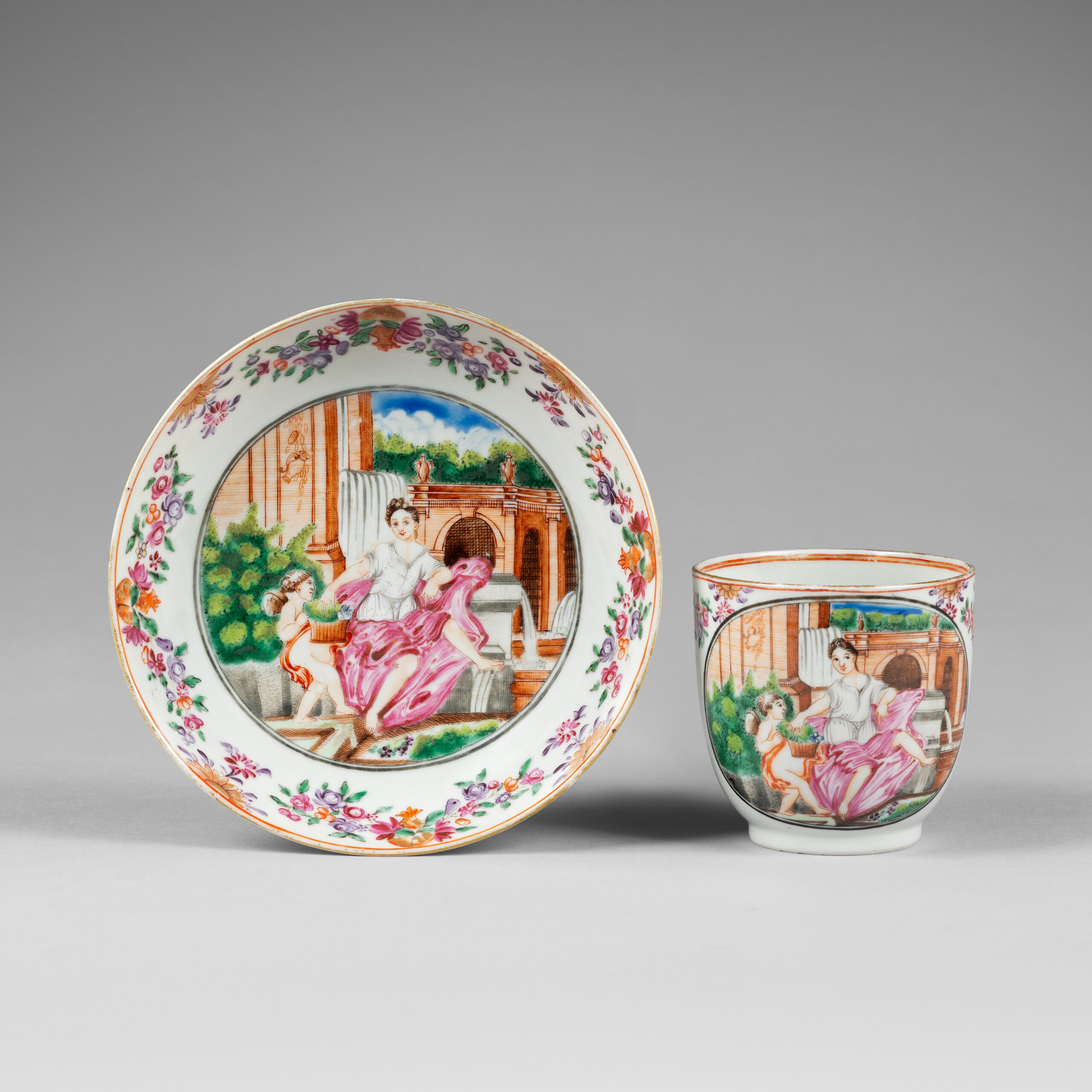
A Chinese “Flora and Cupid” cup and saucer. Qianlong

The cup and saucer are finely decorated in famille rose enamels, each with an oval reserve depicting a European scene: Flora, shown bare-legged and seated in a park, beside Cupid who offers her a floral wreath. In the background, a classical building with arches and columns is visible, together with a fountain and two small cascading waterfalls. The rim is adorned with a delicate floral garland border.

COUNTRY : China
PERIOD : Qianlong (1735-1795), circa 1765
MATERIAL : Porcelain
SIZE : 12,5 cm
REFERENCE : E707
STATUT : sold
Related works :

A saucer is illustrated by Hervouët and Bruneau, La Porcelaine des Compagnies des Indes à décor occidental. Paris, Flammarion, 1986, pl. 134, no. 6.56.

Another cup and saucer is in the collection of the Museum of Fine Arts, Boston (No. 5.849.a-b).

A cream jug, from Polly Latham, is illustrated by Paulo Alves in FROM EAST TO WEST The Quest For Chinese Export Porcelain With Western Themes (1695-1815), Lisbon: Scribe, 2016, p. 265, no. 164.

Another cream jug is illustrated by Michael Cohen and William Motley in The Golden Gate Collection, 2018, p. 54, no. 42.

A teapot was in the J. L. Binder collection.

Additonal informations :

The scene depicting Flora and Cupid is copied from a small ornament print, circa 1710, of the type produced for use by craftsmen—particularly enamelers decorating snuffboxes. In this instance, the Chinese artist, possibly working under the direction of the European merchant who commissioned the service, has modestly dressed the goddess. Although the original print has not been located, the composition was reproduced in John Grand-Carteret’s Rire et Galanterie (c. 1907), p. 184, accompanied by a verse beneath:

Que cette Flore est agréable;
J’admire ces vives couleurs;
Et ne vois rien de plus aimable;
Qu’un bel objet paré des fleurs.

The print bears the inscription “À Paris, chez de Poilly, à la Belle Image”, probably referring to Jean-Baptiste de Poilly (1669–1728) or his brother Nicolas de Poilly (1675–1723), both sons of the better-known François de Poilly (1623–1693).

Demande de condition report

Question about condition report