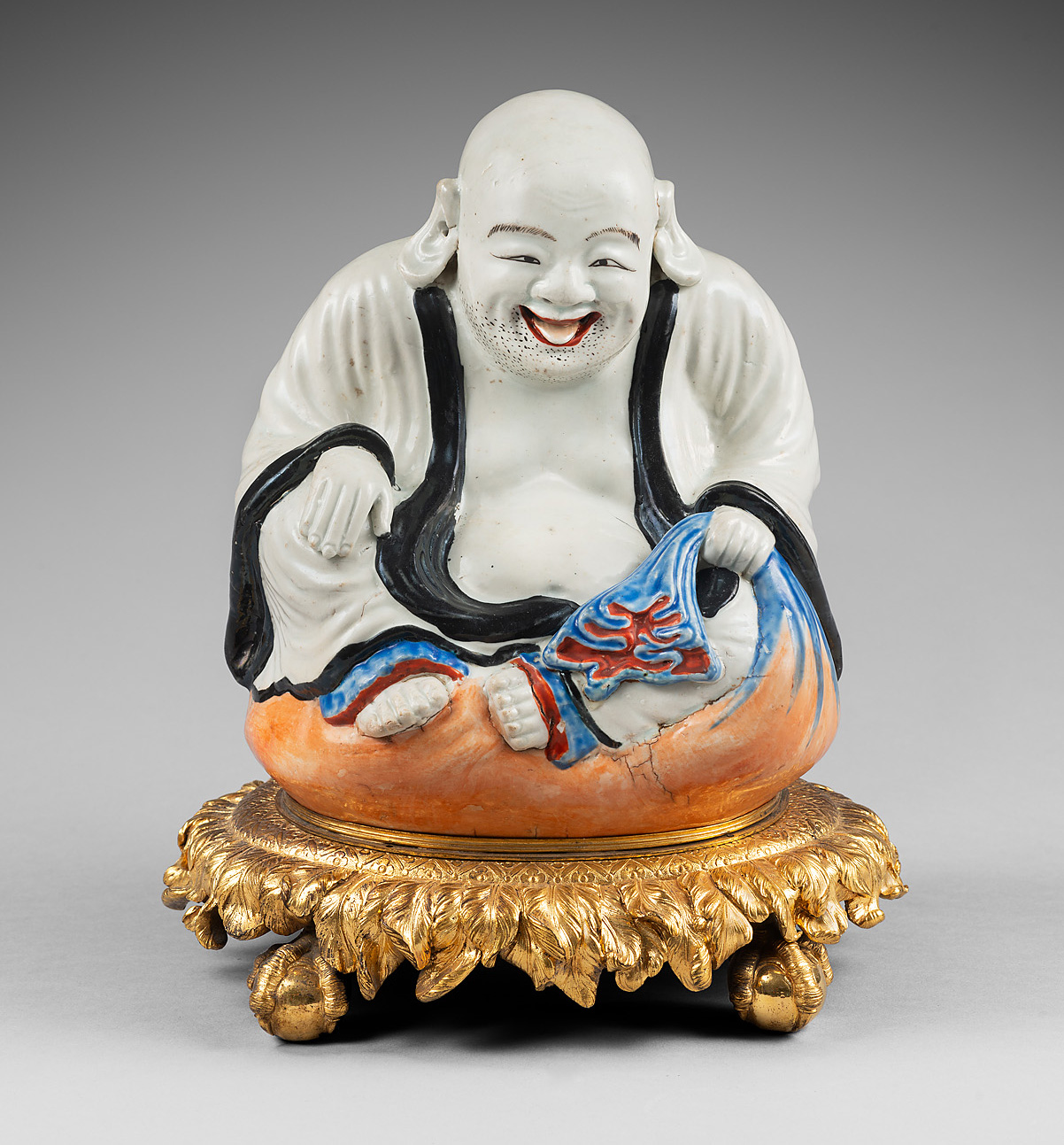
Related works :A shard of a similar figure was found in a samurai residential area around Kubota Castle, in the northern Japanese town of Akita. Other Kakiemon-style figurines have been in the possession of the Japanese elite, including members of the of the daimyo class. They were no doubt intended for display[1].
Figures of Budai (or Hotei) were referred to as “Magot” or “Pagod” in Europe, they embodied “faraway Asia”, a largely unknown world. The term Magot was used as early as the mid-17th century to describe European heavy set or bizarre representations in clay, plaster, bronze or porcelain of Chinese or Indian figures. “Pagoda Figure” comes from the term “Pagode” or religious figures housed in pagoda shrines.
Two figures of Hotei are in the Royal Collections in the Chinese Pavillion at Drottningholm, Stockholm[2]. They probably arrived there during the lifetime of Hedwig of Holstein-Gottorp (1636-1715), Queen and later Queen Regent of Sweden.
Another example, from the Anders collection[3] in the Groninger Museum (Groningen, The Netherlands) is published by Menno Fitski in 500 jaar Aziatishche keramiek uit de collective Anders[4].
Another example painted in green, red and aubergine is published by Nagatake Takeshi in Kakiemon: Nihon jiki akae no seika, koyo hakkutsu[5].
Other figures are in the collection of the Kurita Museum; or in the Yamamoto Collection at the Nezu Museum, published in Ko-Imari zukan: Yamamoto Collection so mokuroku[6].
Another figure is published by Nagatake Takeshi, Yabe Yoshiaki and Minamoto Hiromichi in Kakiemon no. Sekai: genryu kara gendai made.[7]
Another model of Hotei was in the collection of Ernest Oppenheimer (1880-1957), a successful diamond and gold mining entrepreneur, who greatly admired this model of Hotei. The figure was displayed in his study at Brenthurst, Parktown, Johannesburg and appeared in a portrait by Terence Cuneo (1907-1996), illustrated by Graham Viney[8].
[1] Menno Fitski, 500 jaar Aziatishche keramiek uit de collective Anders, vormen uit vuur, 2024, p. 109
[2] Oliver Impey and Christian Jörg, Japanese Export Lacquer: 1580 – 1850, London, 2005, p. 322, pl. 66
[3] Inv.nr.2020-0201
[4] Vormen uit vuur, no. 256, November 2024/3
[5] Fukuoka, 1976
[6] Nezu Museum: Ko-Imari: A Catalogue of Hizen Porcelain from the Nezu Museum’s Yamamoto Collection], (Tokyo, 2017), p. 100, pl. 381-4049
[7]Exhibition of the World of Kakiemon: from its origins to the present, exh. cat., kuoka, 1983, p.49, pl.57.
[8] Graham Viney, Colonial Houses of South Africa, Cape Town, 1987, p. 229