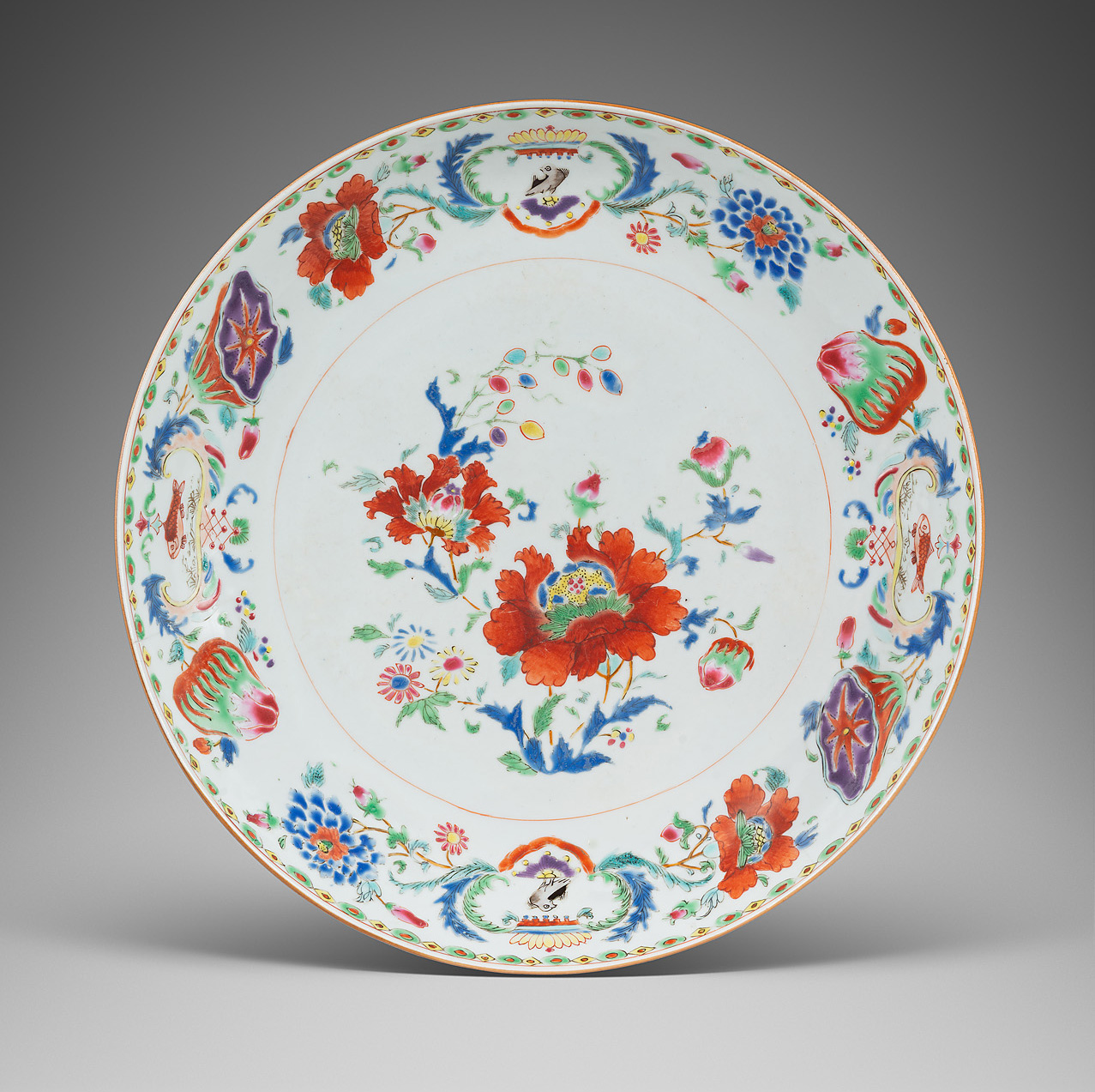
A large Chinese famille rose « Madame de Pompadour » dish. Qianlong period
Brightly enamelled in the famille rose palette, to the interior with a peony medallion encircled at the rim by floral sprays and seed pods flanking cartouches alternately enclosing a fish or an eagle.
COUNTRY : China
PERIOD : Yongzheng period (1723-1735) or Qianlong period (1735-1795)
For a set of plates, see Sotheby’s Paris, Important mobilier, sculptures, objets d’art et tableaux XVIe-XIXe siècle, 19 april 2016, lot 116.
Several pieces from this service are held on in different French museums as the Musée Guimet, the Musée Grobet-Labadit in Marseille, the Musée de Saint-Omer, the Musée des Arts Décoratifs de Paris or the Musée des Arts décoratifs of Bordeaux.
Additonal informations :
Traditional attribution for this service, with its many elaborately shaped pieces, has been given to Madame de Pompadour (1721-64), based on the fish cartouches (relating to her maiden name of Poisson) and the eagle vignettes (representing King Louis XV). But, though certainly a French market pattern, it seems unlikely Madame de Pompadour would have highlighted her humble origins in this way.
Michel Beurdeley, Porcelain of the East India Companies, London, 1962, cat. 190, p. 194.
David S. Howard, The Choice of the Private Trader, London, 1994, no. 271, p. 229.
David Howard, John Ayers, China for the West, vol. II, London and New York, 1978, p. 443.
Rose Kerr, Luisa E. Mengoni, Chinese Export Ceramics, London, V&A Publishing, 2011, p.54, pl.67.