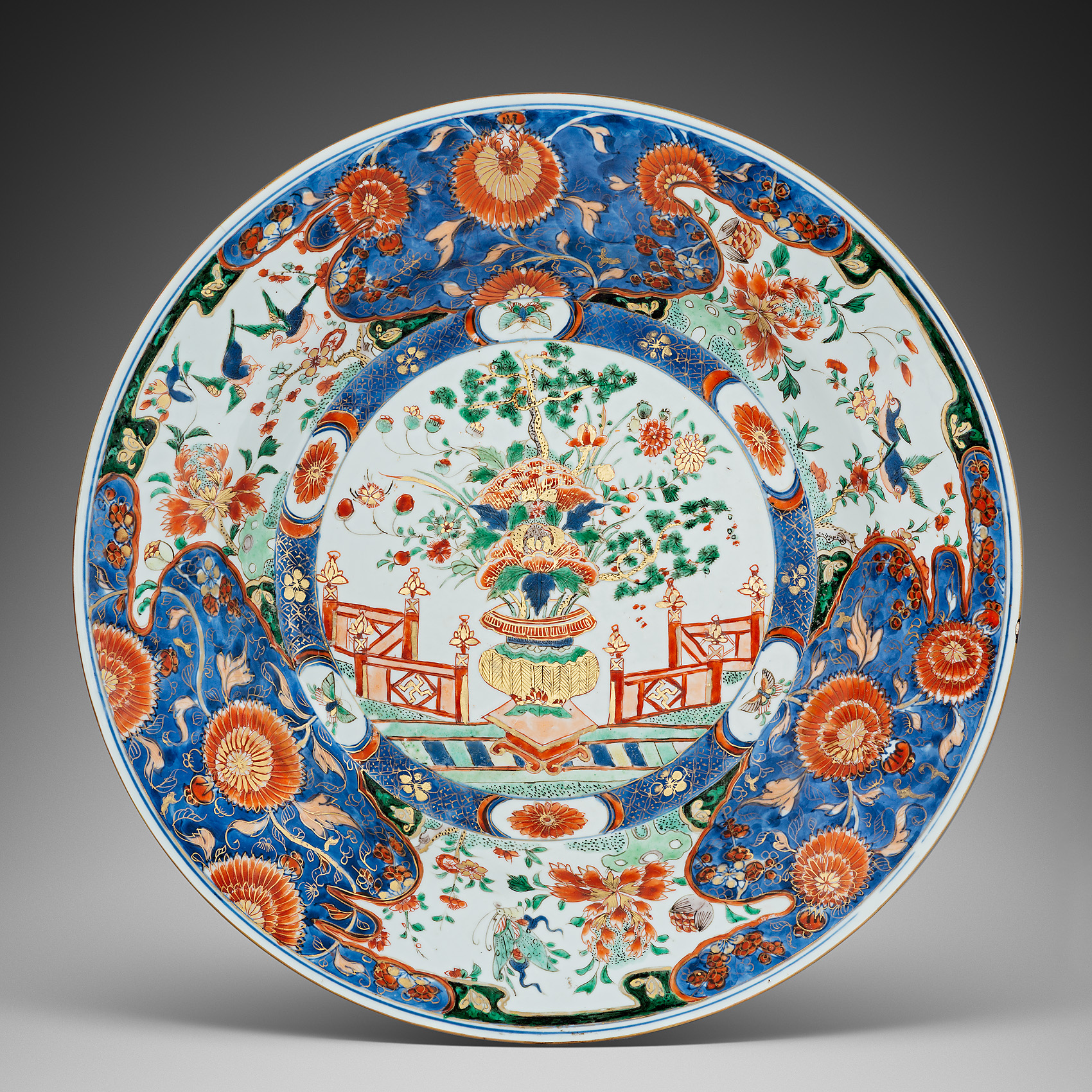
Related works :This pattern can be found in the European princely collections, including August The Strong (1670-1733), King of Poland and Elector of Saxony, housed in the Zwinger, Dresden (different sizes, inventory number PO 5700 for the larger ). One is illustrated in “Porzellane und Waffen aus den Kgl. Sächsischen Sammlungen Dresden” lot 289 (1919).
A smaller dish (28 cm), from the Mottahedeh Collection, is published by David Howard and John Ayers in “China for the West. Chinese Porcelain and other Decorative Arts for Export illustrated from the Mottahedeh Collection (I, pp. 144-145, no. 126).
A smaller dish (34.4 cm), from the collection of August the Strong, Elector of Saxony and King of Poland, is in the collection of the Boymans Van Beuningen Museum (Rotterdam, inv. no. A 2417).
A smaller dish (30.5 cm) is in the collection of the Metropolitan Museum of Art of New-York (from the Hans Syz Collection, Gift of Stephan B. Syz and John D. Syz, 1995, access number 1995.268.35).
A smaller dish (34 cm) is in the Collezione Scalabrino and illustrated by Francesco Morena in “La collezione Scalabrino, porcellanae orientale e mailloche europee” (p. 44, no. 54).
A larger example (54 cm), is in the collection of the Victoria & Albert Museum of London (accession number C.1474-1910).
One example, of a similar dimension (54 cm), from the Dresden Porcelain Collection, was published by Walter Bondy (Kangsi-Epoch Der Chinesesischen Porzellankunst, Munich, 1923, no. 157)
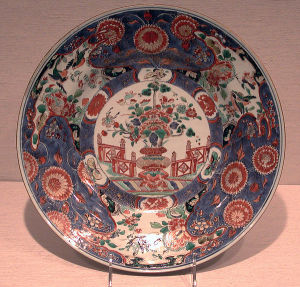
Metropolitan Museum of New-York (access number 1995.268.35)