
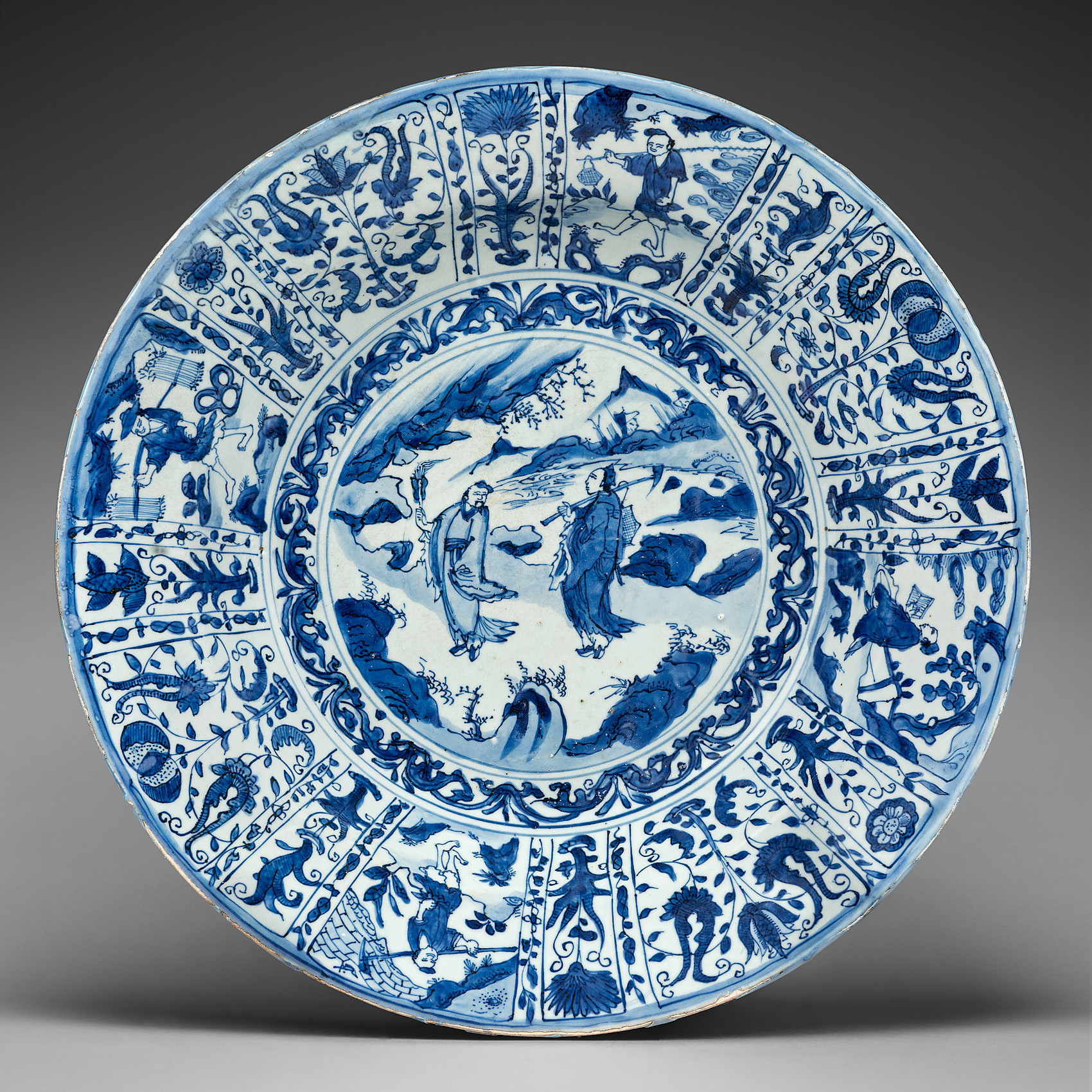
A massive Chinese blue and white charger decorated with Immortals. Transitional period

The massive charger is decorated in underglaze blue. At the centre, two immortals, Zhongli Yuan and Lan Caihe, stand in a mountainous landscape crossed by streams and stylised rocks. The border is divided into alternating wide and narrow panels, variously decorated with figures and floral motifs inspired by Iznik ceramics.

Zhongli Quan, holding his fan, is one of the most senior of the Eight Immortals (Ba Xian). His fan can revive the dead or transform stones into gold, symbolising renewal, transformation, and the transmutation of the mundane into the spiritual — a central Daoist ideal. Lan Caihe, depicted with a basket of flowers, is the most androgynous and enigmatic of the group. His / her flower basket symbolises the fleeting nature of beauty and life, a reminder of the transience of the material world.

Their pairing conveys a sense of balance between transformation and the fragility of the world: Zhongli embodies the power to renew life, while Lan Caihe serves as a reminder of the transience of all existence.

COUNTRY : China
PERIOD : Ming dynasty (1368-1644) / Transitional period, circa 1635-1650
MATERIAL : Porcelain
SIZE : 49 cm
REFERENCE : E837
PROVENANCE : From a Belgian private collection
STATUT : sold
Related works :

A very similar charger (decoration and size), in the collection of KBC Bank NV, is illustrated by Nicole de Bisscop, Seductions Chinoises, 2009, fig. 5.8.

Another charger of the same dimension and size was in the Duchange collection.

Maura Rinaldi, Kraak Porcelain: A Moment in the History of Trade, Londres, 1989, p. 112, pl. 110

See Jorge Welsh, Kraak Porcelain: The Rise of Global Trade in the Late 16th and Early 17th Centuries, pp. 282/285, no. 51 (for a smaller charger) ; p. 286/289, no. 52 (for a massive charger with a different decoration with figures).

Additonal informations :

This massive charger with a divided border belongs to the classic category of Kraak porcelain, produced in the private (minyao) kilns of Jingdezhen at the beginning of the 17th century, specifically for export to the European market.

According to the typology established by Maura Rinaldi (Kraak Porcelain: A Moment in the History of Trade, London, 1989), it corresponds to Group IX, distinguished by a broad central medallion and a border divided into alternating wide and narrow panels, variously decorated with figures and floral motifs — either Dutch-style blooms or designs inspired by Iznik ceramics.

The decoration is executed in a fine range of bluish-purple tones, achieved with the Persian cobalt used at Jingdezhen at the time, whose softly washed hues lend subtle modelling to the figures. These large dishes were among the most spectacular pieces exported to Europe by the VOC and the Portuguese fleets; they adorned the display cabinets and sideboards of aristocratic interiors in Amsterdam and Lisbon.

Demande de condition report

Question about condition report