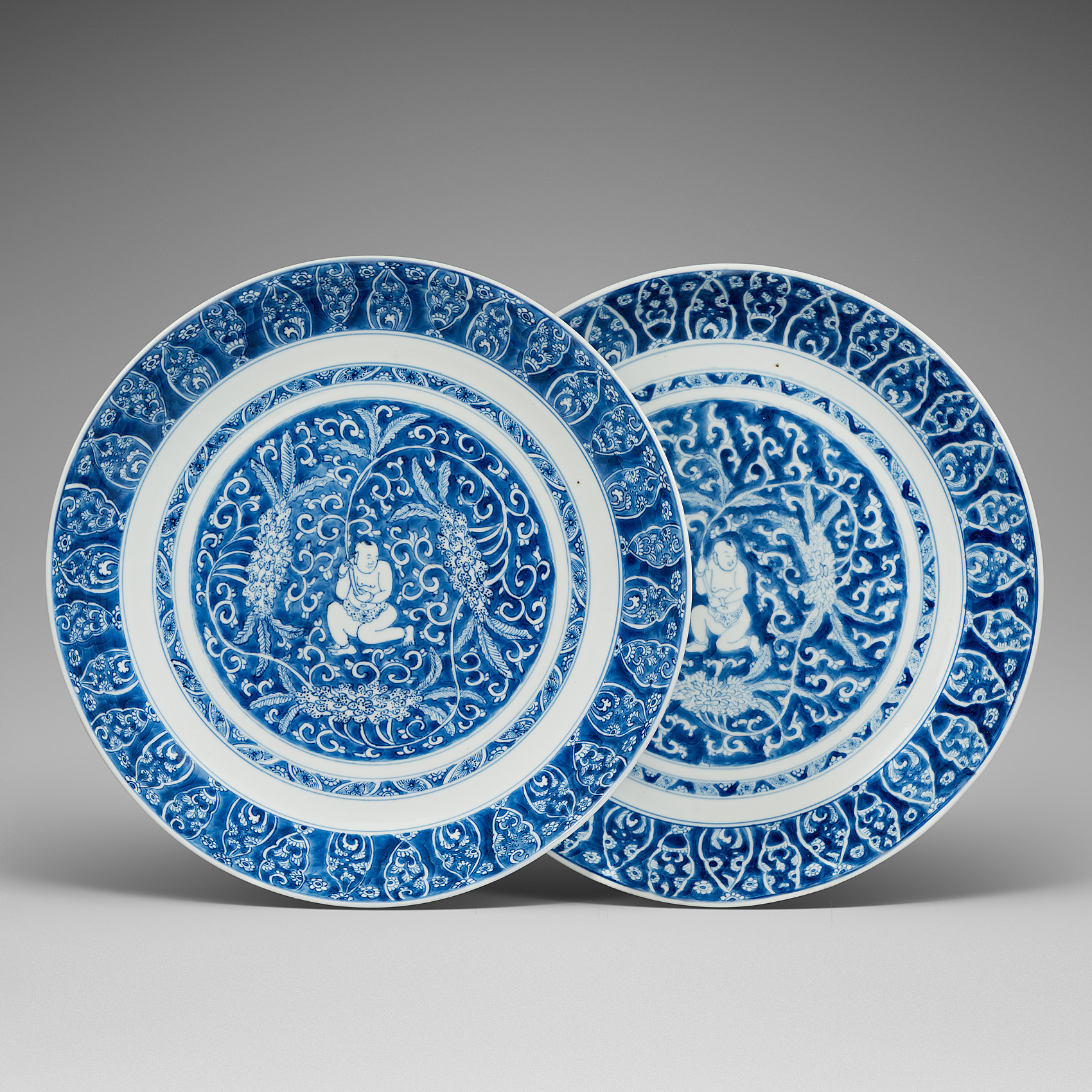
A pair of blue and white ‘boy and peony’ dishes. China, Kangxi

The dishes are painted in underglaze blue, at the centre with a small boy wearing a waistband holding over his right shoulder a curling branch of blossom forming a continuous meander, all on a blue-ground roundel. The rim is decorated with leaf-shaped panels in reserve on a blue ground, containing stylised chrysanthemums. Under the rim with three sprays of plum blossom. The back is bearing the Jue mark.

COUNTRY : China
PERIOD : Kangxi (166-1722)
MATERIAL : Porcelain
SIZE : 27,5 cm
REFERENCE : E926
STATUT : disponible
Related works :

Another dish, formerly in the collection of Mr. George Salting is held in the collection of the Victoria and Albert Museum (C.722-1910).

Additonal informations :

In Chinese visual culture, the association of a young boy with peonies carries a highly auspicious symbolic meaning rooted in traditional wishes for prosperity and lineage. The peony (mudan), celebrated as the “king of flowers,” represents wealth, honour, and high social status, and was closely linked to refinement and official success. The figure of the boy (tongzi), meanwhile, embodies fertility, happiness, and, above all, the hope for male heirs who would ensure the continuation of the family line in Confucian society. When combined, these motifs express a powerful blessing conveying both material prosperity and abundant descendants — a visual rebus often interpreted as a wish for “wealth, honours, and many sons” (fugui duozi). Such imagery appears frequently on Qing dynasty porcelains, paintings, and decorative arts, where it functioned not merely as ornament but as an encoded message of good fortune, particularly appropriate for celebratory or matrimonial contexts.

Question about condition report

Question about condition report