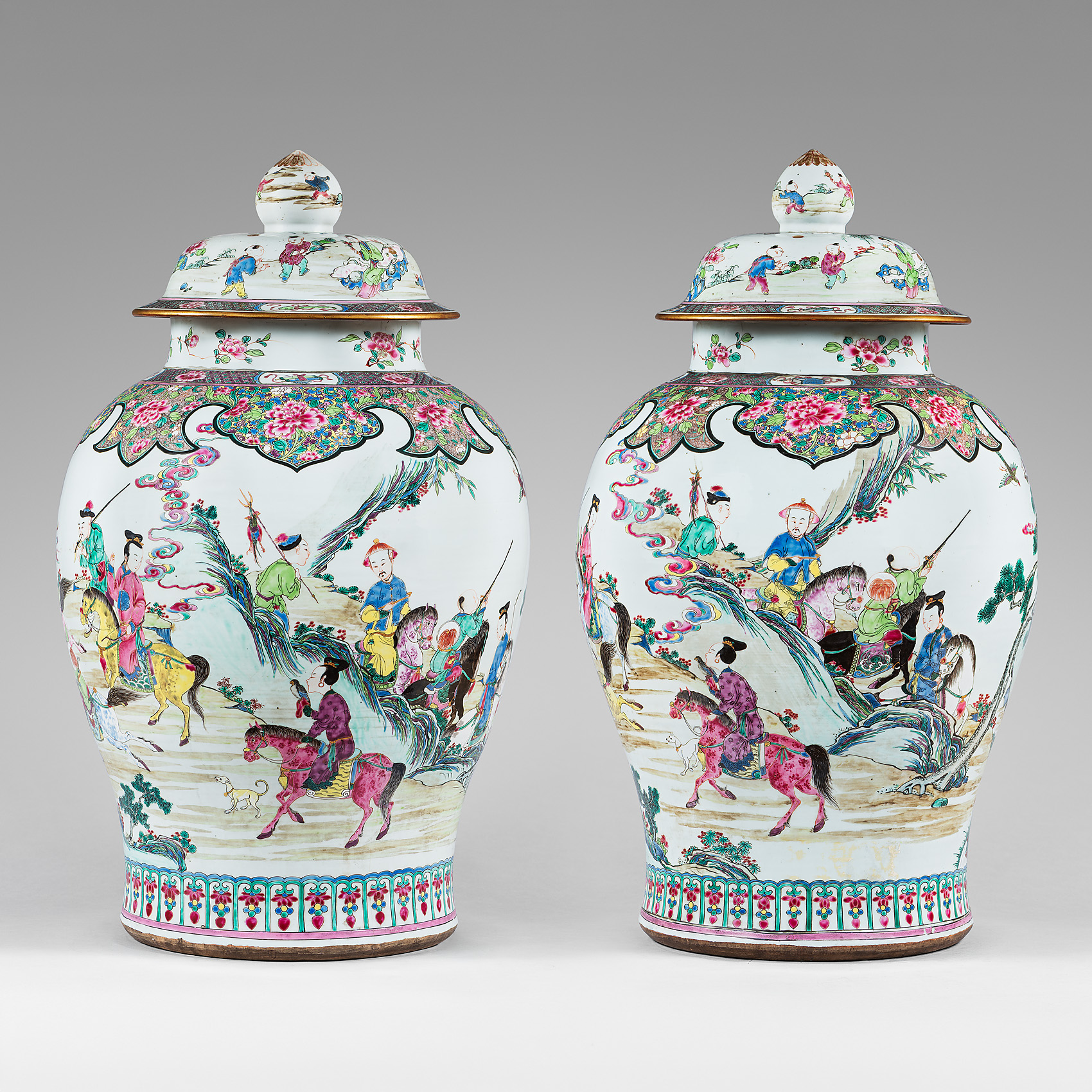
Additional information.A striking transition in atmosphere occurs between the lid and the main body of the vessel. While the covers depict intimate scenes of children at play—a peaceful interior world of domestic harmony—the jars themselves suddenly open up to the vast, exhilarating scale of the Great Outdoors. This shift from the private to the public, from the nursery to the wilderness, prepares the viewer for the true nature of the event. The presence of riders on porcelain is a direct tribute to the equestrian mastery that founded the empire. In the twilight of the Ming Dynasty, the imperial court had turned to these formidable Manchu horsemen—then consolidating their power and script north of the Great Wall—to defend Beijing against the rebel Li Zicheng. Finding the capital already fallen, the Manchus seized the opportunity to claim the Mandate of Heaven for themselves, establishing the Qing Dynasty. It was this superior cavalry and martial tradition that allowed them to secure the throne and systematically dismantle Ming loyalist resistance across the southern territories
The decoration of the main body unfolds around the vases in a continuous horizontal format reminiscent of Chinese handscrolls. In its execution, this decoration draws upon the ancient tradition of realistic horizontal handscrolls, a lineage dating back at least to the Northern Song dynasty and Zhang Zeduan’s Qingming Shanghe Tu, a pivotal work of Chinese realistic painting, illustrating the Qingming Festival (the Festival of Pure Brightness)—a defining moment in the imperial calendar when the solemn rites of ancestral tomb-sweeping, merged with the secular celebrations of spring’s renewal. Just as those monumental scrolls—sometimes dozens of metres long—recorded imperial processions and urban life with thousands of figures, these jars employ a continuous narrative format. They achieve the maximum possible scale compatible with the material. The result is a ceramic tour de force where the “prose” of the historical record meets the “poetry” of the famille rose palette.
The hunters are equipped with a diverse arsenal that illustrates the transition of the Qing military. Alongside the traditional tridents, bows, and arrows of the Manchu warrior, certain figures carry firearms. While the bow remained the symbol of Manchu purity, the firearm was a mark of exotic modernity. The landscape teems with a profusion of game, ranging from deer and antlered beasts to hares and colorful birds. The game pursued across this porcelain landscape—whether antlered, feathered, or furred—possesses an almost supernatural quality. Trained hawks poised for action and hounds with jaws parted in eager enthusiasm are utilised as active predatory hunters. The rendering of the animals transcends simple naturalism; their forms and colours often defy immediate identification, lending the scene an ethereal, dreamlike atmosphere.
While some creatures are clearly defined, others remain enigmatic, prompting various hypotheses. The sturdy, bristled figures seen charging through the brush may be wild boar, a traditional prize of the imperial hunt, while certain horned animals, with their powerful curled profiles, suggest the presence of wild rams or argali from the Mongolian steppes. This ambiguity complements the surreal use of the famille rose palette.
One of the hunters is dressed in imperial yellow, although admittedly he wears a blue waistcoat over his tunic. Despite these precise costumes, the composition is a work of fiction rather than a portrait of a specific imperial personage. The use of dreamlike colours, such as the pink horses, confirms this departure from reality. Such artistic licence was a common practice in the 18th century. In the novel Dream of the Red Chamber, written during this period, the daily life of the powerful Jia family is described with details vividly evoking the Qing court, yet the capital is named Chang’an instead of Beijing. This distance allowed artists to represent imperial themes without the constraints associated with formal portraiture. Amidst the dynamic swirl of the chase, the figure dressed in yellow stands out with quiet but undeniable authority. While the other riders are captured in profile or from behind, focused on the pursuit, he is depicted facing the viewer, almost as if posing for a formal portrait while remaining in motion, instead of hunting. On the other hand, one of the figures sporting a firearm in the most aggressive fashion turns his back at us.
Given the extraordinary variety of naturalistic poses across the landscape, this singularity cannot be a coincidence. In the rigid iconographic language of the Qing court, the combination of the imperial yellow robe and this unique frontal engagement with the spectator serves as a clear signature. It identifies the protagonist not merely as a high-ranking official, but as the Emperor himself—or a member of the immediate imperial family—confirming that the scene depicts an Imperial Hunt. This subtle yet deliberate artistic choice elevates the jars from decorative objects to a representation of an Imperial hunting utopia.
The artist’s attention to detail extends beyond the riders to their mounts, which are equipped with harnesses of remarkable sumptuousness. Each horse is adorned with vibrant red tassels (hongying), a traditional mark of status that adds a rhythmic splash of colour to the galloping procession. These decorative elements were not merely aesthetic; they were symbols of rank and vitality, shimmering against the powerful musculature of the horses as they traversed the rugged terrain of Mulan, the extensive imperial hunting preserve that served as the vast, open-air arena for the Qing dynasty’s most essential martial rituals.”.
Among this equine display, one animal particularly commands attention: a horse with a striking yellow coat. The presence of such a creature is enigmatic. It raises a compelling question of status: does this golden hue represent a bold departure from customary sumptuary laws, a rare artistic licence taken by the porcelain painter? Or is the horse itself an imperial attribute? Just as the rider’s yellow robe signals supreme authority, this “golden steed” may be a direct allusion to the Emperor’s personal stable, further cementing the identification of this scene as a formal Imperial Hunt. Besides, The use of yellow here is of interest for dating the pair, extending beyond its symbolic weight. Technically, the rich application of yellow enamel was at its most popular between 1730 and 1735; this chronology is confirmed by the appearance of identical enamelling on several documented armorial services from those specific years.
The decoration balances realism with artistic freedom. Some technical details are rendered with accuracy, notably the silk pouches (yandai) suspended from the belts. As Manchu costume traditionally lacked pockets, these belt-hung pouches were essential for carrying personal effects, notably snuff bottles. The use of powdered tobacco was introduced under the Manchu dynasty and, much like the snuff box in Europe, the snuff bottle became a symbol of social status. The use of snuff remains rooted in nomadic traditions, as seen in Mongolia where riders still greet one another by exchanging a pinch of tobacco. Under imperial patronage in the palace workshops of Beijing, these bottles evolved into a sophisticated form of miniature art.
The imperial figure in yellow conspicuously holds a ruyi sceptre, an object associated with imperial power but also prized as an auspicious ‘toy’ for the literati. Its presence here recalls its ancient function: a tool used for pointing directions or gesturing command during a journey. However, as the head of the sceptre appears unusually small, an alternative interpretation might suggest it represents a tobacco pipe[1]—further evoking the tobacco culture of the Qing court. However, the practicality of using such a pipe during the rigours of a hunt remains open to question.
Following the final suppression of Ming loyalist resistance in 1683, the iconographic landscape of Chinese porcelain underwent a profound transformation; decorations laden with subversive political allegories or nostalgic allusions to the “Golden Age” of the Ming were no longer tolerated under the consolidated Qing rule. In their stead, “politically neutral” yet grand themes emerged as the new decorative standard, with the spectacle of the Imperial Hunt and celebrated literary classics—such as The Romance of the Western Chamber—providing ideal subject matter. While these narrative designs were initially encouraged as propaganda to legitimise the new Manchu dynasty, by the reign of Yongzheng, this overt political motivation had largely receded. By this period, such scenes were increasingly celebrated for their sheer aesthetic virtuosity and narrative charm rather than a rigid adherence to a specific symbolic or partisan scheme.
The presence of a lady on horseback, a hawk perched upon her arm, may be a historical allusion. The artist emphasises her femininity through large earrings. This imagery evokes the Sui (581–618) and Tang Dynasty (618–907) tradition of court equestrians, much illustrated in painting and ceramic. However, a fundamental distinction must be drawn here. While the celebrated female riders of the Sui and Tang eras participated in courtly entertainments—such as choreographed polo matches or equestrian parades akin to theatrical performances—the Manchu equestrian activities depicted on these jars are of an entirely different nature. We have moved beyond the enclosed, controlled environment of a sports field or palace courtyard and into the vast, unpredictable expanse of the Imperial Hunt.
In this open landscape, the huntress is defined by the momentum of the chase and the flight of the game. Her presence is not a mere courtly ornament but a symbol of an unconstrained lifestyle. Unlike their Han Chinese counterparts, Manchu women did not practise foot-binding (chanzu), instead retaining their “Heavenly Feet” (tianzu), which allowed them to sit a horse with martial assurance. By placing her in this rugged terrain, the Yongzheng artist does more than evoke a past Golden Age; he celebrates physical vitality and freedom of movement of the Qing ruling class, capable of matching the relentless pace of the steppe. The cultivation of Manchu identity led to formal codification of Manchu dress. In 1759, official robes were redesigned to emphasise their equestrian origins. Elements such as the side-fastening to resist the wind and the ‘horse-hoof’ cuffs (matixiu) to protect the hands became the hallmarks of Qing identity, several of which are visible in the attire shown here.
While the presence of this huntress is a powerful testament to the identity of a minority elite seeking to consolidate its position at the helm of a multicultural empire, such a representation remains remarkably rare in Qing dynasty art. In the vast majority of period porcelain and painting, female figures are confined to the realms of classical literature, theatrical drama, or intimate domestic scenes. Even on other objects of high statecraft and ceremony—such as the monumental lacquer screens frequently presented on imperial birthdays—the iconographic tradition remains strictly bifurcated. For instance, scenes celebrating the martial virtues of the Tang general Guo Ziyi (a standard theme for imperial anniversaries) are almost exclusively masculine in their military depictions. The narrative structure of these jars offers a profound commentary on the social and physical organisation of the Qing world. In the grand residences of the “Tartar City” in Beijing—such as the palatial compounds described in Dream of the Red Chamber—architecture was defined by a succession of enclosed spaces. These moved from the public, masculine courtyards in the south to the increasingly private, secluded northern quarters reserved for women.
On these vessels, the transition between the lids and the jars mirrors this progression but subverts it. The domed covers depict the domestic world of the northern pavilions: children and ladies in a sheltered, private atmosphere. However, as the eye moves down to the main body, the walls of the courtyard fall away. We are suddenly thrust into the grand, open spaces of the Imperial Hunt. On these jars, however, the inclusion of a female participant in a scene of active, open-air pursuit is a bold departure from the norm.
Chinese imperial hunts were at the intersection of imaginations in the 18th century. The Yongzheng Emperor did commission Jesuit court painters to depict him in various roles, from a philosopher in a grotto to a European hunter. The hunt on these jars reflects the blending Manchu roots with the artistry of famille rose enamels. At the Qing court, the Jesuit painter Giuseppe Castiglione (known in China as Lang Shining) produced works such as ‘The Qianlong Emperor Hunting Hare’ or ‘The Hunting Banquet’. These paintings represent a rare departure from the rigid traditions of ancestral portraiture. Castiglione introduced Western techniques of perspective and individualised facial rendering to the Forbidden City. His work provided the Emperor with a realistic record of martial prowess, beyond the level of precision seen in the costumes and equipment on these jars.
While the Yongzheng potters remained somewhat anchored in Manchu reality, European artists were creating a different China. In 1742, François Boucher produced the cartoons for ‘La Chasse Chinoise’, part of a celebrated tapestry series for the Beauvais manufactory. Boucher’s vision is largely oniric; he depicts a pursuit of wildfowl in a landscape of pure fantasy. For the Western collector, this version of China was a decorative utopia where the rigour of the Manchu military exercise was replaced by an elegant, pastoral game.
This fascination reached another height in the Cabinet Chinois created for the Maréchal-Duc de Richelieu, whose wall panels were executed in green-ground Vernis Martin, illustrate the cultural distance between East and West. Developed as an imitation of Chinese lacquer, this varnish emulated the depth and sheen of oriental surfaces, providing a Western counterpart to the brilliance lacquer. The decoration on these panels, now held at the Musée Carnavalet, reveals a cultural gap: one scene depicts a hunter aiming his bow at a flying crane. While in China the white crane is a sacred symbol of longevity and never considered as prey, the French artist treats the bird as mere game. These vases therefore served as a bridge between the authentic traditions of the Qing state and the debridled imagination of the European salons.
This pair of vases belongs to a group of monumental pieces, frequently decorated with imperial themes. A notable example is the large dish illustrated in the previous entry, which depicts the episode Sui Yangdi guan gongnü paoma (隋煬帝觀宮女跑馬), or ‘Emperor Yang of Sui watching palace women riding horses.’ A comparable pair of ‘twin’ vases appeared on the market in 2019[2], sharing a nearly identical silhouette, cover, and finial, as well as the distinctive ruyi frieze at the shoulder and the narrative decoration of the Emperor watching the equestrian palace women.
By the final decades of the 17th century, a convergence of political, economic, and technical forces created exceptional conditions for the production of Chinese export porcelain. Following the consolidation of Qing rule after the Ming–Qing transition, the imperial kilns at Jingdezhen regained full stability and operated at a remarkable capacity. Simultaneously, prolonged warfare and the requirements of courtly display in Europe stimulated a fierce demand for luxury goods. The structured maritime trade networks of the VOC, the English East India Company, and the Compagnie des Indes provided the reliable commercial framework necessary for such trade. Within this context of renewed production and expanding global demand, large-scale porcelain pieces reached an unprecedented level of ambition. The European market sought spectacular pieces for grand aristocratic residences; these vessels served to manifest wealth, power, and social authority at a time when such commissions from China were the exclusive preserve of the elite.
The late reign of Kangxi and the early years of Yongzheng represent the zenith of this production. Western patrons sought works suited to grand architectural interiors, prompting the creation of monumental forms. Among the most striking was the so-called ‘soldier vase’, with its tall neck and elongated body. These vases—typically decorated in brilliant underglaze blue, Imari, or the famille vertepalette—were conceived as architectural elements: placed on consoles, set within chimney pieces, or flanking grand doorways. The technical virtuosity of the period is evident in the successful firing of such ambitious dimensions and the increasing mastery of complex narrative compositions.
Under the Yongzheng Emperor, production achieved further refinement: lines became tauter and enamelling more subtle. The full development of the famille rose palette allowed for a luminous and sophisticated chromatic range, introducing a modern brilliance to these monumental forms. This era represents a moment of perfection; the technical prowess achieved under Kangxi reached full maturity, while the expansive decorative vision of the earlier period was transformed through a more balanced sense of proportion.
The collection of Augustus the Strong offers a remarkable testament to this taste for monumental porcelain. A pair of Kangxi-period Imari vases of closely comparable form[3]. though smaller in size than the present examples, is preserved within his historic collection.
During the Yongzheng period, two distinct typologies of monumental vases emerged. The first is the octagonal form, exemplified by the Alfonso Cumberbatch Vases presented by this gallery in 2022. Kakiemon ware, produced in Arita from the second quarter of the 17th century onwards, often favoured these angular forms, perhaps because they were less susceptible to warping in the kiln than circular vessels.
The second category, to which the present pair belongs, comprises globular-bodied forms, arguably more difficult to execute on a grand scale. This silhouette allows the painted decoration to unfold across a continuous, uninterrupted composition. The form of these vases is among the most impressive of the type; the swelling of the body is more pronounced than usual, and the covers are particularly substantial. The knop is notably large; whereas such covers are typically adorned with a simple chrysanthemum, the scale here has permitted the execution of a fully developed figural scene.
This type of jar can be dated with precision. A pair of very similar jars[4], surmounted by Buddhist lion finials, was brought back to the Danish court by the captain of the Kronprins Christian following her maiden voyage to China in 1732[5] Those examples feature the same characteristic ruyi frieze at the shoulder, confirming the stylistic consistency of the period.
[1] We thank Hugh Moss for correspondence regarding the identification of this object
[2] London
[3] Inv. 5429/30, 60 cm hight
[4] Nationalmuseet, Department of Ethnography, Copenhagen, EBc 183
[5] 5 Michel Beurdeley, Guy Raindre, Qing porcelain: famille verte, famille rose, 1644-1912, 1987, pp. 94/95