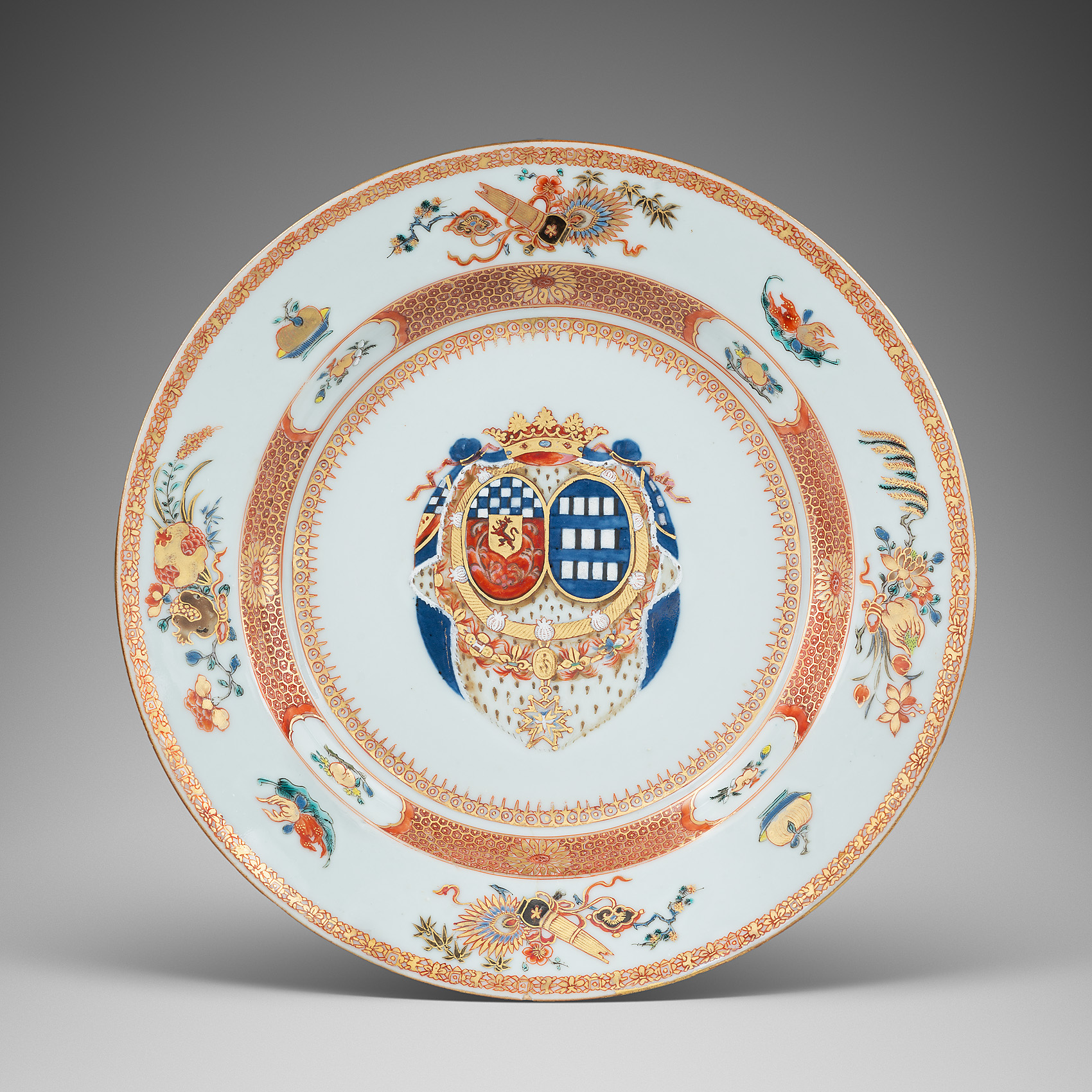
Additonal informations :This service was commissioned by Louis-Auguste Albert d’Ailly (1676–1744), the Duke of Chaulnes. He was the fifth son of Charles-Honoré d’Albert, Duke of Luynes and Chevreuse and Peer of France, and Jeanne-Marie Colbert. Following the deaths of his elder brothers, he became the second surviving son. Under the terms of his parents’ marriage contract, he was substituted for his father, the Duke of Chevreuse, in the succession of Charles d’Albert d’Ailly, 3rd Duke of Chaulnes — a first cousin of his grandfather. This substitution obliged him and his descendants to bear the name, arms and war cry of that ancient house.
He was appointed lieutenant-general in Picardy in 1692 and received his peerage from the Parlement of Paris in 1711. In 1718, he was promoted to lieutenant general of the King’s armies. In 1724, he was made a knight of two of the King’s orders: the Order of the Holy Spirit and the Order of Saint Michael. He was then appointed Governor of Amiens in 1729. He concluded his career with his elevation to the dignity of Marshal of France in 1741.
In 1704, he married Marie-Anne-Romaine de Beaumanoir de Lavardin (1688–1745), the daughter of the Marquis de Lavardin, who was lieutenant general in Upper and Lower Brittany, as well as extraordinary ambassador to Rome. His portrait was painted in 1707 by Hyacinthe Rigaud
A leading shareholder of the Compagnie des Indes
Following the collapse of the Law System in 1720 and the subsequent reorganization of the Compagnie perpétuelle des Indes between 1719 and 1723, the French state sought to disentangle royal interests from those of private shareholders, all the while ensuring the continuity of commercial operations. In this context, the company was placed under close supervision and underwent profound administrative and financial restructuring.
Louis-Auguste Albert d’Ailly, Duke of Chaulnes, emerged at this time as one of the Company’s principal shareholders. In 1721, he was appointed by the shareholders’ assembly as one of the eight honorary directors of the Compagnie des Indes. Each director was placed at the head of a bureau, while a separate director oversaw the port of Lorient, the Company’s main maritime trade hub. The seven bureaux, each staffed by eight to ten salaried clerks, were established in Paris at the company’s headquarters, located at the corner of the Rue de Vivienne and the Rue des Petits-Champs.
The major assemblies held on 28 December 1720 and 2 January 1721 marked the Company’s return to favour among the kingdom’s political and financial elites. To secure the support of leading capital holders and high-ranking figures, several honorary titles were conferred: the Duke of Bourbon was appointed Vice-Protector; the Duke of Chaulnes, the Duke of Antin, Marshals d’Estrées and de Grammont, and the Marquises of Lassay and de Mézières were named honorary directors.
During the 1723 reform, the Duke of Chaulnes was once again among the principal shareholders in attendance, alongside the Prince of Vendôme, the Dukes of La Force and Chaulnes, Marshal d’Estrées and the Marquis of Bully, confirming his continued involvement in the governance and financial interests of the Compagnie des Indes.