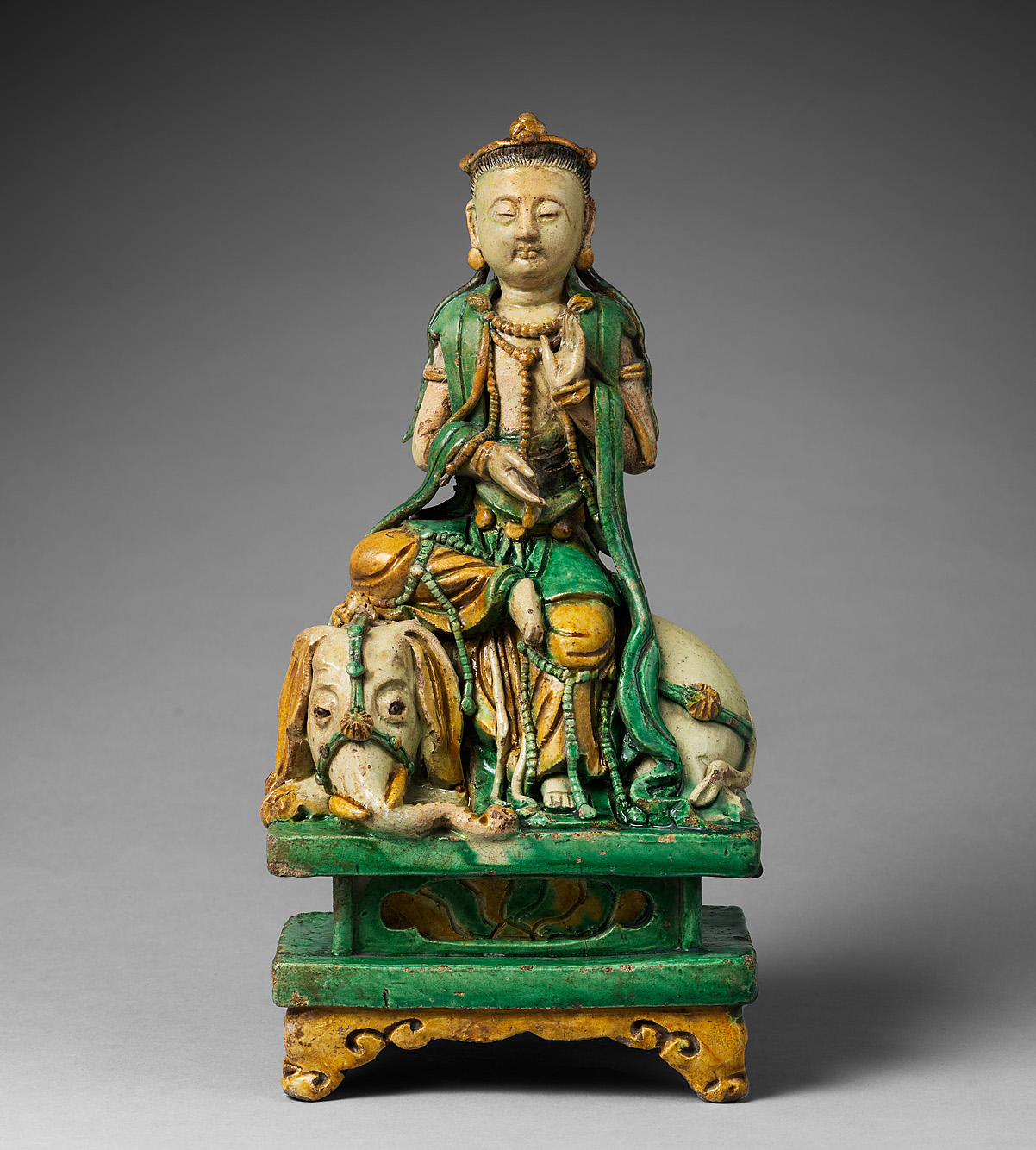
Samantabhadra, called Puxian in Chinese, is venerated as the Bodhisattva of Universal Virtue in Mahayana Buddhism. The Bodhisattva is born of a white elephant, a symbol of the strength achieved through the practice of Buddhism. In Sanskrit, “Samanta” means “extending to the universe”, while “Bhadra” signifies “great virtue”. He is the first of the Five Dhyani Bodhisattvas, and also the bodhisattva of compassion, the manifesta- tion of dharmakaya, the source of all things and the entity to which all things return.
Typically depicted seated on a white ele- phant, he serves as the patron of the Lotus Sutra and is renowned for making the Ten Great Vows, foundations of a bodhisattva’s path. He is sometimes shown in Chinese art with feminine characteristics.
Samantabhadra is rarely depicted alone. Both Samantabhadra and Manjusri are atten- dant bodhisattvas of Shakyamuni Buddha and sometimes portrayed flanking the Buddha. Manjusri is on the left seated on a crouching lion representing wisdom. Samantabhadra is on a white elephant and oversees reason. Together they represent the accommodation of both wisdom and reason in the Buddhist faith. Depictions of Samantabhadra were also produced in bronze or wood during the Ming dynasty (1368-1644).
Sancai meaning three colors is a type of decoration on Chinese ceramics and other painted pieces using glazes or slip, predo- minantly in the three colors of brown, green, and a creamy off-white. Sancai is particularly associated with the Tang dynasty (618-907) and the Ming dynasty (1368-1644).