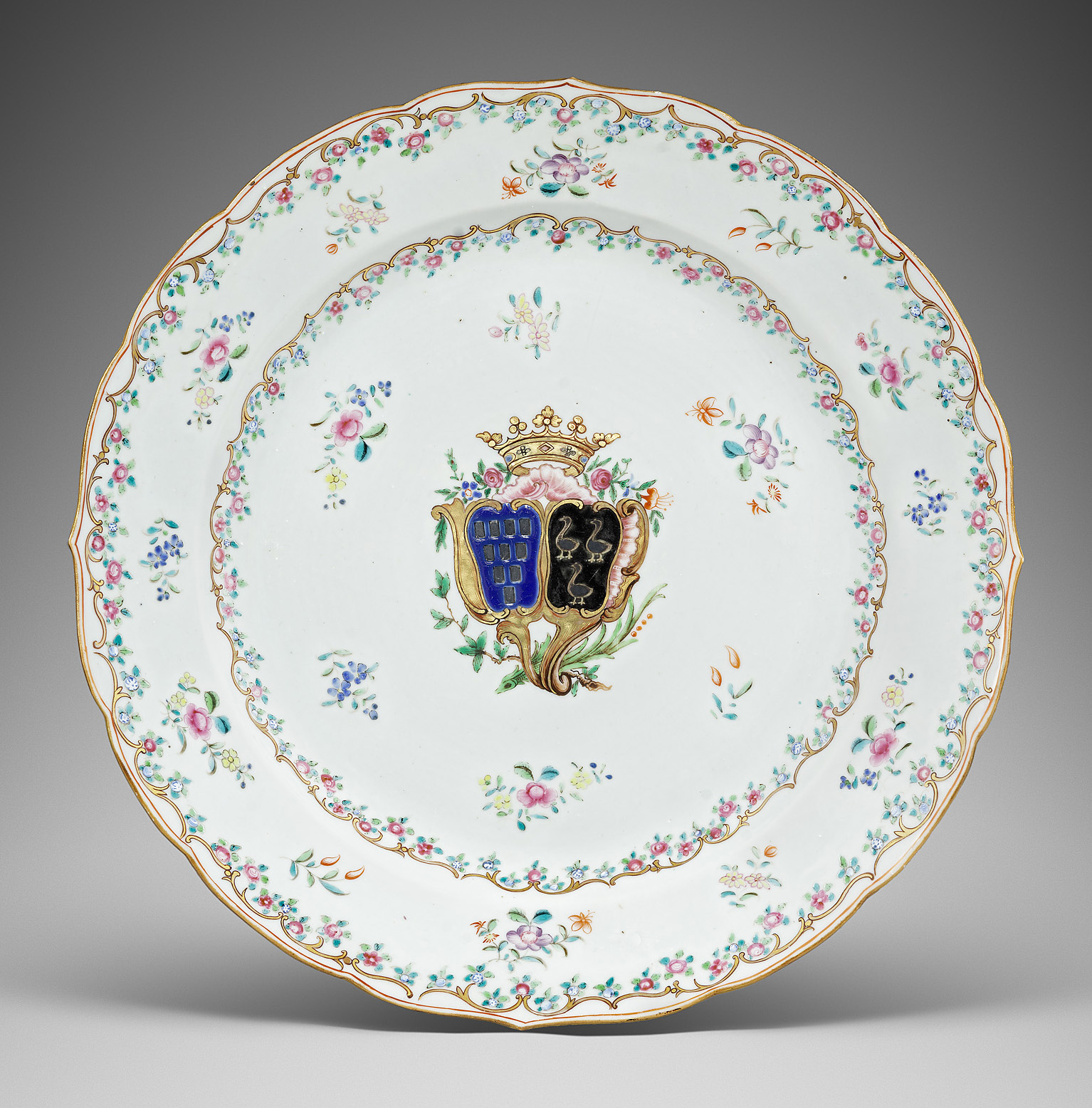
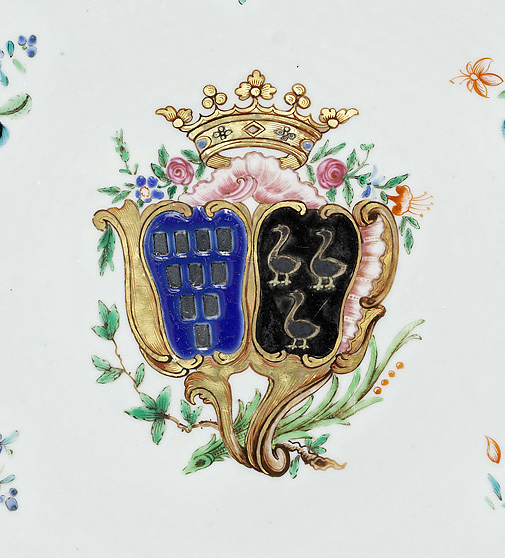
Additonal informations :Julien-Louis-Marie de Robien (1733–1809) was the eldest son of Jean-Thomas de Robien, Seigneur of Treulan (1701–1765), and Hélène-Adélaïde-Josephe Eon de Carman, who were married in Saint-Malo in 1732. The couple had six sons. Julien-Louis-Marie, Count of Robien, known as Robien de Saint-Nervin (1733–1809), Seigneur of Treulan and of Kérambart, was born at the château of Treulan in Pluneret on 16 September 1733.
He was admitted as a garde-marine (naval cadet) in 1748, and embarked on the Amphion in 1750, the Topaze in 1751, and the Aquilon in 1752–53. He became ensign and maréchal-des-logis of the gardes-marines in 1754. He sailed again with the squadron of M. de Conflans in 1756–1757, and later served aboard the Thétis in 1758 and the Célèbre in 1759. He took part in the Siege of Louisbourg (Canada), alongside his brother Jacques. Captured by the English, he was held prisoner for five months and exchanged in August 1760. He then commanded the compagnie des gardes-marines in Brest.
In 1761, he boarded the Vaillant, but when the squadron received the order to disarm two officers per ship, Julien de Robien was among those retired. He was officially retired on 15 January 1762 with a pension of 400 livres, a third higher than that of other officers of the same rank. He petitioned to return to service or to be awarded the Cross of Saint-Louis, but despite the support of the Duke of Chartres, his request was denied. He died in his home at 52, Grande-Rue, Hennebont, on 26 February 1809. He had married Marie-Anne de Lesquen—born 12 March 1734, died at Treulan in 1792—at Saint-Gildas d’Auray on 17 June 1760.
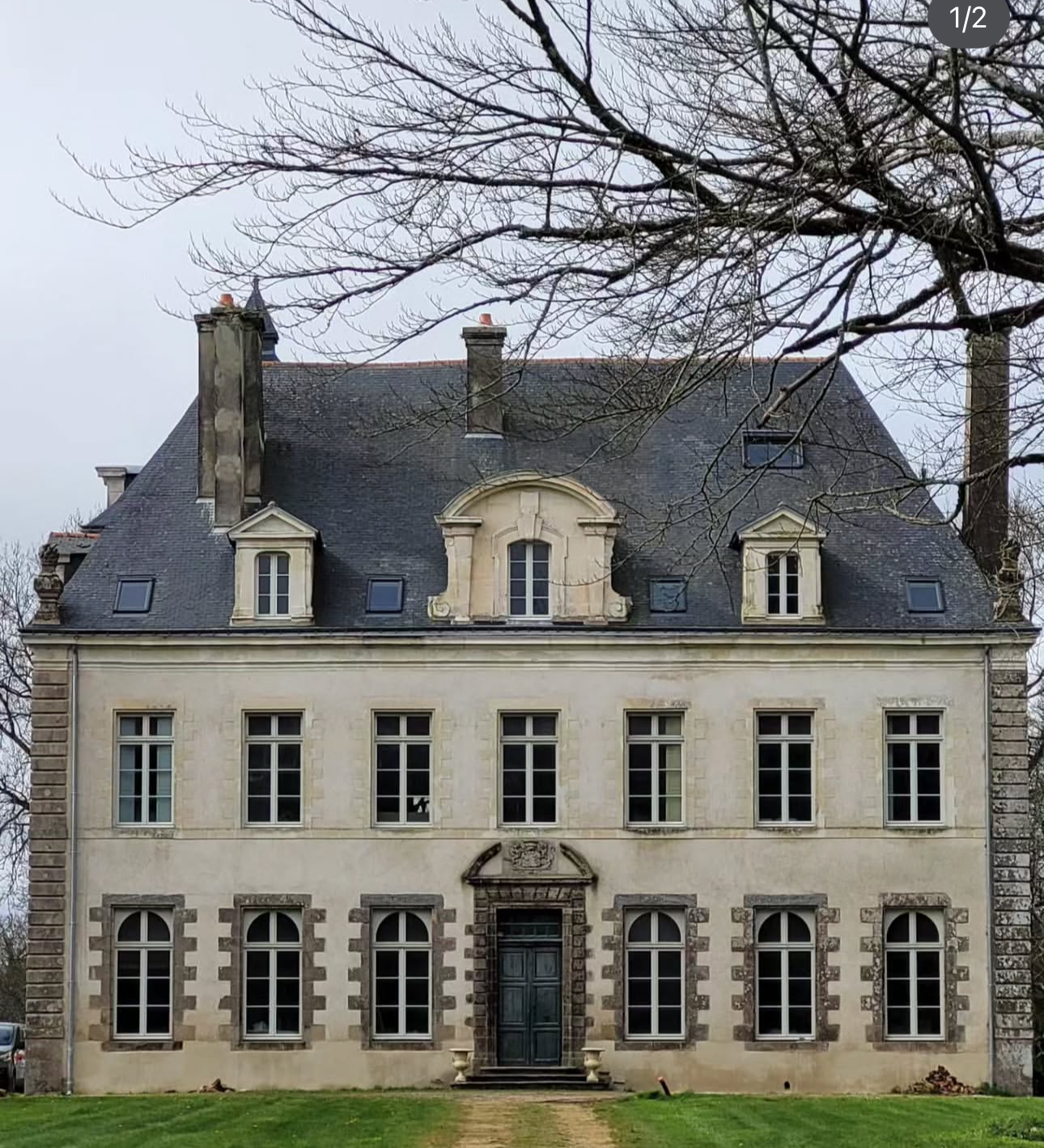
He had several daughters and two sons, one of whom died in infancy. The other, Paul-Julien-Malo, Count of Robien, was born at Treulan in 1766 and died in Auray in 1824. He was appointed mestre de camp of cavalry in 1786 and took part in the Revolutionary campaigns. On 12 Pluviôse, Year XIII (1 February 1805), he became adjutant major of the 5th Cuirassiers. He was removed from active duty in 1806. Later, he served as mayor of Pluneret. In 1795, he married Marie Vincent.
Pierre-Louis-Achille, Chevalier de Robien, known as “the Chinese” (1736–1792)
Pierre-Louis-Achille, Chevalier de Robien, known as “the Chinese”, was born in Mériadec-Coëtsal on December 16, 1736. Like his brother Julien, he is said to have served as an ensign in the Royal Navy, although no evidence of this appears in his official dossier (Marine, C7 1878). Thanks to family connections within the French East India Company, he stayed in Canton from 1766 to 1777. He secured a prestigious position as supercargo aboard the Duc de Duras, under Captain Magon de Villebague—a post previously held by notable figures such as Dupleix (1724), Godeheu (1735–1737), Duvelaer, Montigny, Damain, Michel, and Hay. Such roles were reserved for agents closely related to the Company’s leadership.
The Duc de Duras, a 1,000-ton ship armed with 20 cannons and manned by 205 crew members—one of the largest vessels in the fleet—departed from Lorient on December 15, 1765, reached Canton in December 1766, and returned to Brittany on July 7, 1767. The commander was likely a relative or ally of the Robien family. While the ship’s ports of call are unknown, it likely arrived in Mauritius (then not yet named Île-de-France) in March, as suggested by a letter from Thomas de Robien (father of Louis-Achille and Julien) to his uncle de Carman: “I have news of my Chinese, who arrived in Mauritius on March 10. He won’t be leaving anytime soon. He was well and seemed delighted with his journey. Messrs. Magon, our dear nephews, send him a thousand greetings…”
As he had hoped, Robien attained an important position in Canton. He was appointed secretary to the Board of Directors on December 20, 1768, then promoted to third supercargo. He might have remained in that post had it not been for the dissolution of the French East India Company in 1769–1770. This decision—taken unilaterally by the French government while other European companies continued operating—diminished France’s prestige in Chinese trade and fractured the small French colony in Canton into two opposing groups: the remnants of the Company and the delegates of private French shipowners. Having joined the Board in 1770 and appointed third supercargo, Robien likely became chief of the trading post on March 4, 1771—an exceptional appointment at the age of 35, since the Company had never granted such positions before the age of 45 or 50.
P.-L.-A. de Robien also played a role in the transmission of the Conquests of the Emperor of China. On July 13, 1765, Emperor Qianlong ordered that his greatest military victories be illustrated by Jesuit artists at court—Giuseppe Castiglione (1688–1766), Jean-Denis Attiret (1702–1768), Ignace Sichelbart (1708–1780), and Jean Damascene (†1781)—then engraved in Europe. Their transmission to France was negotiated by Father Joseph-Louis Le Febvre (1706–), the Paris procurator for the Beijing Jesuits, by Robien on behalf of the French East India Company, and by Chinese hongmerchants. The Company contributed significantly to the engraving costs. Henri Bertin arranged for the works to be produced in France along with Sèvres porcelain and Beauvais tapestries. The drawings were delivered to the Marquis de Marigny, Director of the Royal Academy of Painting, on December 31, 1766, by M. de Mery d’Aréy, head of the Company. Charles-Nicolas Cochin (1715–1790), official historiographer of the Academy, oversaw the project.
In any case, Robien had arrived in Canton with the ambition to make his fortune and share it with his family and friends. To that end, he borrowed money from various sources, including his brother Joseph, a colonel of engineering at Versailles. He departed Canton aboard the Maréchal de Broglie (Captain Caro) between January 10 and 15, 1777, with two barrels of baggage—explaining the abundance of Asian art objects left to his descendants and the belief that he contributed to the collection of his relative, the Marquis Paul-Christophe de Robien (1731–1799), now housed in the Musée des Beaux-Arts in Rennes. It is very likely that he also played a role in his brother Julien’s commission of Chinese porcelain.
Bibliographie : Huard P., Wong Ming, Pierre‑Louis‑Achille de Robien, chevalier de Robien, dit « le Chinois » (1736‑1792), Annales de Bretagne et des pays de l’Ouest, 1963, 70-3, pp. 269-289.