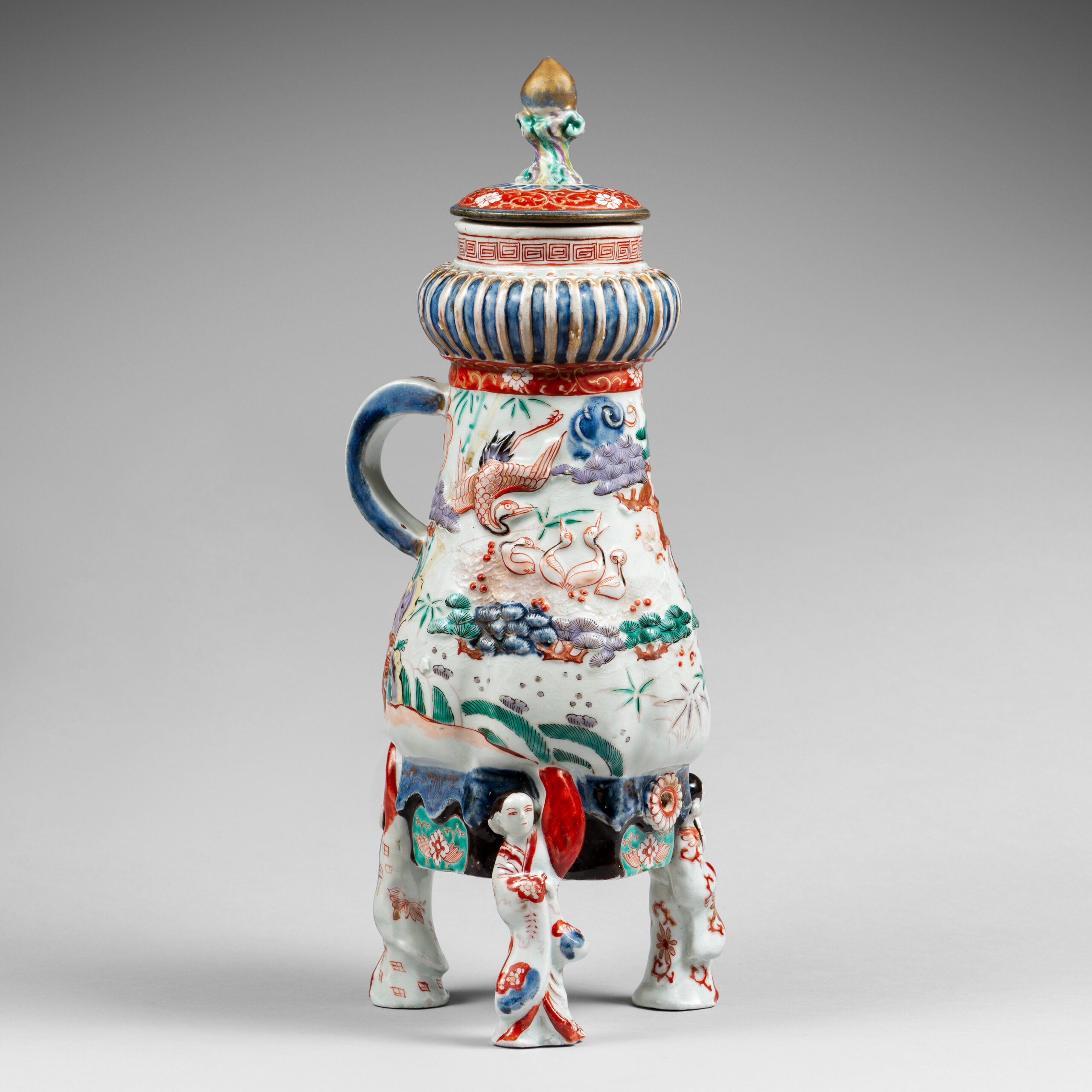
An Imari coffee urn. Japan, Arita, circa 1700

Modelled after a Dutch metal prototype, of pear shape with spirally lobed sides, showing a bulbous swelling with classical fluting below the neck, surmounted by a frieze of leiwen, with a flat loop handle and three tall feet in the form of bijin. The domed cover is topped with a knop in the form of a jewel set upon a rock. The decoration of cranes among pines, rocks, and a waterfall runs around the sides in moulded relief. The painting is executed in the characteristic Imari palette: underglaze blue enriched with enamels and gilding.

COUNTRY : Japan, Arita
PERIOD : Edo (1602-1868), circa 1700
MATERIAL : Porcelain
SIZE : 41,5 cm
REFERENCE : E482
STATUT : available
Related works :

An identical coffee urn is illustrated by John Ayers and David Howard in China for the West: Chinese Porcelain and Other Decorative Arts for Export Illustrated from the Mottahedeh Collection, 1977, Tome I, p. 128/129, no. 108.

There are similar examples in the Princessehof, Leeuwarden, published by Lunsingh Scheurleer, De Japanse Porseleinkast’ Mededelingenblad, Vrienden van de Nederlandse Ceramiek, 1972, no. 8, p. 75 ; and at the Musée de la Compagnie des Indes, Lorient.

Another example is illustrated by David Howard in The Choice of the Private Trader – The Private market in Chinese Export Porcelain illustrated from the Hodroff Collection, 1994, p. 141, no. 148.

A similar urn,  in the collection of the British Museum, is illustrated by Jenyns Soame, Japanese Porcelain, London, 1965, pl. 28A.

Additonal informations :

Generally considered to be for coffee, such urns may also have been used sometimes for tea. A painted table-top of c. 1700 shows Nicolaas Heinsius and his family apparently taking tea from a metal urn of basically this form (The Dutch at the Tea-table illustrated by Lunsingh Scheurleer, De Japanse Porseleinkast’ Mededelingenblad, Vrienden van de Nederlandse Ceramiek, 1972).

This form is one if the more ambitious adaptation from metalware and the idea seems only to have been tried in Japan – perhaps because it proved expensive and clumsy.

Demande de condition report

Question about condition report