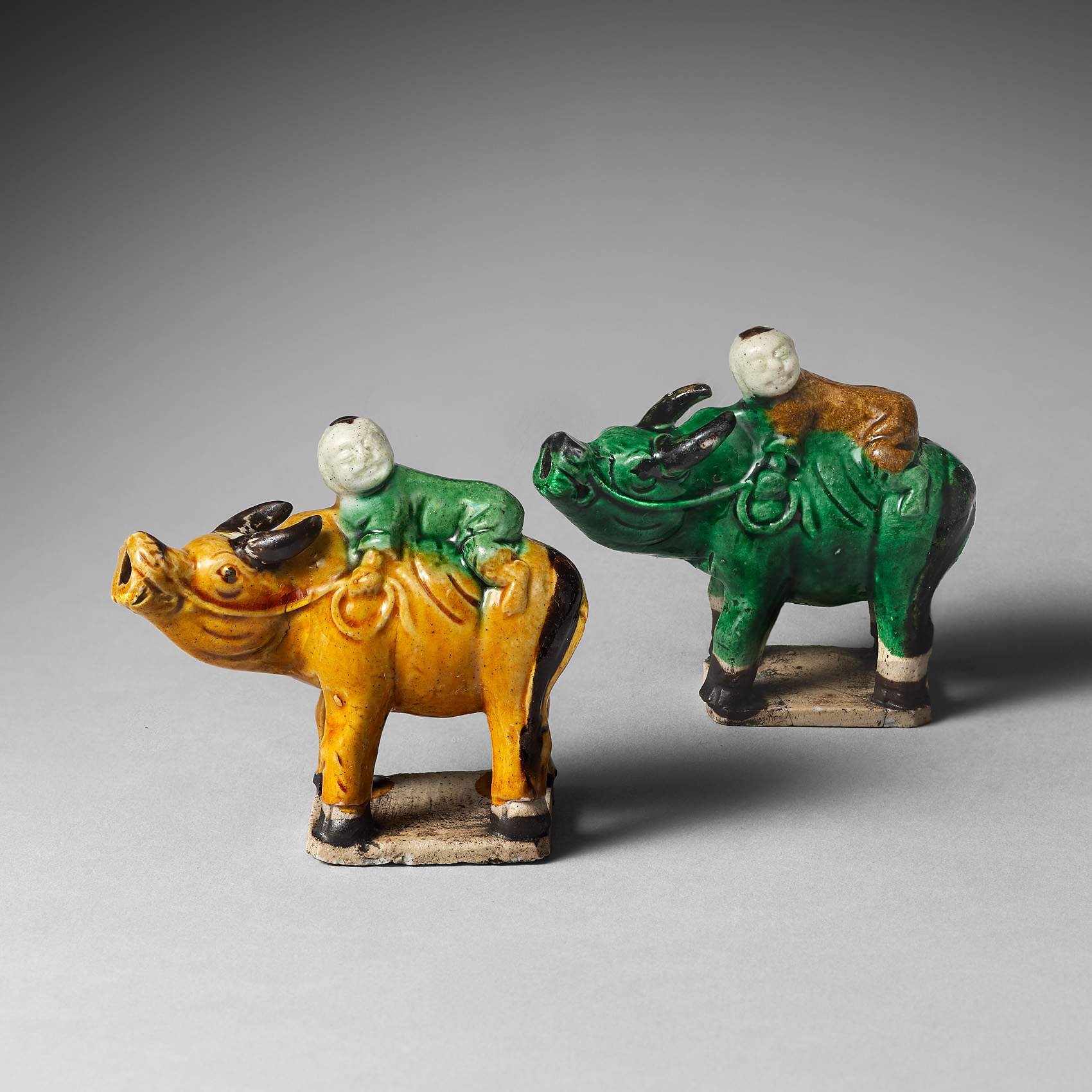
Additonal informations :The theme of boys playing with animals is one of the most enduring and charming motifs in Chinese art. Many animals, whether real or mythical, are believed to have auspicious meanings or to protect the boy.
In China, the water buffalo is known as a shui niu: shui meaning ‘water’ and niu a generic term for ‘ox’, ‘cow’ or ‘bull’. Revered for its strength and patience, the water buffalo is often depicted as the mount of Laozi, the founder of Daoism.
The water buffalo (shui niu) is one of the twelve animals of the Chinese zodiac and symbolises strength, patience, springtime and agriculture. For millennia, it has been used to pull ploughs in rice fields throughout China. It thus also represents prosperity and hard work. A herd boy riding a buffalo was a popular subject in paintings from the Song dynasty. This subject matter depicts a natural, bucolic, carefree life in the countryside, far from ceremony and social obligation. In this depiction, the buffalo also symbolises benevolence and submissiveness, as it obeys a child. After work, the boy would bathe the buffalo before returning home on its back, relaxed and often playing a flute
Tending a water buffalo was also likened to the daily life of a monk and was therefore a common motif in paintings inspired by the Chan (Zen) tradition. The water buffalo is an emblem of spring and agriculture. The ‘Spring Ox’, or ‘Chun Niu’, along with the herder boy ‘Niu Mang’ or ‘Mang Shen’, is made of clay and beaten with sticks to symbolise the revival of spring. This custom dates back to a time when an ox would be sacrificed at the start of spring.
The ox appears in all forms of decorative art, for both domestic and export markets. In the West, the motif was most prevalent in the eighteenth century, appearing on porcelain, wallpaper, lacquer screens, and in paintings. The Chinese ox was so popular in the West that it appeared in chinoiserie form on fabrics and wallpapers, as well as in sculptural ceramic form. While it is unclear which medium served as a source for the Western ceramic figures, the multiple examples of tortoiseshell lead-glazed pottery from Staffordshire are similar to various ceramic figures from China.