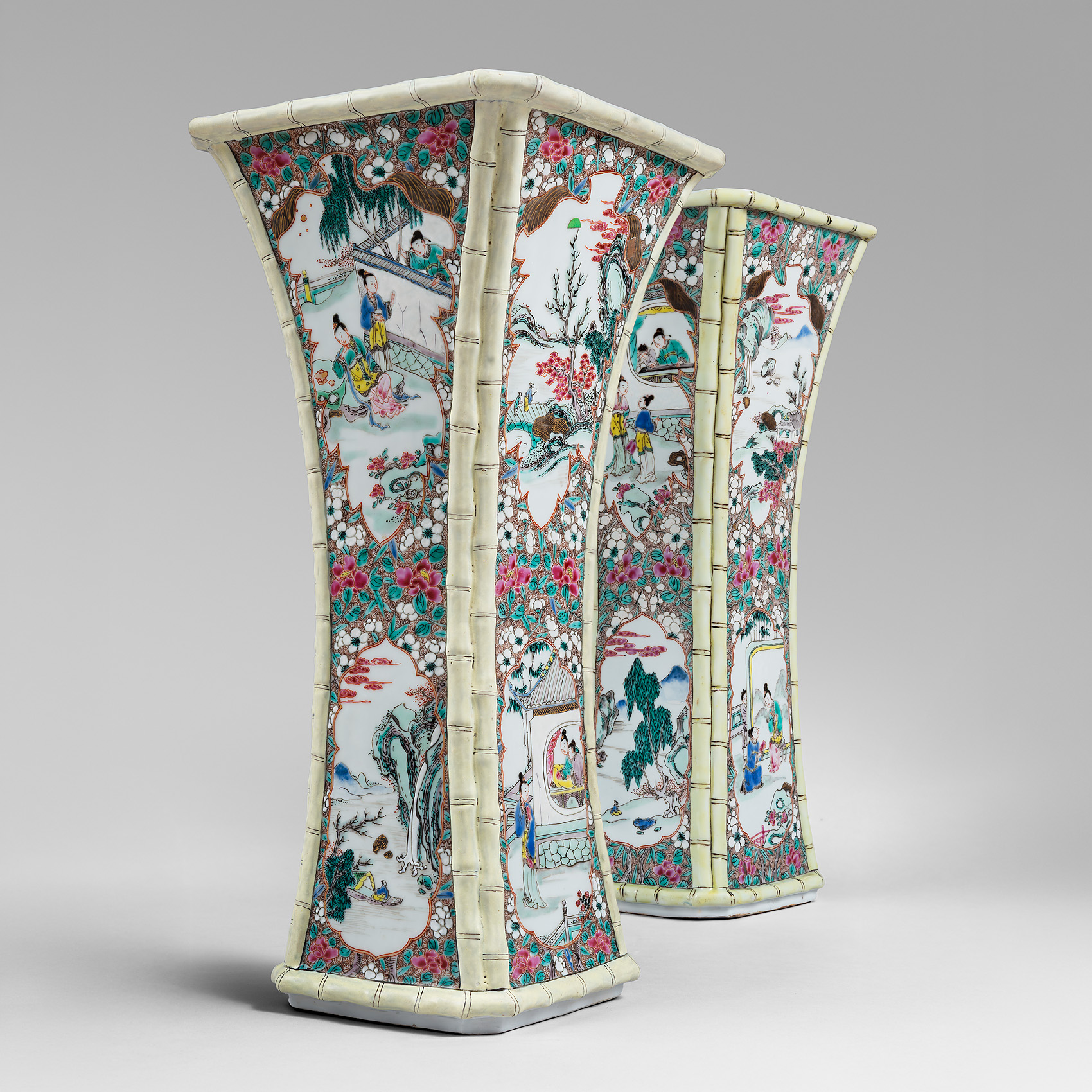
Two large famille rose “Romance of the Western Chamber” Gu vases. China, Yongzheng

The square-section vases are decorated in famille rose enamels. Each face is painted with scenes arranged within vertical leaf-shaped reserves. The scenes depict figures moving through structured settings of pavilions, bridges, and trees, set against more rugged landscapes or intricate rock formations. The edges of each vase are modelled in imitation of bamboo. The reserves are decorated with scenes from the Romance of the Western Chamber. The story originated in China, at the end of the 12th century, when a certain Dong Jieyuan compiled existing textual variants of popular theatrical plays, romances and ballads recounting a well-known love story. This work was published as the Xixiang Ji Zhugongdiao (Romance of the Western Chamber in All Keys and Modes). The narrative was subsequently adapted and expanded  by the playwright Wang clandestine romance defying familial opposition Shifu (c. 1250-1300), who published it as a comedyin eight volumes, entitled Xixiang Ji (Romance of the Western Chamber). While the work earned a permanent place in the literary canon, the story itself remained immensely popular across all social strata. This enduring appeal persisted well into the 20th century, with the theme adapted for opera and film in 1980s Beijing. Xixiang Ji stands as an indispensable pillar of the theatrical heritage of China.

COUNTRY : China
TIME: Yongzheng (1723-1735)
MATERIAL : Porcelain
SIZE : 42 cm
REFERENCE : E855
PROVENANCE : Possibly C.T. Loo, Paris, 13 mai 1967
Reproduced in A.Varela Santos, Yongzheng Chinese Export Porcelain: A Private Collection, London, 2005, pp.72-73, pl.24.
From the collection of Maude da Conceição Santos Mendonça de Queiroz Pereira, Lisbon, 2021
STATUS : vendu
Related works .

A pair of large famille rose vases, decorated with similar scenes from the “Romance of the Western Chamber”, with edges simulating spotted bamboo, is illustrated by O.V. Krog et al. in Treasures from Imperial China: The Forbidden City and the Royal Danish Court[1]. A similar pair of vases, originally held in the Danish Kunstkammer (now in the National Museum in Copenhagen), is known to have been brought from Guangzhou in 1732 on the Cron Printz Christian, the first ship engaged in trade between Denmark and China.

Another pair of Gu vases of this model with matching porcelain stands were in the collection of Roger Keverne[2].

A pair of baluster-shaped vases of this model, mounted in gilt bronze, formerly in the collection of Adolphe Thiers (1797-1877), is held at the Louvre[3].

[1] Copenhagen, 2006, pp.605-606, no. 185; pp.196-199

[2] Roger Keverne Ltd., Summer Exhibition, London, 2011, no.52

[3] Inv. TH 470 / TH 471

Additional information.

Given the immense popularity of the tale in China,  pivotal scenes evolved into canonical images readily recognised by the public. Woodblock illustrations in the various editions focused on these core scenes, thereby creating a corpus of motifs inspiring painters, silk embroiderers, lacquer workers and other craftsmen.

The taste for porcelain decorated with scenes from the Romance of the Western Chamber was firmly established in the Shunzhi period (1644-1661) and peaked during the Kangxi period (1662-1722). Famille verte wares decorated with these depictions were not only produced for the domestic Chinese market but also exported to Europe.

The imitation of bamboo in Chinese porcelain dates back to the Ming dynasty, when potters began incorporating natural motifs and botanical forms into ceramic decoration and, more significantly, into sculptural form. During this period, bamboo appeared primarily as a painted motif. Early experiments with relief and moulding laid the conceptual foundations for later developments.

Under the Qing dynasty, and particularly during the Kangxi period (1662–1722), the imitation of bamboo evolved into a fully articulated structural language. Rather than serving merely as surface ornament, bamboo became integral to the morphology of the vessel. Vases with moulded edges simulating bamboo culms, complete with pronounced nodes and internodes, exemplify this approach. These moulded edges emphasise verticality and provide a frame for the painted decoration

Closely related in conception and taste[1] are teapots fitted with bamboo-shaped handles, produced from the late Ming period and increasingly refined under Kangxi[2]. In these wares, the handle is modelled as a segmented stalk with clearly defined nodes, so that simulated bamboo enjoys a functional role in addition to its symbolic meaning.

The symbolic resonance of bamboo—one of the “Three Friends of Winter,” alongside pine and prunus—remained central to its appeal. In Qing porcelain, it conveyed ideals of moral uprightness, adaptability and resilience, virtues prized within the literati circles of the era. Its presence on exquisitely crafted vessels harmonised technical mastery with profound cultural symbolism.

[1] Notice 25

[2] Notice 25

Question about condition report

Question about condition report