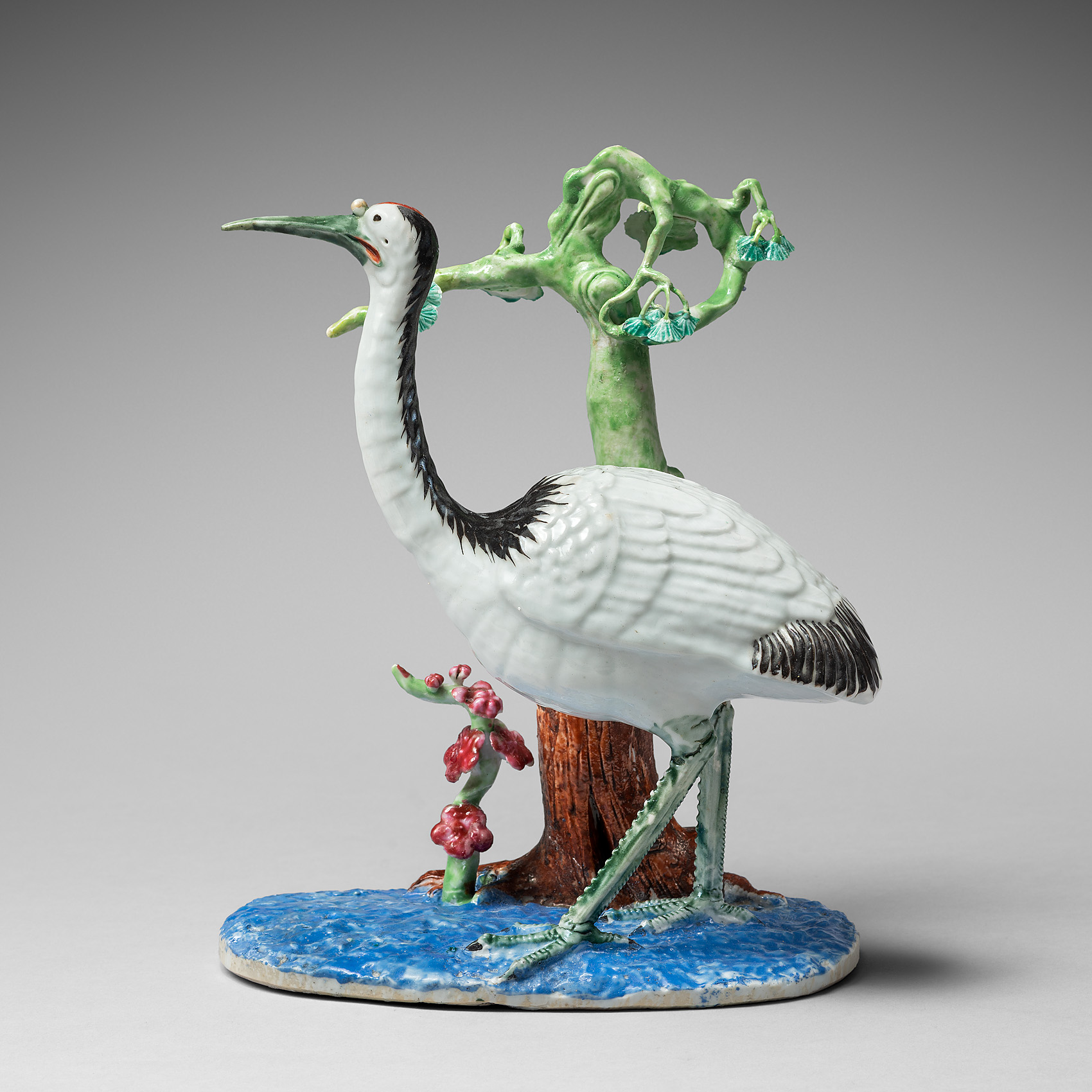
A Chinese famille rose figure of a crane. Qianlong

Naturalistically modeled, the crane stands beside a prunus tree on a rough oval base suggesting a grassy mound. Its beak and legs are enameled green; markings in black enamel define the feathers on the back of its neck and the tail. Its crest is enameled in iron-red. The tree is separately modeled and emerges from a depression in the base, which is splashed with green to indicate water. Pink prunus blossoms adorn the pine, which is enameled in greens and browns.
COUNTRY : China
PERIOD : Qianlong (1735-1795), circa 1750
MATERIAL : Porcelain
SIZE : 24 cm x 17,5 cm x 11 cm
REFERENCE : E724
STATUT : sold
Related works :

Two similar figures are listed in the 1777 inventory of the Chinese Pavilion at Drottningholm. One is illustrated by Are Setterwall in The Chinese Pavilion at Drottningholm, 1974, p. 296, FE 85.

Four similar figures were in the Copeland collection, now in the Peabody Essex Museum, illustrated by William Sargent in The Copeland Collection: Chinese and Japanese Ceramic Figures, 1991, p. 153/155, no. 70.

A very similar group was also in the Tibor / Alvaro Conde collection, illustrated by William Sargent in Chinese Porcelain in the Conde Collection, 2015, p 26.

Additonal informations :

The blossom of the prunus (plum) tree, which blooms in the “spring month” (January/February), is the emblem of winter and a symbol of good fortune and longevity. Laozi, the founder of Daoism, was born beneath its branches. Always a popular motif, the image of a crane can be found in various media and forms including wall coverings of the mid-eighteenth century for the export market. Figures such as these also inspired European copies and interpretations. Dehua examples were the earliest exportation of this form.

Demande de condition report

Question about condition report