Additional information.The hare (兔, tu) is an emblem of longevity and a recurring motif in Chinese art. It is the animal associated with the fourth of the Twelve Terrestrial Branches, mao (卯). While the branch itself is a calendrical unit, its isomorphism with the zodiacal hare has long established the animal as a symbol of the fourth month and the period from 5 to 7 a.m. The hare is reputed to derive its origin from the vital essence of the Moon, to whose influence it remains subject.
Zhang Hua (232–300), a poet and ‘proto-scientist’ of the Jin Dynasty—a turbulent era of disunity following the fall of the Han—is the traditional progenitor of the Bowuzhi (博物志, or ‘Treatise on Manifold Things’). In this seminal collection of myths and observations, Zhang Hua asserts that the hare conceives simply by gazing at the Moon, though earlier writers alleged that the female becomes with young by licking the fur of the male. The history of the Bowuzhi is as spirited as the myths it contains; the text underwent successive compilations and its authenticity remains a subject of scholarly debate—a fluidity that perhaps befits a work of proto-science. Like the fox, the hare is said to attain the age of a thousand years, turning white once half that remarkable lifespan is completed.
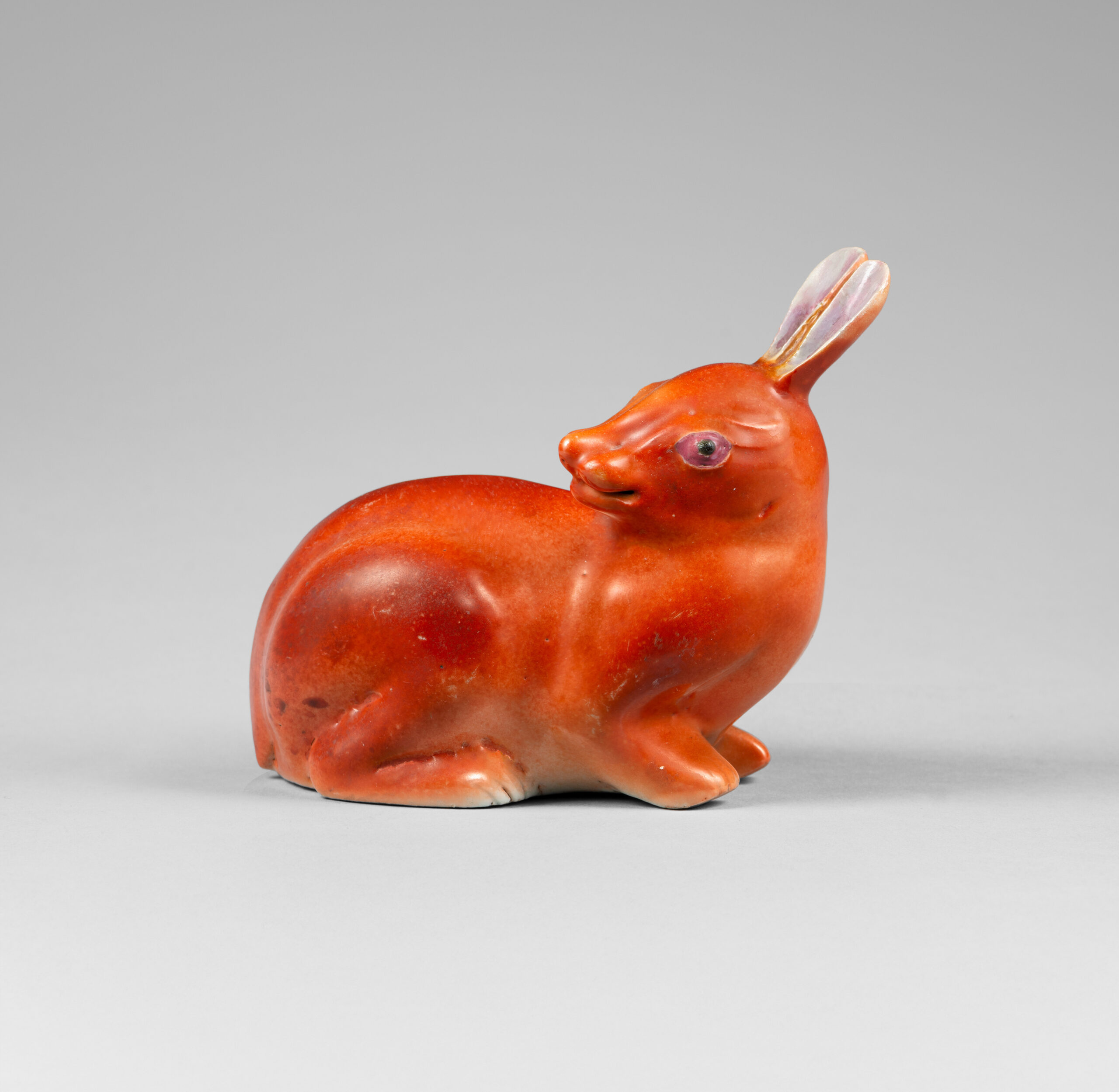
The Red Hare (赤兔, chi tu) is a supernatural beast of auspicious omen, said to appear only when virtuous rulers govern the Empire[1]. While the name is famously shared with the legendary horse of the Three Kingdoms—so called because its extraordinary speed was compared to that of a bolting hare—the creature discussed here is a distinct cosmological symbol.
Tradition predating the Han dynasty asserted that a hare inhabited the Moon. Later Daoist fables depicted this ‘Gemmeous Hare’ (玉兔, yu tu) as a servitor of the genii, perpetually pounding the botanicals required for the elixir of life. This connection between the hare and the Moon is likely traceable to Indian Buddhist legends[2], where a hare offered its body as a willing sacrifice and was rewarded with a place upon the lunar surface.
In classical Chinese political thought, Heaven expressed its mandate through visible signs in nature. The appearance of unusual animals—distinguished by their rarity or colour—was interpreted as a cosmic endorsement of the emperor’s rule. Alongside the qilin, the white deer, and the sacred tortoise, the Red Hare was recorded in imperial chronicles as a primary signifier of harmony. The colour red (赤, chi) is associated with the element of Fire in the theory of the Five Phases (五行, wu xing), representing the South, the season of summer, and the radiant virtue of the sovereign. An ordinarily terrestrial animal appearing in this extraordinary hue was thus a remarkable phenomenon, signalling that the ruler governed with virtue (德, de) and that the Mandate of Heaven (天命, tianming) was secure.
It is important to distinguish this political symbol from the Jade Hare of the Moon. While both share lunar associations, the Jade Hare is a narrative figure of folklore, often depicted in art with a lingzhifungus upon its back—a symbol of the immortality it helps to prepare—whereas the Red Hare serves as a formal heraldic emblem of dynastic legitimacy.
[1] Charles Alfred Williams, Chinese symbolism and art motifs: an alphabetical compendium of antique legends and beliefs, as reflected in the manners and customs of the Chinese, 1988, pp. 220-221
[2] Mayers: Chinese Reader’s Manual, Pt. I, 724