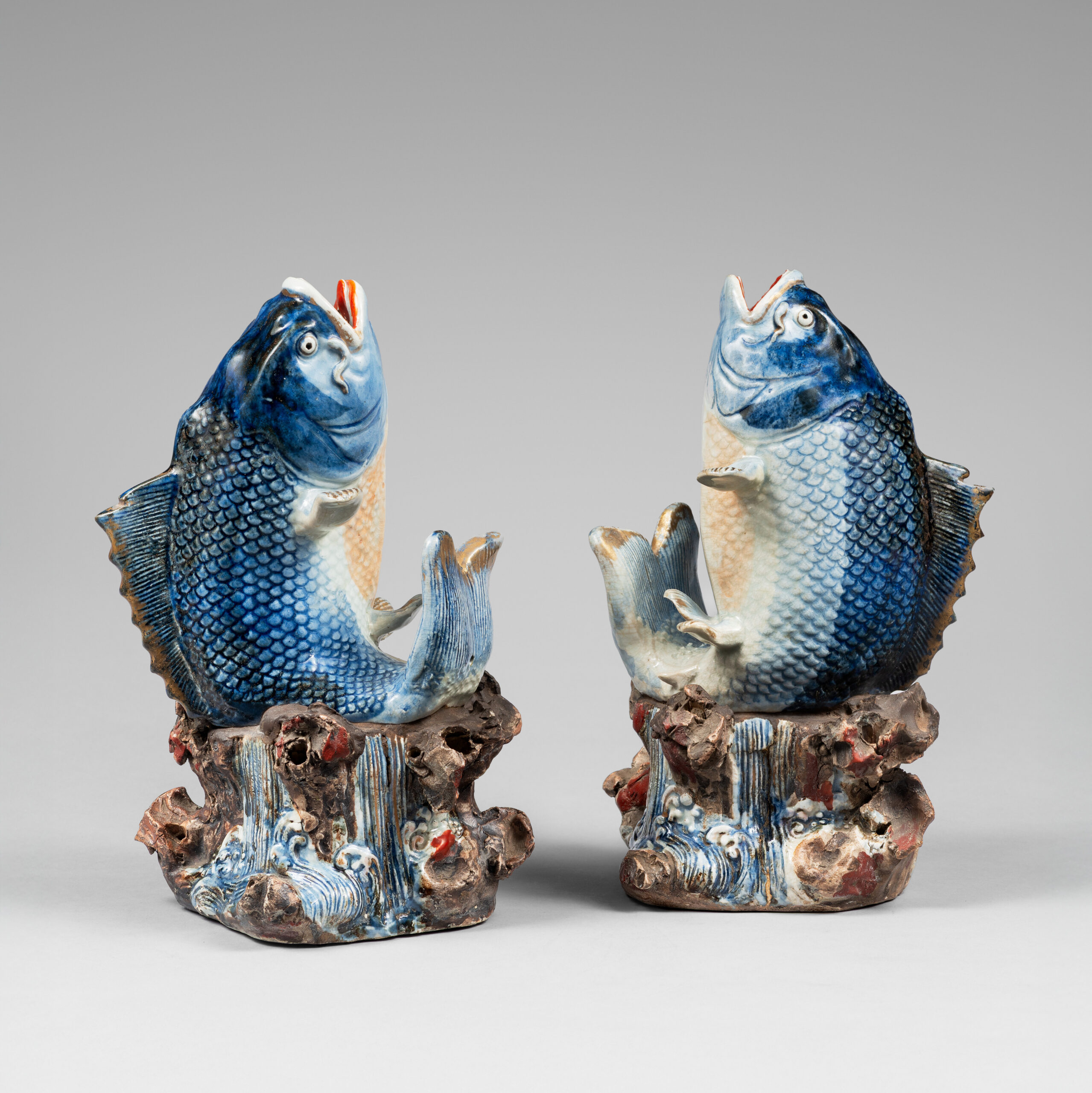
A pair of large models of leaping carps. Japan, circa 1700

Each carp is modeled in the round, poinsed upon its curved and forked caudal fin, with an open mouth, protruding eyes, raised pelvic fins, and detailed scales. The cyprinids are set upon quasi-rectangular bases depicting rocky outcrops, speckled with manganese and iron-red, amidst foaming waves from which the fish appear to leap.

COUNTRY : Japan
TIME: Arita
MATERIAL : Porcelain
SIZE : 25 cm
REFERENCE : E835
PROVENANCE : From a European collection
STATUS : vendu
Related works .

An identical carp[1], likewise fitted with an ormolu mount, was formerly in the collections of Pierre-Victor de Besenval de Brunstatt (1721–1791)[2], better known as the Baron de Besenval. A native of Solothurn in Switzerland, Besenval rose to become a prominent general officer, notably commanding the Swiss Guards in the service of the French Crown. Beyond his military duties and his role as a keen, chronicler of his era through his Mémoires, Besenval was an enlightened collector.

Close to the Court and deeply embedded within artistic circles, the Baron developed an early and discerning passion for the decorative arts. In 1767, he acquired the Hôtel de Chanac de Pompadour on the Rue de Grenelle, specifically to showcase his burgeoning collections. The residence, famous for its ‘antique-style’ subterranean nymphaeum, soon became one of the celebrated curiosities of Paris. Today, the hôtel—presenting an additional upper floor—serves as the Embassy of Switzerland.

The splendour of Besenval’s legendary Parisian salon is patially recorded in the portrait commissioned in 1791 from Henri-Pierre Danloux. Painted shortly after the Baron’s release from two years of imprisonment during the French Revolution, the work captures him surrounded by his most cherished possessions. In this intimate setting, Besenval is depicted leaning against a paper screen—a ‘chinoiserie’ element typical of the era’s inventories—while the background reveals a masterful assembly of textures and periods.

The work betrays an obvious delight in the virtuoso rendering of materials— from the cool polish of the brèche d’Alep marble and the glimmering giltwood and ormolu mounts, to the translucent glaze of the Arita porcelain. Rather than the starkness of the triumphant Neoclassicism (visible perhaps only in the fireplace’s andirons), the interior celebrates the Rocaille taste, with a glimpse of a Grand-siècle Boulle cabinet.

Amidst these treasures, the Arita porcelain carp takes pride of place. Its spirited silhouette is clearly recognisable, standing alongside ormolu-mounted celadons. The leaping carp, serves as a symbol of an independent taste—once as dynamic as the fish itself—now captured in a moment of defiant and quiet grace.

[1]Private collection, Geneva

[2] Paul Gallois, « Baron de Besenval’s Eclectic Eye», The Furniture History Society, Newsletter 221, February 2021, pp. 2-12
Additional information.

It is probable that Japanese potters drew inspiration from Ming-dynasty glazed-terracotta prototypes to create these porcelain models. In common with Chinese tradition, the carp in Japan is a potent symbol of longevity, perseverance, and fidelity in marriage. The fascination with carps first led to their captive breeding in garden ponds during China’s Song dynasty. Through meticulous selective breeding, the carp was transformed into the goldfish—a genetic marvel that became a symbol of wealth. Fancy goldfish eventually reached the West via the East India Companies in the 18th century. In the previous century, Louis XIV had kept wild-type carps in the ponds of Marly, famously developing a particular fondness for a carp affectionately known as ‘la Dorée’ (the Golden One).

In China, the leaping carp in foaming waters is associated with an old legend according to which the first carp to swim upstream in the Yellow River and leap over the Dragon Gate Falls would miraculously transform into a dragon. This popular tale served as a metaphor for a scholar who, after passing the imperial exams, would become a rise to the rank of a high official. Adopting this rich iconography and its symbolism, Japanese artisans embraced the carp as a central motif in the decorative arts. One of the most favoured portrayals depicts the animal arching its body upwards amidst crashing waves, as  in the model presented here.

These porcelain sculptures were primarily used as decorative figures, and occasionally as vases. Various examples were crafted by Japanese potters in Arita in a range of sizes—typically between 12 cm and 32 cm—and were set upon varied bases depicting rocky outcrops, cresting waves, or a combination of both, as exemplified by the present model. In Japanese iconography, the carp is occasionally depicted being ridden by a male figure, representing the legendary 12th-century warrior monk Benkei. According to tradition, Benkei sought out and vanquished a monstrous carp near the Bishamon waterfalls to avenge his mother, who had been devoured by the creature.

Exported to Europe from the late 17th century, Japanese porcelain models of carps were held in exceptionally high regard for their quality of execution. During the early 18th century, Japanese porcelain often commanded higher prices and greater prestige than its Chinese counterparts. Their striking decorative appeal caught the eye of the Parisian marchands-merciers, who further elevated these by commissioning sumptuous gilt-bronze mounts.

Question about condition report

Question about condition report
