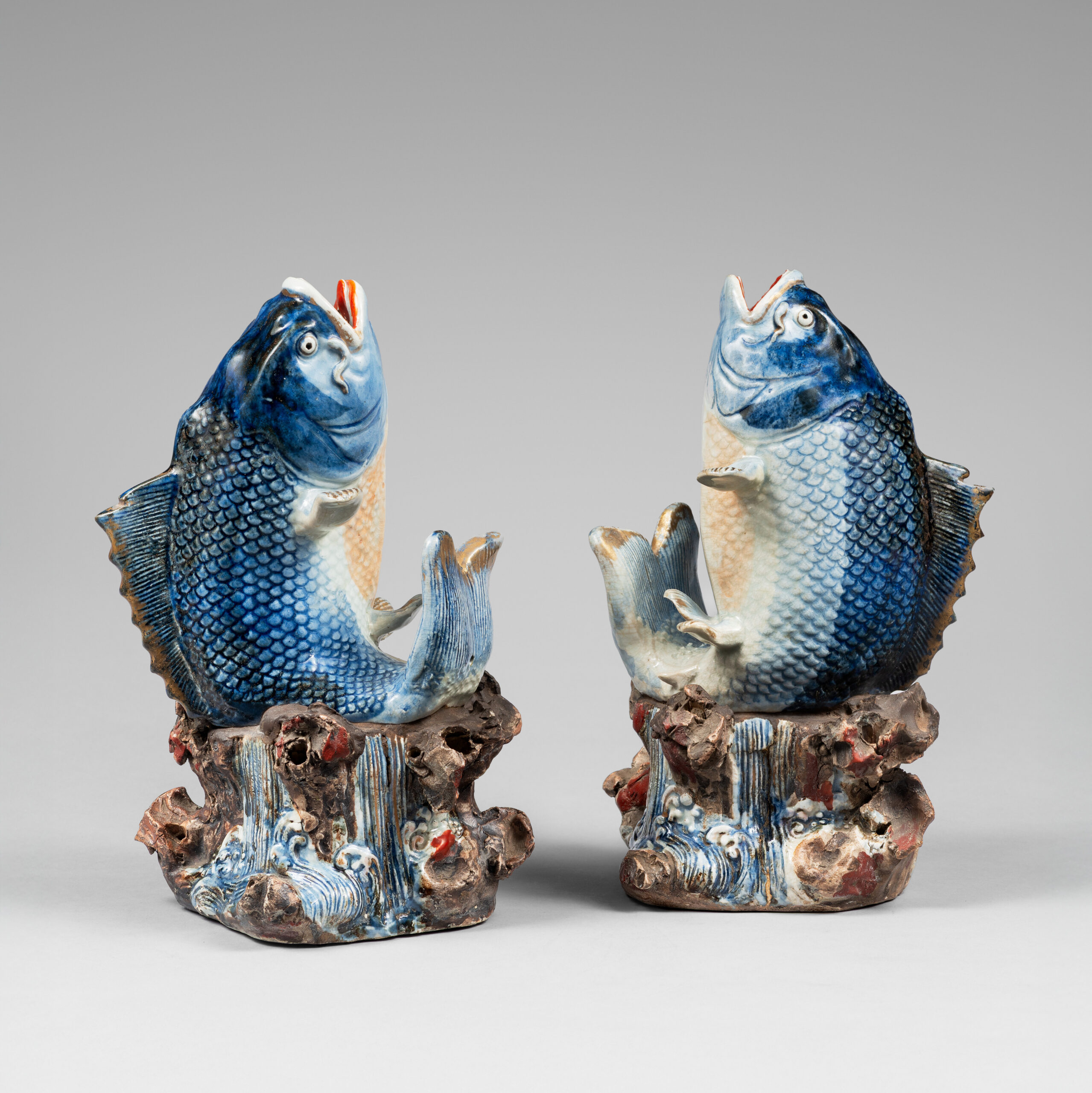
Related works .An identical carp[1], likewise fitted with an ormolu mount, was formerly in the collections of Pierre-Victor de Besenval de Brunstatt (1721–1791)[2], better known as the Baron de Besenval. A native of Solothurn in Switzerland, Besenval rose to become a prominent general officer, notably commanding the Swiss Guards in the service of the French Crown. Beyond his military duties and his role as a keen, chronicler of his era through his Mémoires, Besenval was an enlightened collector.
Close to the Court and deeply embedded within artistic circles, the Baron developed an early and discerning passion for the decorative arts. In 1767, he acquired the Hôtel de Chanac de Pompadour on the Rue de Grenelle, specifically to showcase his burgeoning collections. The residence, famous for its ‘antique-style’ subterranean nymphaeum, soon became one of the celebrated curiosities of Paris. Today, the hôtel—presenting an additional upper floor—serves as the Embassy of Switzerland.
The splendour of Besenval’s legendary Parisian salon is patially recorded in the portrait commissioned in 1791 from Henri-Pierre Danloux. Painted shortly after the Baron’s release from two years of imprisonment during the French Revolution, the work captures him surrounded by his most cherished possessions. In this intimate setting, Besenval is depicted leaning against a paper screen—a ‘chinoiserie’ element typical of the era’s inventories—while the background reveals a masterful assembly of textures and periods.
The work betrays an obvious delight in the virtuoso rendering of materials— from the cool polish of the brèche d’Alep marble and the glimmering giltwood and ormolu mounts, to the translucent glaze of the Arita porcelain. Rather than the starkness of the triumphant Neoclassicism (visible perhaps only in the fireplace’s andirons), the interior celebrates the Rocaille taste, with a glimpse of a Grand-siècle Boulle cabinet.
Amidst these treasures, the Arita porcelain carp takes pride of place. Its spirited silhouette is clearly recognisable, standing alongside ormolu-mounted celadons. The leaping carp, serves as a symbol of an independent taste—once as dynamic as the fish itself—now captured in a moment of defiant and quiet grace.
[1]Private collection, Geneva
[2] Paul Gallois, « Baron de Besenval’s Eclectic Eye», The Furniture History Society, Newsletter 221, February 2021, pp. 2-12