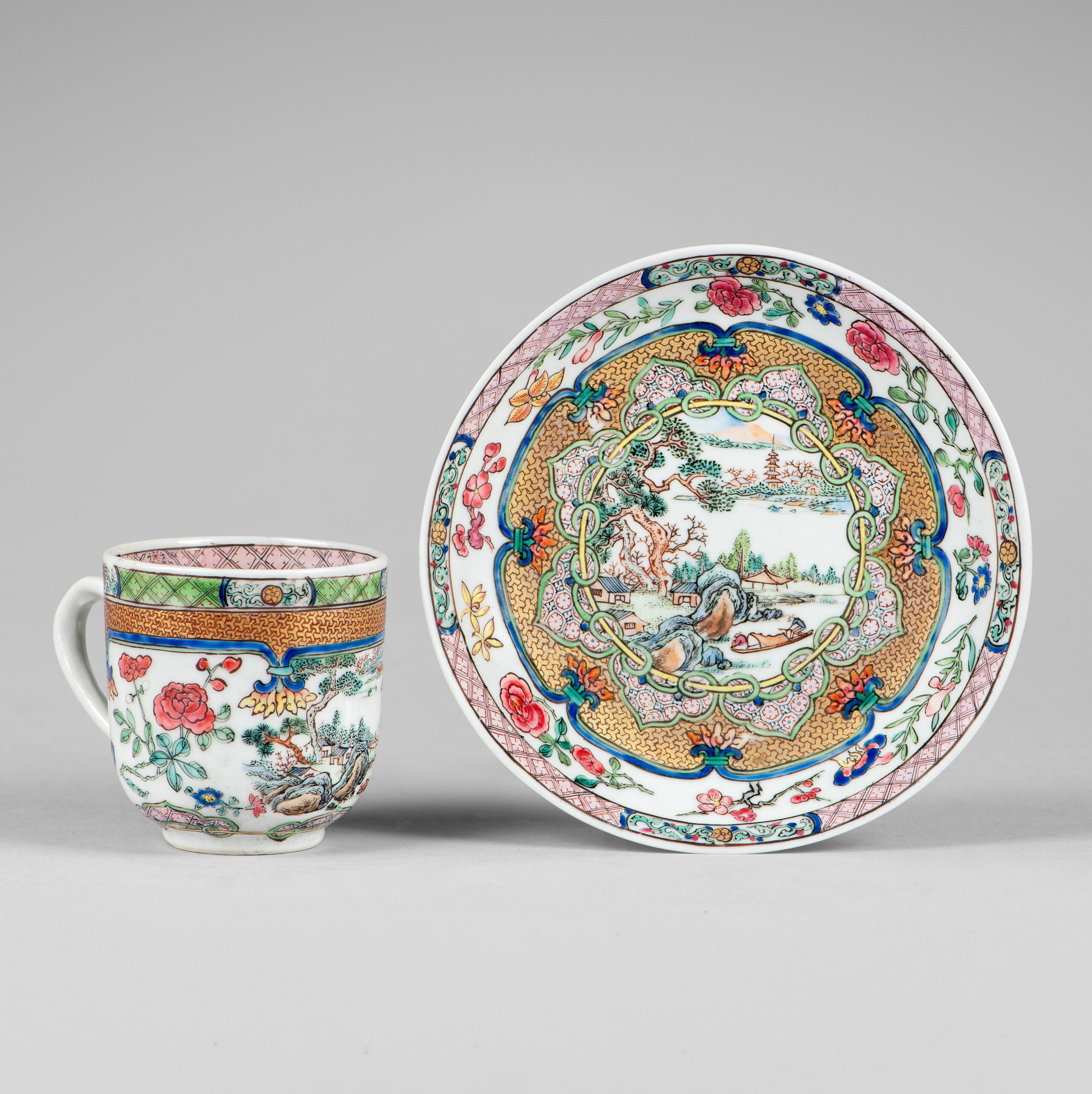
A famille rose coffee cup and saucer. China, Yongzheng

The cup and saucer are painted with a central shanshui (mountain and water) scene, depicting figures in a sampan navigating a riverbank near cottages. This landscape is framed by a double-border system: a yellow line entwined with pink cell-diaper ruyi panels, and a series of stylised lotus petals, echoing the structured compositions of Imperial cloisonné enamels, where the lotus—a fundamental Buddhist symbol of purity—is often rendered as a corolla. This arrangement, combined with the eight ruyi heads, subtly invokes the Eight Auspicious Treasures of Buddhism (babao).

The surrounding floral sprays, including clearly identifiable peony and prunus, are treated more naturalistically. This tension between the organic and the structured continues to the outer rim, where a delicate band of symmetrical, slender scrolls frames five-petalled blossoms. These scrolls may be interpreted by the viewer as clouds, lingzhi (fungus of immortality), or archaic dragons.
COUNTRY : China
TIME: Yongzheng (1723-1735)
MATERIAL : Porcelain
SIZE : 11.6 cm x 5.5 cm
REFERENCE : E907
PROVENANCE : From the private collection of Khalil Rizk, New York, 2008
STATUS : vendu
Related works .

The pedigree of this cup and saucer is tied to The Chinese Porcelain Company, one of New York City’s most storied and prestigious galleries. Founded in 1984 by Khalil Rizk and Pierre Durand, the gallery was a cornerstone of the Manhattan art scene, celebrated for its connoisseurship and its ability to bridge the gap between Asian art and European decorative traditions.

Rizk, a figure of renowned elegance and taste, and Durand, a financier with a profound passion for the decorative arts, were instrumental in shaping the market for fine Chinese export porcelain. Their legacy extends beyond the gallery walls: as co-founders of Asia Week New York, they helped establish the city as a global hub for Asian art studies. The gallery was also noted for its commitment to scholarship, publishing a series of authoritative catalogues from the mid-1980s through the early 2000s that remain essential references for collectors today.

A tea bowl and saucer with the same decoration, from the Martin Hurst collection, is illustrated by G. C. Williamson in The book of Famille Rose[1].

[1] G. C. Williamson in The book of Famille Rose, 1927, plate XII

Additional information.

The technical virtuosity of the early Yongzheng period (1723–1735) is further evidenced by the complex use of diaper grounds. Three distinct patterns coexist here, including the “Y-diaper”—a motif of ancient lineage found on early Chinese armour. Another pattern features the association of octagons and squares, strikingly reminiscent of the dallage à cabochons (cabochon paving) that became a staple of French interiors from the Grand Siècle through the 18th century. This geometric universality suggests a shared aesthetic language between East and West, where such patterns were prized for their balanced rhythm. In China, these repetitive diaper motifs were also perfected in lacquerware, often applied to three-dimensional forms such as fruit-shaped boxes, where the pattern subtly adapts to the object’s curvature. On this porcelain, the grounds perform a similar structural role, creating a dense field from which the figurative scenes emerge.

Question about condition report

Question about condition report