Additional information.
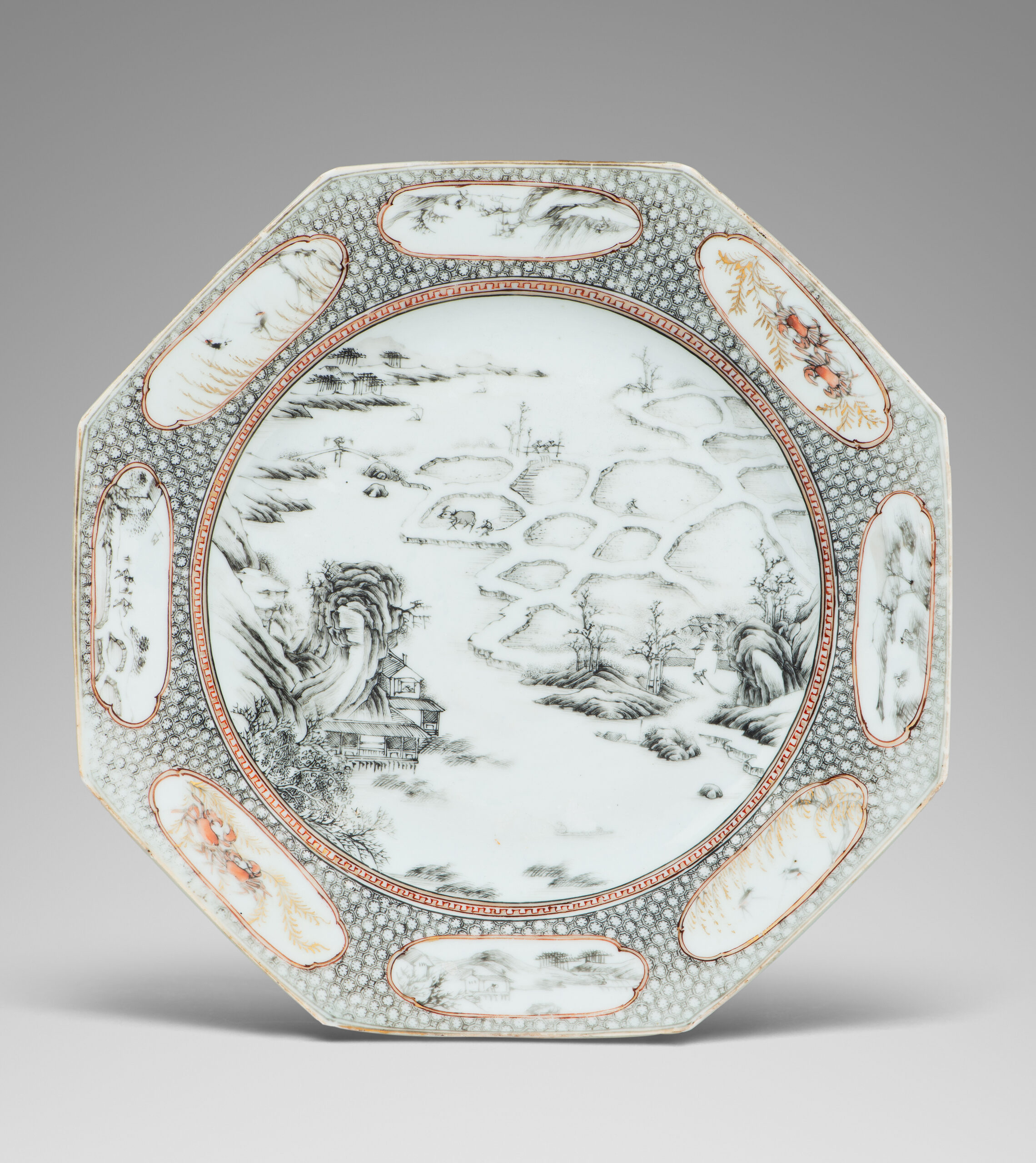
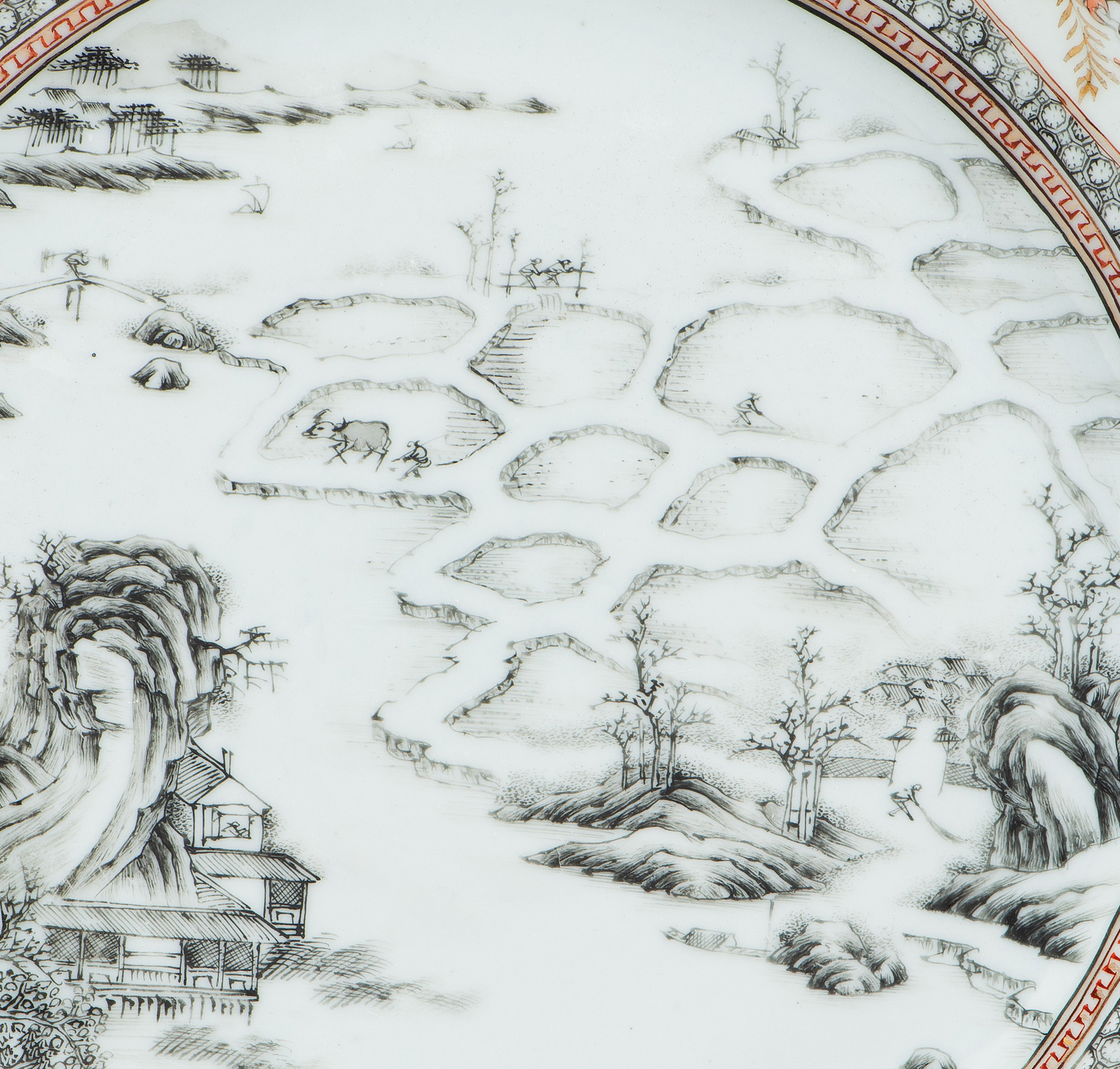
In the context of 18th-century export porcelain, the use of ink supported peinture en grisaille, designed to emulate the tonal depth of Western engravings. However, the application of ink to porcelain also draws from a far older and more profound Chinese tradition. For centuries, potters at kilns known as Geor Guan utilised ink to accentuate the random network of crackles inherent in the cooling process. By rubbing ink into these fissures, the artisan could highlight the aesthetic of the “broken” surface. This technique could involve multiple applications of ink in varying shades, creating the celebrated “gold thread and iron wire” (jinxi tiexian) effect, where broader dark lines were interlaced with lighter ones. On this octagonal plate, Encre de Chine serves as a medium for painting in a distinctly Chinese taste.
Rice is a bedrock of social order and aesthetic ideal in China. Rice is so fundamental to existence that the language itself has been shaped by it: the verb ‘to eat’ is rendered as chi fan (literally, ‘to eat rice’), making the grain the default synonym for sustenance. Every element of the plant was utilised, with its straw by-products providing durable thatch for roofing. Within the Confucian social hierarchy, agriculture occupied a position of paradoxical prestige. Farmers were officially ranked second, immediately following the scholar-officials (shi), and placed well above the potentially wealthy merchants, who were relegated to the lowest tier as they were perceived to be non-productive.
This theoretical reverence for the land was mirrored by an aesthetic fascination among the ruling class. In the 18th-century masterpiece The Dream of the Red Chamber (Hong Lou Meng)—a definitive encyclopedia of aristocratic life by Cao Xueqin—this ‘feigned rusticity’ is exemplified within the powerful Jia family’s magnificent garden (the ‘Prospect Garden’ or Daguanyuan). Indeed, one of the sites in the park is called the Rice-Fragrant Village (Daoxiang Cun 稻香村). This enclosure, featuring a thatched cottage and its own small paddy field, serves as a sophisticated retreat where the ruling classes could cultivate a nostalgia for a simple, virtuous life, far removed from the complexities of the court. Retreat to the paddy field—whether real or architectural—evokes the ideal of rural peace suggested by the popular proverb “the mountains are high and the Emperor is far away” (shan gao huangdi yuan).
The iconography of the rice paddies on this plate finds its source in the “Pictures of Tilling and Weaving” (Gengzhi tu). Originally compiled in the 12th century, this series of poems and illustrations was designed to familiarise the Emperor with the arduous labour of his subjects. By depicting the twenty-one stages of rice production—from the initial soaking of the seeds to the final ritual of thanksgiving—the Gengzhi tu became a powerful moral instrument, reminding the ruling elite that the Mandate of Heaven underlying the authority of the Emperor rested upon the prosperity of the peasantry.
While the theme is ancient, the early Qing period witnessed a spectacular revival of the genre. In 1696, the Kangxi Emperor commissioned a new, lavishly illustrated edition, followed later by his grandson the Qianlong Emperor, who further expanded the series. During this period, the representations shifted from strictly technical diagrams toward idealised, poetic landscapes. The 18th-century augmentations shifted towards the style of “mountain and water” (shanshui), where the agricultural work is harmoniously integrated into a scenic landscape—much like the landscape seen on this octagonal dish.
The iconography of the Gengzhi tu was not limited to rice; it sparked a broader 18th-century fascination with the “Four Noble Industries”: the production of rice, silk, tea, and porcelain. Under the Kangxi Emperor, these themes flourished in underglaze blue and famille verte enamels, presenting a highly idealised vision of Chinese industry. These scenes purposefully omitted the soot and heat of the Jingdezhen kilns, replacing them with serene, pastoral landscapes where labour appeared as a graceful, rhythmic ritual. Interestingly, this elite idealisation of agricultural and industrial production did not go unchallenged within Chinese literature. In the late Ming masterpiece The Peony Pavilion (Mudan Ting) by Tang Xianzu—often described as the “Chinese Shakespeare”—this romanticised view is subtly satirised. The play features the high official Du Bao, a descendant of the legendary poet Du Fu, who embarks on a formal inspection of the tea and silk-producing countryside. As he observes the rustic spectacles staged by the villagers to welcome him, Du Bao responds by reciting classical poetry, convinced of the mutual enchantment between the ruler and the ruled. The audience is free to perceive the disconnect.
The “vogue for the rural” transcended ceramics to define the interior aesthetic of the European aristocracy. Such representations were particularly favoured for the hand-painted wallpapers of English “Chinese Rooms”. Other in situ examples of this taste include the opulent apartments of the Badenburg at Schloss Nymphenburg in Bavaria. Today, a monumental silk panel depicting porcelain production adorns the gallery of Qing Monochromes at the Baur Foundation in Geneva.
The 18th-century fascination with China was not merely aesthetic. In France, its broader nature was championed by Henri-Léonard Bertin (1720–1792). A Minister of State under Louis XV and Louis XVI, Bertin acted as an exceptionally inventive statesman, fundamentally modernising French rural life through the creation of the first veterinary school (Ecole Vétérinaire)—an institution that continues to thrive today. His commitment to the land led him to attempt the introduction of rice cultivation to France, viewing the Chinese model of productivity as a blueprint for national prosperity. Moreover, Bertin was kept at the vanguard of the most refined Chinese creations through his prolific correspondence with the Jesuit Father Amiot in Beijing. This intellectual bridge allowed Bertin to amass a legendary collection. The statesman famously held exquisite albums of porcelain designs, which he generously opened to the public in his library. By possessing a dish such as the present one, a collector was participating in the same enlightened curiosity that drove Bertin to harmonise the rigorous demands of the State with the mastery of Chinese art.