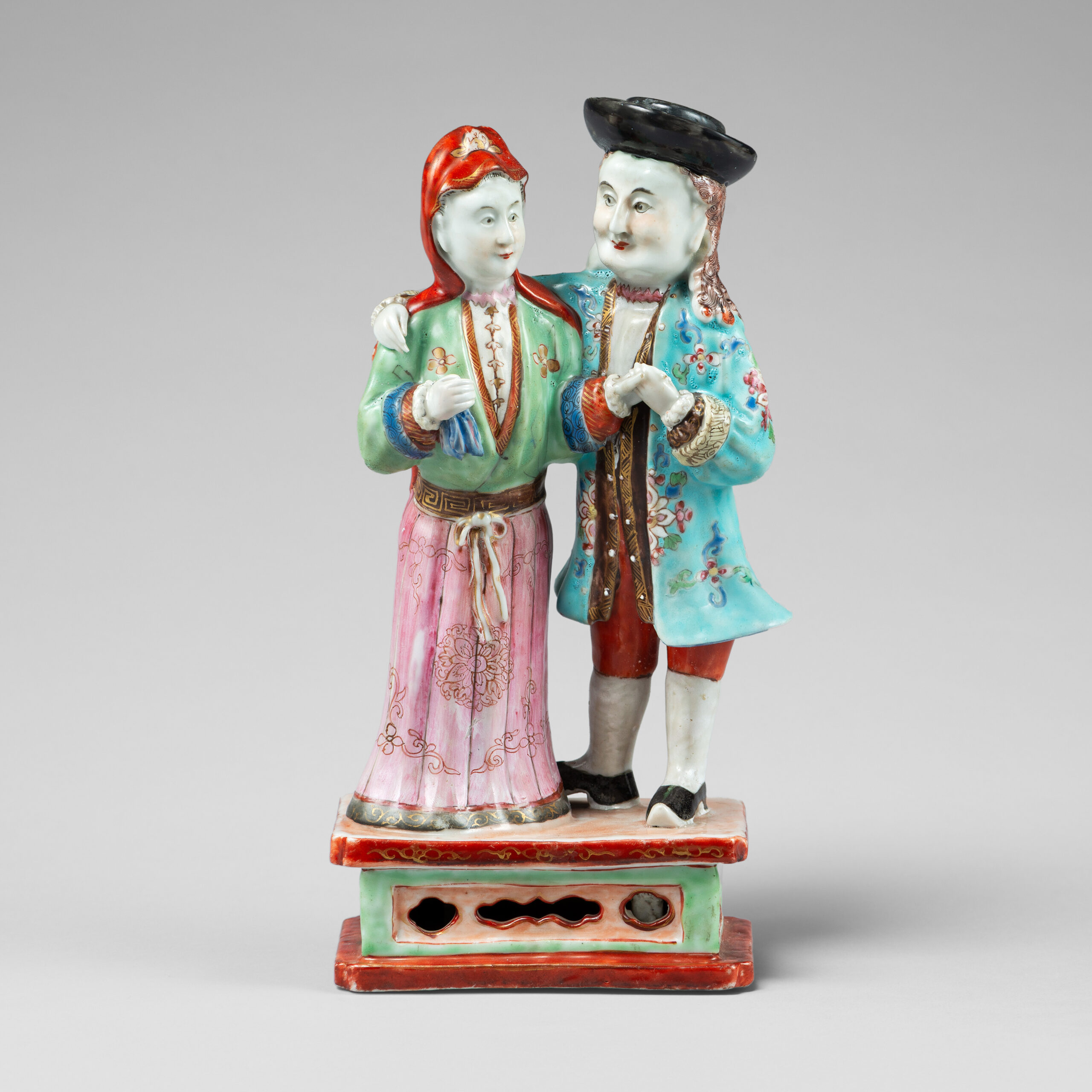
A rare famille rose group depicting a standing Dutch couple. China, Qianlong

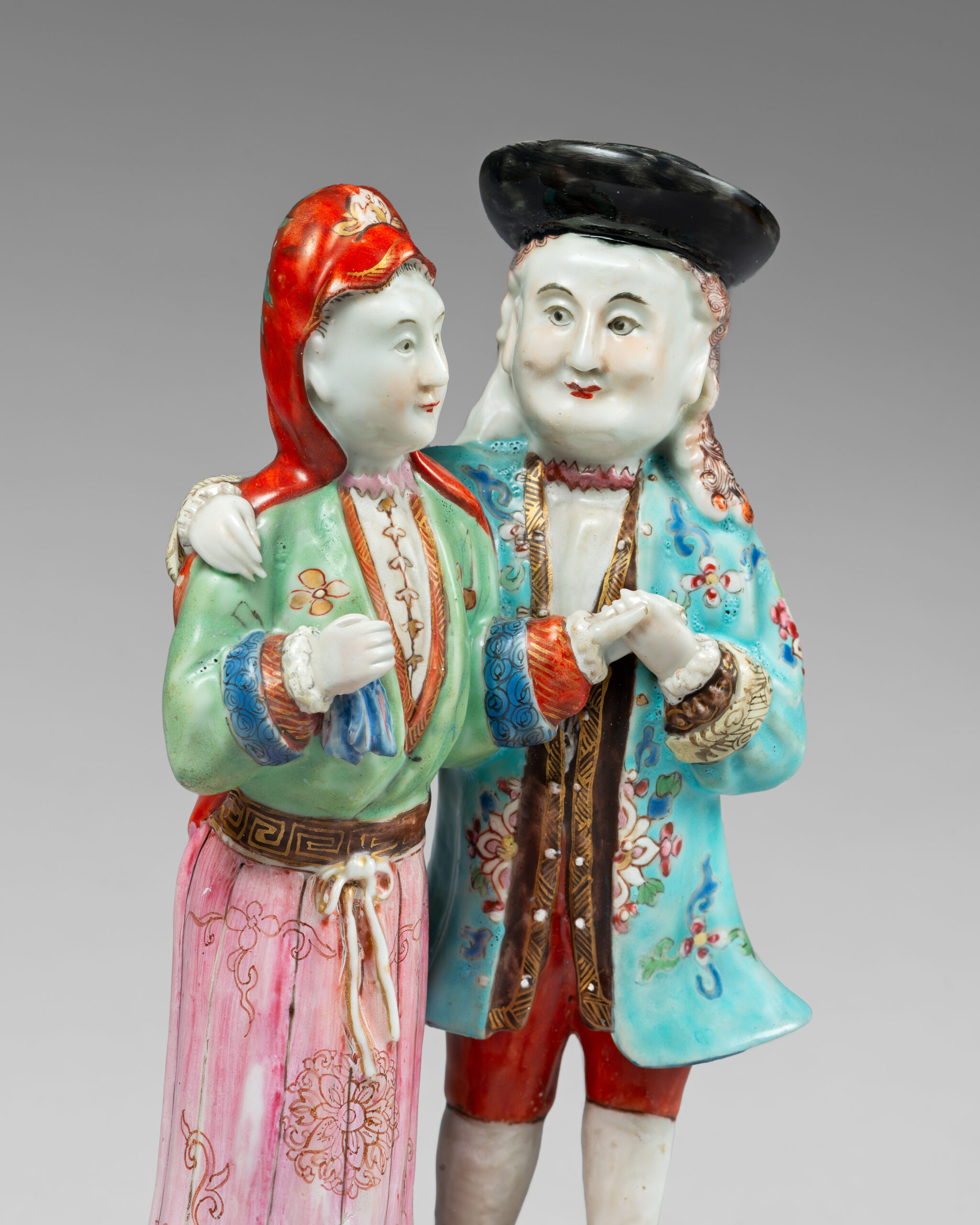
This European couple was modelled in a dancing pose, as if at the commencement of a minuet. The man stands to the woman’s left, with his right arm over her shoulders, holding her left hand in his left hand. He is wearing a black hat with a flower on the crown over long curly brown hair, a turquoise coat patterned with flowers over a long brown waistcoat, iron-red knee breeches, white gaiters and pointed black shoes.

The woman is depicted wearing an iron-red shawl decorated with white flowers and a gilt lotus flower round her head. She wears a green jacket fastened with a brown belt, a white blouse with gilt buttons, and a long pink pleated skirt with iron-red flowers and a brown hem with gilt scrolls, tied at the waist by a gilt ribbon applied in relief. In her hand, she holds a blue handkerchief.

The couple is standing on a rectangular orange-glazed plinth with multi-lobed perforations in the front and back panels. The side panels have moulded floral motifs painted in iro- red, green and yellow. The base of the plinth is painted in bright iron red. The foot is unglazed.
COUNTRY : China
TIME: Qianlong (1735-1795), circa 1740-1760
MATERIAL : Porcelain
SIZE : 25 cm
REFERENCE : E860
PROVENANCE :
-Alberto Santos, London
-From the collection of Maude da Conceição Santos Mendonça de Queiroz Pereira, Lisbon, 2021
STATUS : disponible
Related works .

An identical group[2], formerly in the Dr Anton Dreesman Collection, is preserved in the collection of the Albuquerque Foundation in Sintra.

Another group, formerly in the collection of Nelson & Happy Rockefeller and in the Espirito Santo Collection was published by Cohen & Cohen in The Elephant in the Room[3].

Other figures were in the former Mottahedeh and Ionides collections, as well as in the Peabody Essex Museum, Salem, Massachusetts, from the Copeland Collection.

Cohen & Cohen presented several examples in 2006, 2008 and 2020.

Examples of this model are also recorded with a rockwork base, possibly serving as a prototype for the later dancing figures. An example was in the Martin Hurst Collection[4]

[2] INV. NO. 479

[3] Cohen & Cohen, 2019, no. 21, pp. 54-57

[4] George Williamson, The book of Famille Rose, 1970, plate XLI.

Additional information.

This group ranks among the rarest, most celebrated and iconic subjects in Chinese export porcelain. It was originally thought to represent “Governor Duff” and his wife, a misidentification referring to the Dutch governor of Batavia, Diederick Durven (1676–1740), who served as a colonial administrator and Governor-General of the Dutch East Indies from 1729 to 1732.

These figures do not conform to most other export models, and their intended market remains uncertain. Although they would appear to have been produced for the Dutch market—and several examples were clearly exported to Europe—they may also have been made for the amusement of a Chinese audience, possibly even for the Qing court[1]. The Qianlong Emperor is known to have shown an interest in objects decorated with European figures, which were perceived as exotic curiosities. These groups are characterised by a synthesis of European and Chinese influences: while the costumes reflect eighteenth-century contemporary European fashion, their decoration incorporates prunus blossoms and other flowers in a distinctly Chinese style. The form of the plinth further suggests that such groups were not made solely for export, as analogous bases are occasionally encountered on wares intended for the domestic market.

Representation of such couples appear in instructional books depicting “foreign barbarians” and explaining their customs to a Chinese readership. It is almost certain that these figures were conceived as matching pairs: the first, as here, shows the couple preparing to dance, with the man standing with parted feet and guiding the woman’s shoulder; the second group captures them whirling in the midst of the dance.

The twirling pose was very likely influenced by a model of a dancing couple first produced at the Meissen factory, and subsequently copied by Chinese workshops as well as by Bow, Chelsea and Derby. Originally modelled by Johann Friedrich Eberlein in 1735 for Meissen, the group was later reworked by Johann Joachim Kändler and listed in his Taxa of 1743 as “Harlequin and a maiden doing a Polish dance, possibly a Mazurka”. Although very few examples of this group are known, the recovery of the VOC ship Geldermalsen in 1985 yielded five damaged examples. Having lost their enamels through prolonged exposure to seawater, these figures nevertheless provided compelling evidence allowing the model to be dated to 1752.

Question about condition report

Question about condition report