
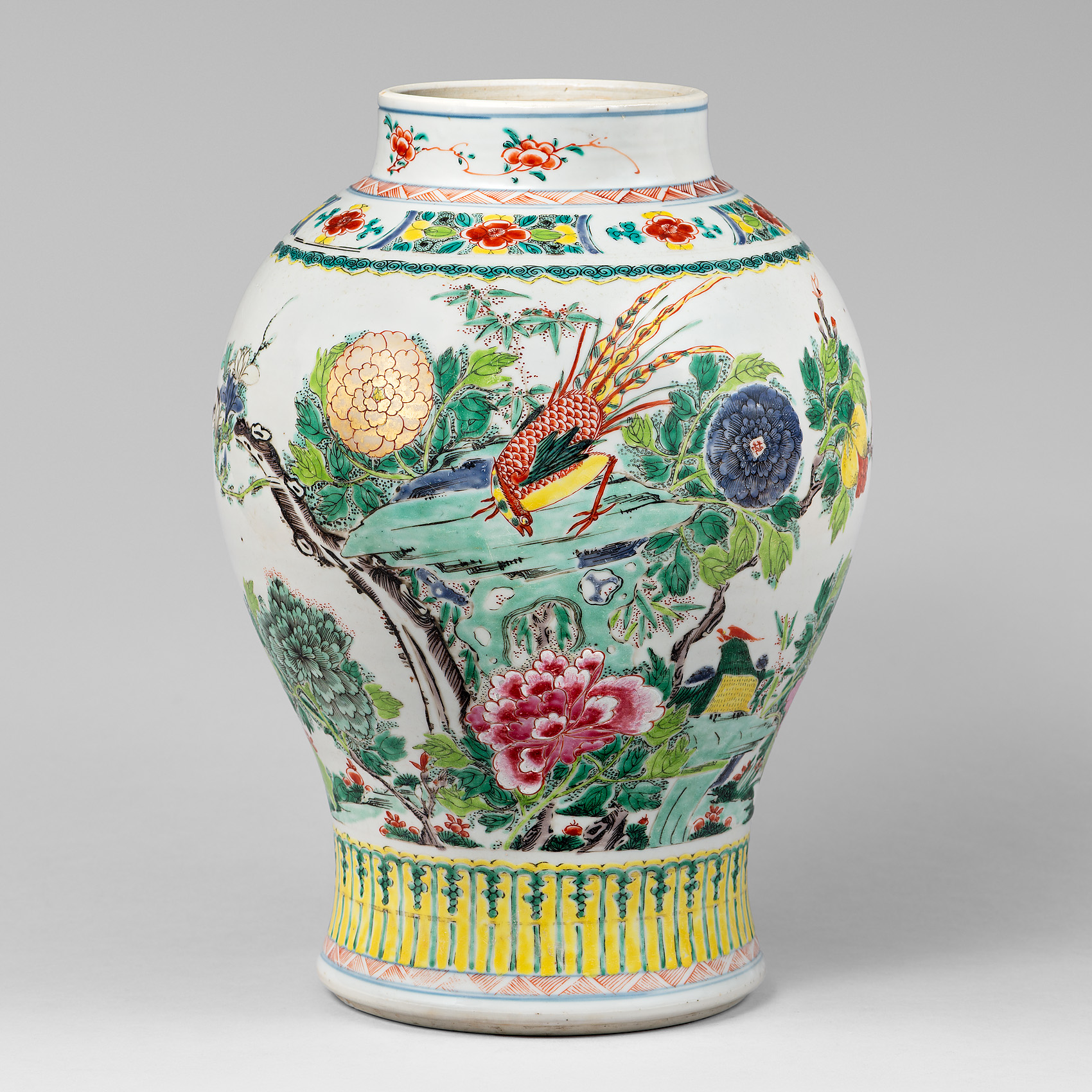
The baluster vase, with its slightly flared cylindrical neck, is decorated in the famille rose-verte palette, employing yellow, aubergine, green, blue and iron-red enamels. It stands on a short spreading foot and features a generously rounded body, whose fullness contrasts elegantly with the restrained form of the neck.
The principal decoration unfolds across the body as a luxuriant flowering garden scene. At the centre of the composition are two pheasants, one of which is perched upon a pierced garden rock. Around them flourishes an abundance of vegetation, including peonies, chrysanthemums and other garden flowers rendered in a rich polychrome palette. The shoulder is encircled by a decorative band punctuated with cartouches enclosing floral compositions, while the neck is adorned with delicate flowering branches painted in iron red. A narrow band of pale red diaper pattern marks the transition between the neck and the shoulder. The lower part of the body is framed by a substantial architectural border composed of vertical reserves. The iconography combines several themes particularly favoured under the Qing dynasty: floral abundance, auspicious birds, and pierced rocks, the latter serving as emblems of longevity and scholarly cultivation.